Storm damage roofing leads go to the roofer who answers first, sounds local and books a documented inspection. The roofer with the biggest ad budget doesn’t win them. After a nor’easter, a hail cell or a tropical remnant crosses Narragansett Bay, phones light up for a few days. Every call you miss goes to the next number on the homeowner’s list. So the work is mostly done before the storm: a findable Google profile, a website that books inspections, and a system that answers every call and text at 9 p.m. on a Saturday.
This guide covers how to get ready, how to respond when volume spikes, how to qualify and book the jobs, and how to track what it costs. It is written for Rhode Island and Massachusetts roofing owners.
TL;DR
- Storm leads are won on speed and trust. The first roofer who answers and looks like a real local company usually gets the inspection.
- Build your pipeline before the storm: a complete Google Business Profile, service area pages, fresh reviews and a booking-ready website.
- Plan for the surge. Missed-call text-back, an AI voice agent and website chat keep every inquiry from going to voicemail.
- Beat storm chasers with a written scope, photos, a local address and a steady stream of reviews.
- Track cost per booked inspection and cost per signed job, not just clicks and calls.
Table of Contents
- Why storm leads behave differently from everyday roofing leads
- Prepare before the storm hits
- Be the roofer homeowners find first
- Answer fast: handling the call surge
- Qualify the lead and book the inspection
- Win the trust contest against storm chasers
- Measure what storm leads actually cost
- Perspective
- What we can set up for your roofing company
- FAQ
- Sources
Why storm leads behave differently from everyday roofing leads
A normal roofing lead is a homeowner who has been thinking about a replacement for months. They compare three quotes and read reviews. A storm lead is different. There is water in the hallway, a tarp is needed, and an insurance claim may be coming. The homeowner is calling several roofers in a row and will usually book the first one who picks up and sounds credible.
Three things follow from that:
- Demand arrives in a burst. A quiet office can get a week’s worth of calls in an afternoon.
- The window is short. Homeowners who don’t reach you move on within hours, not days.
- Trust is under pressure. Out-of-state crews knock on doors after big storms, so homeowners are wary of anyone they can’t verify.
You can’t buy your way out of all three with ads. Each one has a fix, and the fixes are mostly operational.
Prepare before the storm hits
The best storm marketing happens in the weeks when the sky is clear. Atlas Roofing, a shingle manufacturer, recommends having storm messaging and materials ready, and listing the areas and past customers likely to be hit. It also points to NOAA’s free Storm Prediction Center maps and social media for spotting affected neighborhoods. Turn that into a standing checklist:
- Pre-write your storm page and messages. Have a “storm damage roof inspection” page, a short text template and a social post ready to publish the morning after an event. Writing them in the middle of a surge means they never go out.
- Map your territory by town. List the towns you serve, such as Warwick, Cranston, Providence or East Greenwich in RI, and the same for your Massachusetts coverage. When a storm tracks across a county, you know which service area pages and neighborhoods to push first. Our guide to service area pages that avoid doorway penalties explains how to build those pages so they help rather than hurt.
- Clean up your listings. Your name, address and phone number need to match everywhere. A 30 to 90 minute NAP consistency audit is cheap insurance for the map listing homeowners tap first.
- Get your existing customers ready. Past customers in a storm path are your warmest leads and your best source of fresh reviews. A short text offering a free post-storm roof check often brings in jobs without paying for a click.
Be the roofer homeowners find first
When a homeowner searches for a roofer near them after a storm, three places matter: the Google map results, Local Services Ads at the top of the page, and your own website. Neighborhood platforms add a fourth.
Google Business Profile and local SEO
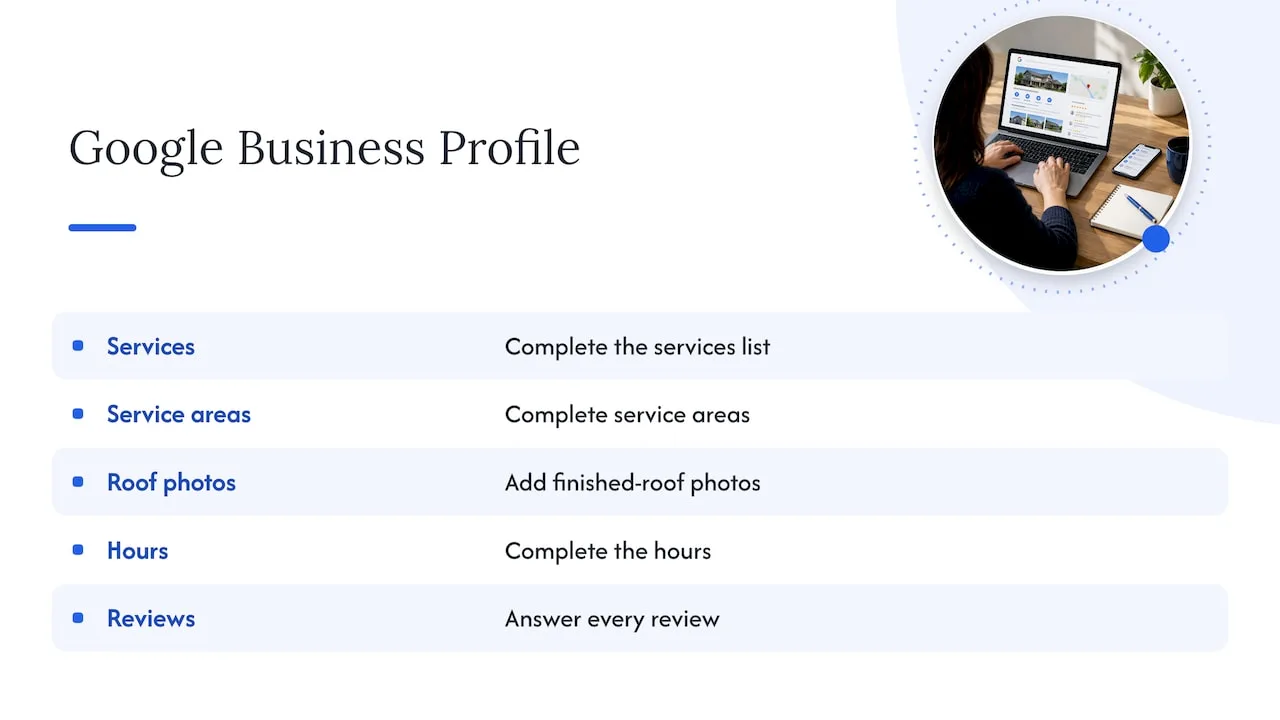
Your Business Profile is the storefront for emergency searches. Complete the services list, the service areas, the photos of finished roofs and the hours, and answer every review. Reviews carry real weight here, since a homeowner scanning three options in thirty seconds reads the star rating and the most recent comments. If you want a deeper look at what moves you up in the map results, our page on local SEO and Google Business Profile lays out how we handle it for contractors.
Local Services Ads
Local Services Ads put your company at the top of the results with a call button. They only pay off if the calls get answered and followed up. Our walkthrough on converting Local Services Ads leads in five minutes shows the response routine that makes the spend worth it.
Your website
A storm visitor wants three things within seconds: proof you’re local, a phone number that works and a way to request an inspection without a phone call. A site built to turn visits into bookings does that. Our list of the five pages that should come first on a roofing website is a good starting point, and the contact page examples show how to cut friction at the point of action.
Neighborhood and referral channels
Roofing depends heavily on referrals, and storms make word of mouth louder, because neighbors ask neighbors who they used. Nextdoor is where those questions get asked. Here is how to book more Nextdoor estimates without burning goodwill. Paid lead sources also exist, and if you are weighing ways to find new storm leads through search, roof leads from Google is one place to read about how that channel works.
Answer fast: handling the call surge
Speed is the whole game in the first 48 hours. Most small roofing companies have one or two people on the phones, and those same people are on ladders tarping roofs when the surge arrives. The result is voicemail, and voicemail loses storm jobs.
Build a response ladder so no inquiry sits unanswered:
| Layer | What it does | When it matters |
|---|---|---|
| Live answer | You or office staff pick up | Business hours, when someone is free |
| Missed-call text-back | Instantly texts the caller and asks what happened | Any call you can’t take |
| AI voice agent | Answers, collects address and damage details, books an inspection | Nights, weekends, and surge hours |
| Website chat | Greets visitors and captures the request | Visitors who won’t call |
| Review and follow-up automation | Keeps in touch and requests reviews after the job | Days and weeks after the storm |
We build exactly these layers for contractors. Missed-call text-back and CRM makes sure a caller always gets a reply. The AI voice agent handles inbound calls around the clock, and AI website chat captures web visitors. If you want to test the idea first, our two-week AI call answering pilot outlines a low-risk way to do it, and the after-hours answering steps cover the night calls that tend to be the most urgent.
One practical point: write the intake script before you need it. A good storm intake collects the address, whether water is entering the home, whether a tree or debris is on the roof, whether the homeowner has called their insurer, and the best time for an inspection. Our chatbot scripts for contractors include ready flows you can adapt.
Qualify the lead and book the inspection
Not every inquiry is a job. After a storm you’ll get real damage, cosmetic worries, tire-kickers and people who only want a number for their insurer. Qualifying quickly protects your crew’s time.
- Confirm the location. Is the address inside your service area? Storm surges often bring calls from towns you don’t cover.
- Sort by urgency. Active leaks and exposed decking get a same-day or next-day visit and a temporary tarp. Missing shingles with no interior damage can wait a few days. Eric Thomason of Blue Nail Roofing, quoted in Roofing Contractor magazine, stresses separating urgent from deferred work, and homeowners appreciate the honesty.
- Ask about insurance. Note whether a claim is open. Your role is to document damage accurately, not to promise coverage.
- Book, don’t just quote. Offer two inspection slots in the first reply. A booked slot beats a “we’ll call you back.”
- Confirm automatically. A text reminder the day before and the morning of cuts no-shows when your crew is stretched.
A CRM that tracks every inquiry from first touch to signed contract is what makes this routine possible. Without one, storm leads live in text threads and sticky notes. Our guide to lead nurturing automation covers follow-up sequences, and the CRM data cleanup playbook keeps the records usable once the surge is over.
Win the trust contest against storm chasers
Homeowners know about door-knockers who arrive after a storm and vanish by the next season. That works in your favor if you make your local roots obvious. Roofing Contractor reports that roofers who beat the chasers slow the process down, document everything and communicate constantly. Garrett Maxwell of Brown’s Roofing points to a physical office, manufacturer certifications, years of reviews and stable crews as the proof that counts.
Translate that into what the homeowner sees:
- A real address and local phone number on every page and every ad.
- A fully written scope with photos of the damage, attached to every estimate, so the homeowner can show it to their insurer.
- Licensing and insurance details stated plainly. Rhode Island and Massachusetts both register roofing contractors, so show your registration number and tell homeowners to verify any roofer they consider with the state.
- Recent, specific reviews. A review that names the town and the storm is worth more than a generic five stars. Our collection of review response examples helps you answer them quickly, and an automated review request routine asks happy customers while the job is fresh.
- Clear communication. Daily status texts during a repair do more to prevent complaints than anything on the contract.
Transparency about what you find on the roof matters just as much, because homeowners can’t see it for themselves. Photos and plain language build the confidence a flyer can’t.
Measure what storm leads actually cost
Storm season can make any marketing look good because demand is high. To know what actually worked, track a few numbers per source (Google map results, Local Services Ads, website, referrals, Nextdoor):
| Metric | How to calculate it | What it tells you |
|---|---|---|
| Cost per lead | Spend divided by inquiries | Whether a channel is cheap or expensive to start |
| Answer rate | Inquiries answered within minutes divided by all inquiries | How many leads your phones lose |
| Booking rate | Inspections booked divided by inquiries | Quality of your intake |
| Cost per booked inspection | Spend divided by booked inspections | The real price of a conversation on the roof |
| Cost per signed job | Spend divided by signed contracts | The number that decides where money goes next |
Worked example with made-up numbers: you spend $3,000 over a storm week and get 60 inquiries, so cost per lead is $50. You answer 40 of them quickly, book 20 inspections and sign 8 jobs. Cost per booked inspection is $150, and cost per signed job is $375. If automated answering lifts the answered count from 40 to 55, the same spend now books more inspections and the cost per signed job drops, without buying a single extra lead. That is why we look at the answer rate before the ad budget. Our guide to roofing lead generation and cost per booked job goes deeper on this math.
Perspective
Most roofers we talk to think they have a lead problem. After a storm, they usually have a pickup problem. The calls arrive. They land on a phone nobody can answer because the owner is on a roof in Cranston and the office manager is already on the other line.
We work only with contractors in Rhode Island and Massachusetts, and that focus shapes how we build. Local SEO and a complete Google profile get you found in the right towns. A website built to book jobs turns the visit into an appointment. Missed-call text-back, an AI voice agent and chat make sure nobody reaches voicemail. Automated review requests keep your proof of local roots growing.
The reason is simple: these pieces work together instead of sitting in separate tools from separate vendors. A storm just makes the difference visible, because it compresses a month of demand into a weekend.
Set it up when the weather is calm. By the time the forecast turns, it should already be running.
Tyson
What we can set up for your roofing company
We are Coastal Connect, and we build the lead capture side of storm response for roofers in Rhode Island and Massachusetts: websites that book jobs, local SEO and Google Business Profile work, missed-call text-back and CRM, AI voice and chat, and review automation. Plans are published on our pricing page: Foundation is $597 per month, Growth is $1,297 per month and Scale is $2,497 per month. An AI employee on the Growth plan is $199 per month, and Scale Plus is $249 per month. Extra locations start at $299 per month.
If you want to be ready before the next storm, start at coastalconnect.ai and tell us which towns you cover.
FAQ
How fast should I respond to a storm damage inquiry?
As fast as you can, ideally within minutes. Homeowners call several roofers in a row after a storm, and the first one to answer usually gets the inspection. If you can’t pick up, an instant text-back or an automated answering system keeps the conversation alive until you can call.
Do roofing companies pay for storm leads?
Many do, through Local Services Ads, pay-per-click campaigns or purchased lead lists. Whatever the source, track cost per booked inspection and cost per signed job. Leads you earn through map listings, reviews and your website are often the cheapest because they cost no fee per inquiry.
How do I stand out from storm chasers?
Show that you are local and accountable: a physical address, registration and insurance details, written scopes with photos, and a long run of recent reviews. Roofing Contractor’s reporting stresses documenting everything and communicating constantly. Respond quickly and keep homeowners updated through the repair.
What should I ask a homeowner during storm intake?
Get the address, whether water is coming in, whether debris or a fallen tree is on the roof, whether they have opened an insurance claim, and when they are available for an inspection. Then offer two inspection times in your first reply.
When should I start preparing for storm season?
Weeks before it. Finish your Google profile, service area pages, review requests and answering setup while demand is calm. Pre-written messages and a booking-ready website let you act the morning after an event instead of scrambling.
Sources
- Data-Based Jobs, Atlas Roofing
- Storm Season Is Here. So Are the Chasers., Roofing Contractor
- Roofing Marketing: Roof Leads From Google, Bass Media