Yes, always reply to positive reviews, and keep it short: thank the reviewer, mention something specific from their visit or job, sign off with a name, and add a soft next step only when it fits naturally. That structure protects your rating, builds trust with future customers reading the review, and takes less than a minute per reply once you have a system.
TL;DR:
- Responding promptly to positive reviews within one to two days reinforces trust and encourages future engagement from customers.
- Personalizing replies by referencing specific details or staff members increases their authenticity and demonstrates genuine appreciation.
- Longer responses that acknowledge the review and suggest a future interaction, such as a referral or follow-up, strengthen customer relationships.
- Avoid using promotional language, discounts, or repetitive templates to maintain a warm, genuine tone that resonates with readers.
- Automating review requests and reply drafts with human review helps maintain speed and authenticity at scale, especially for busy contracting businesses.
Table of Contents
- Why replying to positive reviews matters
- Best-practice checklist for replying to positive reviews
- Copy-paste templates for every scenario
- Industry examples for service businesses and contractors
- Managing replies at scale without losing authenticity
- What actually moves the needle in review management
- How Coastal Connect keeps replies fast and authentic for contractors
- Sources
- FAQ
Why replying to positive reviews matters
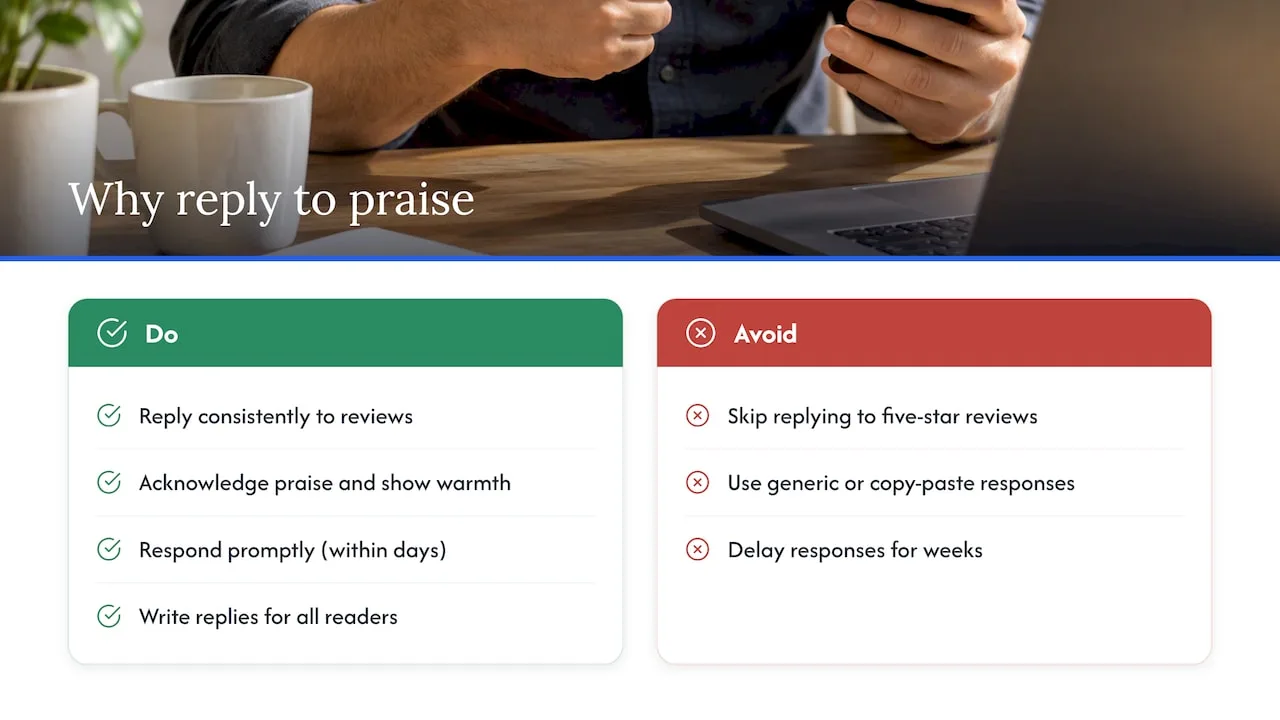
Skipping a reply to a five-star review feels harmless, but it leaves value on the table. Research on hotel reviews found that managerial engagement with reviews is linked to improved future ratings, particularly when responses combine a rational acknowledgment with genuine warmth. Businesses that reply consistently tend to see their aggregate scores hold up better over time than those that stay silent.
A separate analysis covered by Harvard Business Review found that thoughtful replies to customer reviews are associated with better future ratings and stronger customer perceptions of trust and concern. The effect is not limited to damage control on negative feedback. Replying to praise signals that a business pays attention no matter what a customer says, which shapes how the next reviewer frames their own experience.
Consumers actively expect a response, not just tolerate one. BrightLocal’s Local Consumer Review Survey found that most consumers prefer businesses that reply to reviews and are put off by replies that read as generic or copy-pasted, and many expect a response within days rather than weeks.
That expectation cuts both ways. A reply written for the original reviewer is really written for everyone who reads it afterward. Your response becomes a second piece of social proof sitting right below the five-star rating, and a warm, specific reply tells a future customer that the person behind the business actually shows up.
Best-practice checklist for replying to positive reviews
Every reply you write should pass the same short set of checks before it goes public. Get these right and the templates in the next section will do most of the remaining work.
Tone. Keep it warm and conversational, never promotional. A reply that reads like an ad undercuts the praise it is supposed to celebrate.
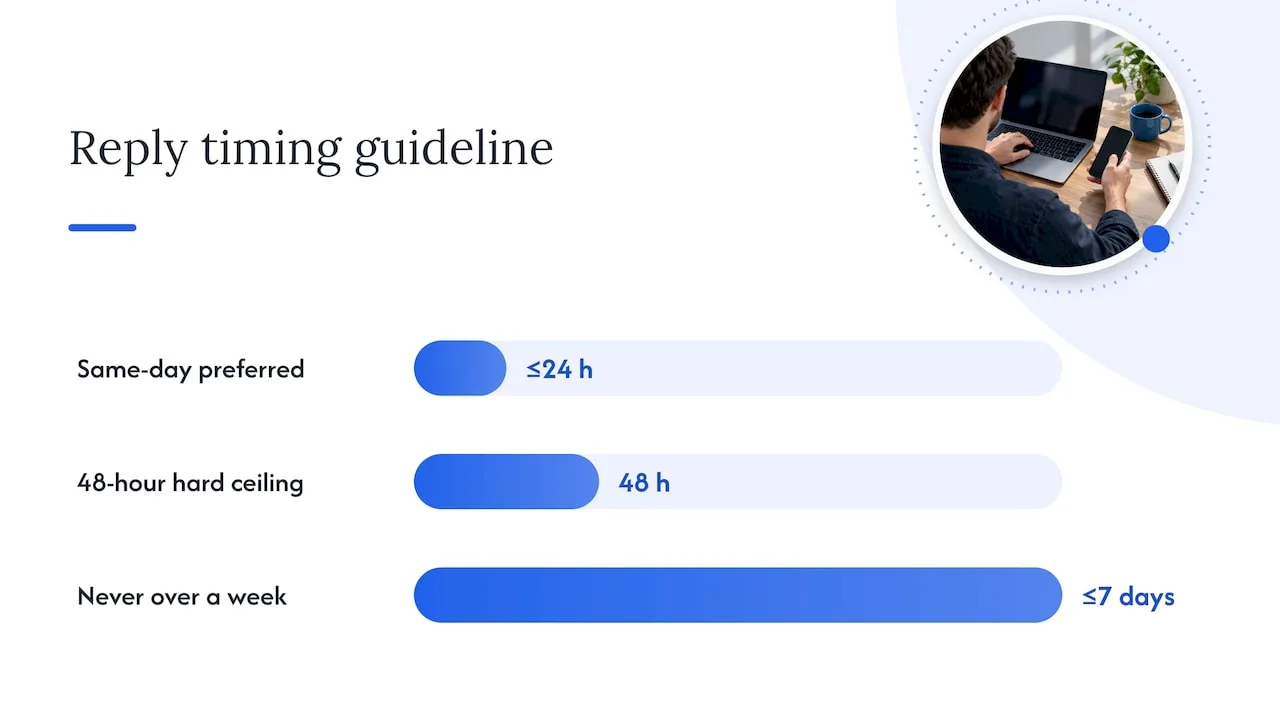
Timing. Reply within the same day when you can, and never let a positive review sit longer than a week. BrightLocal’s research shows consumers notice slow responses, so set an internal deadline (same-day for anyone who checks reviews daily, 48 hours as a hard ceiling) and treat it like any other service level agreement.
Structure. Thank the reviewer, reference one specific detail from their comment or job, add an optional next step, and close with a name and role. That fourth piece matters more than it seems: a reply signed by “Sarah, Office Manager” reads as a real person, while an unsigned reply reads as a brand account.
Personalization. Swap in the customer’s name, the service or product involved, and the staff member if one is mentioned. Two replies to two different five-star reviews should never look identical, both because it feels lazy to the next reader and because BrightLocal’s survey work finds that templated-looking replies actively turn people off.
What to avoid is just as important as what to include:
- Don’t negotiate discounts or promotions in a public reply. Save any offer for a private message or a follow-up email.
- Don’t repeat private details like an address, invoice number, or phone number in the public thread.
- Don’t turn a thank-you into a sales pitch. One soft mention of your other services is fine; three sentences of upsell is not.
- Don’t copy the same sentence structure every time. Rotate your openers so replies don’t read like a form letter.
Pro Tip: Keep a shared document of banned phrases (anything that sounds like ad copy) so new team members learn what “too promotional” looks like before they start replying on their own.
Copy-paste templates for every scenario
Here is the template bank. Pull from whichever length fits the review and swap in the bracketed detail. Treat every bracket as a required edit, never leave it in the published reply.
1. Short one-liners
These work for a quick five-star rating with no written comment, or when you’re clearing a backlog of simple reviews.
- “Thank you, [Name]! We’re so glad you had a great experience.”
- “Appreciate the kind words, [Name]. Hope to see you again soon.”
- “This made our day, [Name]. Thanks for taking the time to write it.”
- “Thanks so much, [Name]! We’ll pass this along to the team.”
- “Glad we could help, [Name]. Thanks for the five stars.”
2. Medium replies with a specific reference
These name the product, service, or staff member the customer mentioned, which is the detail that turns a generic thank-you into proof the review is real.
- “Thank you, [Name]! We’re thrilled [Staff Member] took such good care of you during your [service/product]. We’ll let them know.”
- “Really appreciate this, [Name]. [Staff Member] loves hearing feedback like this, and we’re glad the [product/service] worked out so well for you.”
- “Thanks for sharing this, [Name]. Getting your [product] right the first time is exactly what we aim for, and comments like this make it worth it.”
- “We’re so glad the [service] met your expectations, [Name]. Thanks for the detailed review, it helps other customers know what to expect.”
- “Thank you, [Name]! It sounds like [Staff Member] made your visit a good one. We’ll share your note with the whole team.”
3. Longer replies that invite engagement
Use these when a reviewer wrote a paragraph and deserves more than a one-line thanks, or when there’s a natural opening to mention something else you offer.
- “Thank you so much for this, [Name]. We’re glad [Staff Member] was able to walk you through the [service] and answer your questions along the way. Feedback like this tells us we’re doing the small things right, not just the big ones. If you ever need [related service], we’re here.”
- “This means a lot, [Name]. We put a lot of thought into [specific detail mentioned], so it’s great to hear it made a difference for you. We’ll pass your comments to [Staff Member] and the rest of the team. Thanks again for taking the time to write this.”
- “We really appreciate you sharing your experience, [Name]. It sounds like [Staff Member] covered everything from [detail one] to [detail two], which is exactly the kind of service we aim for on every job. Thank you for trusting us with your [product/service], and we hope to work with you again.”
4. Soft-ask variants
These add a light next step without turning the reply into a pitch. Use one soft ask per reply, never stack two.
- “Thank you, [Name]! If you know anyone else who could use [service], we’d appreciate the referral.”
- “So glad this worked out, [Name]. If you have a minute, a photo of the finished [product/job] would be great to see, feel free to send one our way.”
- “Thanks for the kind words, [Name]. We’re usually booking a few weeks out, so if you’re thinking about [related service] down the road, it’s worth getting on the calendar early.”
- “Appreciate you, [Name]! If [service] ever comes up again for you or someone you know, we’d love the chance to help.”
Replying on Google Business Profile
A few platform rules shape how these templates should be used on Google specifically. Google’s own guidance confirms that replies are public, reviewed under Google’s policies, and tied to a verified business profile, so a reply written for one platform’s character limit or tone might need light editing before it goes on another. Google’s tips for writing better replies note that the people most likely to read a reply are future customers deciding whether to book, not just the original reviewer, which is the reason a specific, human-sounding reply outperforms a generic one even on a platform with no algorithmic reward for engagement.
Industry examples for service businesses and contractors
The templates above flex easily across industries once you swap in the right detail. A few sector-specific patterns make that easier.
- On-site service and contractors: Reference the specific job and crew member by name, and mention the completion timeline if the reviewer did. “Thank you, [Name]! Glad [Tech Name] got your [HVAC unit/panel/roof] squared away on schedule. We appreciate you letting us know how it went, and we’re here if you need anything down the road.”
- Retail purchases: Name the product and point to a resource if one exists. “Thanks for the review, [Name]! Glad the [product] is working out. If you ever have questions about care or warranty, our team is happy to help.”
- Hospitality and food service: Reference the specific dish, room, or staff interaction mentioned. “So glad you enjoyed [specific dish/detail], [Name]! We’ll let [Staff Member] know. Hope to see you back again soon.”
- Contractor punctuality and cleanup: These get their own line because reviewers mention them constantly, and they deserve a direct acknowledgment. “Thank you, [Name]! We’re glad [Tech Name] showed up on time and left things clean. That’s the standard we hold every crew to, and we appreciate you noticing.”
For contractors specifically, naming the job type, the date range, or the crew adds a level of authenticity that generic replies never reach, since it shows the reply came from someone who actually knows what happened on site rather than a marketing account skimming star ratings.
Managing replies at scale without losing authenticity
Once review volume grows past a handful a week, a single owner replying from memory stops working. A basic system fixes that without adding headcount.
- Monitoring: Pick the platforms that matter most to your business (usually Google Business Profile plus one or two industry-specific sites), turn on notifications, and assign one person as the default responder with a backup.
- Template rotation: Keep three to five versions of each reply length so no two consecutive replies read identically, and swap in name, service, and staff tokens every time.
- AI-assisted drafts: AI can draft a first pass quickly, but BrightLocal’s research points to a required human edit step as the safeguard against replies that read as robotic or off-brand.
- Quality controls: Log every reply, spot-check a sample weekly, and set an escalation rule for anything involving a complaint buried inside an otherwise positive review.
- Privacy: Never repeat a customer’s phone number, address, or invoice detail in a public reply, even if they included it themselves.
Pro Tip: Automated review requests sent right after a completed job shorten the whole cycle, since a happy customer who gets asked within a day of the work is far more likely to write a specific, glowing review than one contacted a week later.
What actually moves the needle in review management
Most of the advice on replying to reviews focuses on wording, but wording matters less than people think. Speed and consistency do more work than a clever sentence ever will. A short, slightly imperfect reply sent the same day beats a polished paragraph sent two weeks later, every time.
Templates are scaffolding, not a finished product. The moment a reply reads exactly like the last ten a business posted, it stops working as social proof and starts reading as noise. Small teams that commit to fast, specific, personalized replies, even with the simplest one-line templates, tend to see rating and trust benefits faster than businesses chasing a perfect response.
— Tyson
How Coastal Connect keeps replies fast and authentic for contractors
Contractors already stretched thin on service calls rarely have time to chase reviews between jobs, which is exactly the gap Coastal Connect’s Reviews that keep coming service is built to close. It automates the review request the moment a job wraps, so the ask goes out while the work is still fresh instead of days later, and it pairs that with AI-suggested reply drafts that still get a human check before anything goes public.
That combination protects the two things that matter most from the sections above: speed and authenticity, without asking a plumber, electrician, or roofer to become a part-time reputation manager. It runs alongside Coastal Connect’s Local SEO & Google Business Profile work and websites that book jobs, so a strong review shows up right where a prospective customer is already deciding who to call.
| Coastal Connect offering | What it handles |
|---|---|
| Reviews that keep coming | Automated review requests and reply support |
| Local SEO & Google Business Profile | Profile optimization and local visibility |
| Websites that book jobs | Lead capture and booking conversion |
Plans start at the Foundation tier at $597 per month, with Growth and Scale tiers available for contractors ready to add more automation. Check the full pricing breakdown to see which tier fits your crew size and lead volume.
Sources
- Cornell Business — Research recap: Customer engagement key to long-term loyalty impact
- Harvard Business Review — Study: Replying to customer reviews results in better ratings
- BrightLocal — Local Consumer Review Survey
- Manage customer reviews - Google Business Profile Help
FAQ
What is a good example of responding to a review?
A good reply thanks the reviewer by name, references a specific detail from their visit or job, and signs off with a real name. For example: “Thank you, Maria! Glad our technician got your furnace running before the cold snap hit. We appreciate you taking the time to write this.”
What is an example of a good review?
A strong review names the specific service or product, mentions a staff member or detail, and describes the outcome, which is also what makes it easy to write a personalized reply back. Reviews like this give a business real material to reference instead of a generic thank-you.
Can you provide some examples of positive review responses?
Yes: a short reply might read “Thanks so much, [Name]! Hope to see you again soon.” A medium reply could add a specific reference, such as “Glad [Staff Member] got your project done on schedule, we’ll pass this along to the team.” Longer replies add a sentence inviting a referral or future booking.
What are some examples of responses?
Responses generally fall into three lengths: a one-line thank-you, a medium reply that names a product or staff member, and a longer reply that adds appreciation plus a soft next step like a referral request. The right length depends on how much detail the original review included.