A roofing answering service picks up every call you can’t take, finds out whether it’s a leak or an estimate request, and gets the caller booked or routed to the right person. For a roofer, the case is simple. You are on a ridge, in a truck or in a crawl space when the phone rings, and a homeowner with water coming through the ceiling calls the next roofer on the list if you don’t answer. The best setup answers instantly, asks the questions you would ask, and puts a booked inspection on your calendar. We build that for contractors in Rhode Island and Massachusetts, and this guide covers how the service should work, what to give it and how to tell whether it’s paying off.
TL;DR
- A good roofing answering service does more than take messages. It sorts emergencies from estimates, collects the job details and books or routes the call.
- Give it a written script: service area, job types you take, emergency rules, who gets which call and what counts as a booked inspection.
- Cover nights, weekends and the hours you’re up on a roof, and add a missed-call text-back so no caller is left with a voicemail.
- Judge it by booked inspections and cost per job sold, not by how many calls it answered.
- Our AI voice agent handles 24/7 inbound calls for contractors in RI and MA.
Table of Contents
- Why roofing calls get lost
- What a roofing answering service does
- Sorting emergencies from estimates
- What to give the service: your script
- Call forwarding and handoff to your team
- After-hours calls and the hours you’re on the job
- Live agent or AI voice: which fits a roofing company
- What a roofing answering service costs
- How to compare providers
- Measuring whether it works
- Our perspective
- Put an answering system behind your phone
- FAQ
- Sources
Why roofing calls get lost
Roofing is a job you can’t do from a desk. Your best hours for production are the hours your phone is hardest to reach. Add storms, when everyone with a damaged roof calls at once, and a single owner or a one-person office can’t keep up.
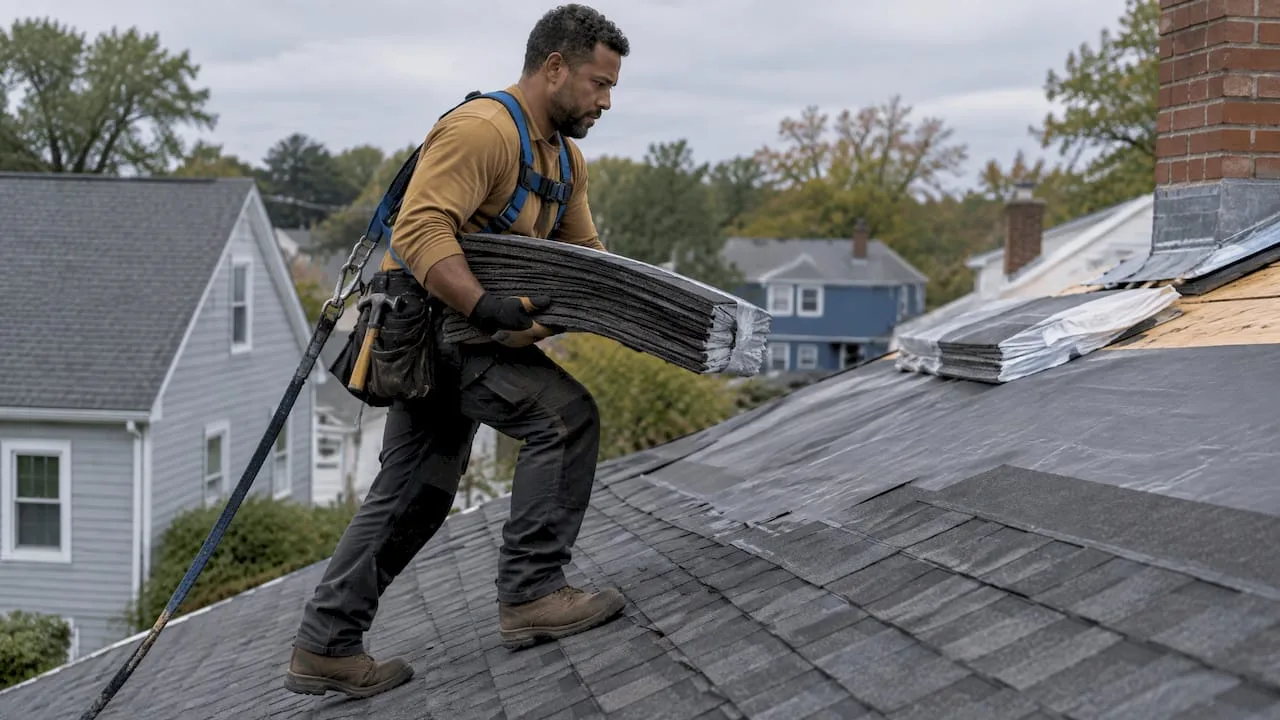
The lost call usually isn’t dramatic. It’s a 7:40 a.m. call while you’re loading shingles, a 6:15 p.m. call at dinner, a Saturday call about a stain on a ceiling. A homeowner in that position is not leaving a polite voicemail and waiting a day. They are searching for roofers and calling down the list until a human answers. The roofer who answers first usually gets the inspection.
That is why speed matters more than polish. How quickly you respond is one of the few parts of lead handling you fully control, and follow-up timing guidance for sales teams makes the same point about the early minutes after a lead comes in.
What a roofing answering service does
At its core, the service answers your business line in your company’s name and follows a script you wrote. In practice, a roofing-specific setup should do five jobs:
- Answer every call, fast. No ringing out, no voicemail box for a first-time caller.
- Identify the type of call. Active leak, storm damage, repair, full replacement, a quote on a gutter, an existing customer, a vendor, a wrong number.
- Capture the details. Name, mobile number, property address, what the caller sees, how long it’s been happening, whether they own the home.
- Handle the next step. Book an inspection, offer a callback window, or send an emergency straight to you or your on-call crew.
- Report back. A summary of each call, sent by text or email, plus a record in your CRM, the software that holds your leads and customers.
The difference between a message service and a booking service is the fourth step. A message service writes down a phone number and leaves you to call back. A booking service finishes the conversation. For a roofer, that can mean the difference between a callback tag and a scheduled inspection.
Sorting emergencies from estimates
Triage is the part that makes a roofing service worth having. A call about a ceiling that’s dripping tonight is not the same as a call about a roof that’s twenty years old and might need replacing next spring. They need different speeds, different people and different questions.
A workable triage looks like this:
| Call type | What the caller says | What should happen |
|---|---|---|
| Active leak or storm damage | Water coming in, tree on the roof, missing shingles after wind | Collect address and phone, ask if anyone is in danger, alert your on-call person right away, offer a tarp or inspection slot |
| Repair estimate | A few shingles, flashing, a small leak that stopped | Capture the details, book the next available inspection |
| Replacement estimate | Old roof, selling the house, insurance claim | Ask about the age of the roof, the home type and the timeline, then book an estimate visit |
| Existing customer | Warranty, scheduling, invoice | Route to your office or project manager |
| Vendor, supplier, spam | Sales calls | Take a note or screen out |
If a caller describes a fire, a collapsed roof or anyone in danger, the script should tell them to call 911 first. That rule belongs in every roofing script, and it protects you and the homeowner.
Insurance comes up constantly. Homeowners often call because they think their policy will cover the roof, and many of them don’t know what it pays. Your answering service should not tell anyone what their policy covers. It should record that the caller plans to file a claim, note the date of the storm if they know it, and book the inspection. If you want to send callers somewhere that explains the basics, a page on what a home policy pays for roof replacement gives them the background without anyone on your side giving coverage advice.
For storm season specifically, we wrote a guide on how RI and MA roofers win storm damage leads, covering the surge in calls after a big weather event.
What to give the service: your script
An answering service is only as good as the instructions behind it. Most disappointing setups fail because the roofer never wrote anything down. Before you turn anything on, put these items on one page:
- Business basics. Company name as you want it said, hours, towns and counties you serve, and the towns you don’t.
- Jobs you take and jobs you don’t. Shingle, flat, metal, slate, gutters, siding. Say what to do when someone calls about a job you don’t do.
- Emergency rules. What counts as an emergency, who gets the alert, and how fast they should expect a callback.
- Questions to ask. Address, type of roof, approximate age, what happened, whether water is entering the house, whether there is an insurance claim, best time for an inspection.
- Booking rules. Which days and windows can be offered, how long an inspection takes, and who owns the visit.
- Pricing language. Most roofers prefer the service says an inspection is the next step, not quote prices over the phone. Decide what the script says when a caller asks “how much?”
- Tone. Short, calm and clear. Callers in a leak are stressed. A script with ten questions in a row feels like an interrogation, so keep to the ones you actually use.
Our resource on lead qualification questions can help you pick which questions are worth asking up front and which can wait for the site visit.
Call forwarding and handoff to your team
There are two common ways to connect the service to your phone. You can forward your existing business number when you don’t answer or when you’re busy, so customers keep calling the number on your truck and your website. Or you can send all calls to the service first and have it transfer the ones that need a person.
Whichever you choose, write down the handoff rules:
- Who gets emergencies. One named person at night, a backup if they don’t pick up, and a time limit before the call moves to the backup.
- Who gets estimates. Your office manager, sales rep or you. Spread by territory, by job type or by who is free.
- What a transfer looks like. A warm transfer means the service tells you who is calling and why before you speak. That saves the caller from repeating the story.
- What happens when nobody picks up. The service should keep the caller, offer a callback time and text you the details.
This is the same logic as lead routing rules for contractors: decide who gets which call before the call arrives, not during it. If your callers get stuck in a menu first, our phone tree best practices cover how to keep that menu short.
After-hours calls and the hours you’re on the job
There are two different gaps to cover, and they need slightly different handling.
Nights and weekends. Leaks don’t keep office hours. The after-hours setup should answer, triage and only wake you for true emergencies. Everything else becomes a booked slot for the next business day, waiting on your calendar when you start work. We lay out the steps in our guide to keeping night leads with after-hours answering.
Business hours when you’re busy. This is the gap owners underestimate. If you’re the estimator and the installer, your phone goes unanswered for most of the working day. Set the service to pick up after a few rings, or whenever you’re on a job, so the caller never gets a recording.
A missed-call text-back is a useful safety net on top of both. When a call goes unanswered, the caller gets an immediate text from your business and can reply with details. We offer missed-call text-back and CRM for exactly that, and it keeps the conversation going in the same thread your team uses.
Live agent or AI voice: which fits a roofing company
You’ll see two kinds of answering service: live receptionists working from a call center, and AI voice agents that answer with software. Both can follow a script. The practical differences are how fast they pick up, how well they handle a surge, and how well they connect to your calendar and CRM.
For roofers, we recommend the AI voice route, and the reasons come from how roofing calls arrive:
- Surges. After a storm, dozens of calls come in at once. An AI agent can pick up all of them at once rather than queueing them.
- Always on. It answers at 2 a.m. and on holidays with the same script.
- Booking. It can work from your calendar and CRM, so a call ends with an appointment, not a message.
- Consistent questions. It asks the same questions every time, so every lead record looks alike and is easy to sort.
Our AI voice agent is built for contractors, and we set it up around the towns and trades we serve in Rhode Island and Massachusetts. If you want a low-risk way to start, our two-week AI call answering pilot guide walks through how to run a short trial on a small set of calls.
AI website chat is the same idea for your site. When a visitor is reading about roof replacement at 9 p.m. and doesn’t want to call, AI website chat can answer and capture the inquiry. Pair it with a site built around inspection requests, and you cover the phone and the web. Our roofing website CTA guide shows which buttons turn visitors into booked inspections.
What a roofing answering service costs
Answering services are generally priced a few ways: by the minute, by the call, as a flat monthly fee, or as a monthly fee with an allowance of calls and overage on top. Setup fees and usage caps are common, so read the terms for what happens when a storm doubles your call volume. A plan that looks cheap at 40 calls a month can be expensive at 200.
When you compare quotes, put them on the same footing:
- What’s included in the monthly price, and what’s billed extra?
- Is there a setup fee, and a contract term or a cancel-anytime option?
- What counts as a billable minute or call?
- Is booking onto your calendar included, or is it a message service only?
- Does it connect to your CRM, and is the CRM included?
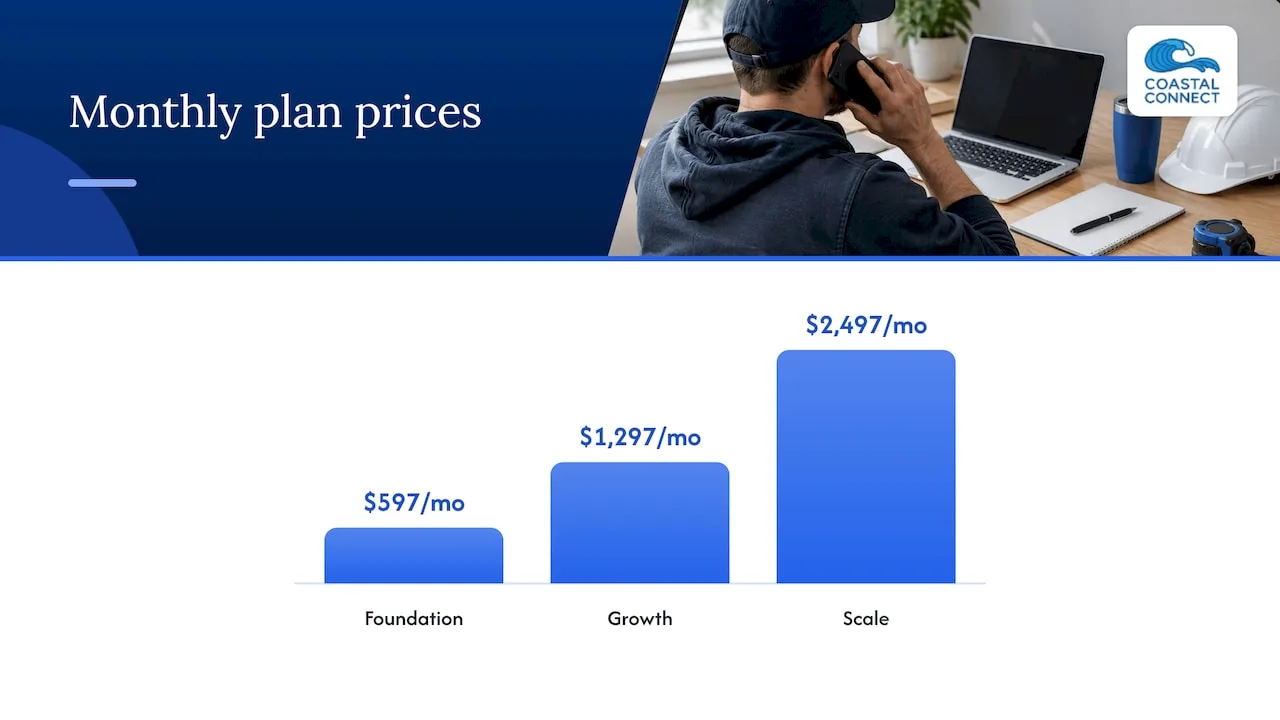
Our published plans bundle call handling into a wider contractor growth system. Foundation is $597 per month, Growth is $1,297 per month and Scale is $2,497 per month. On Growth, an AI employee is available as an add-on at $199 per month. Extra locations start at $299 per month. Those are agency plans for lead capture and conversion, not a stand-alone answering line, which is why they make the most sense when you also need your website, Google Business Profile and reviews working.
The price that matters most is cost per booked job. An answering service that costs less per month but books fewer inspections is not the cheaper one.
How to compare providers
Most roofers pick a service from a quick call and a price. Use a short list of criteria instead:
- Roofing questions built in. Does the script ask about roof age, leak status and insurance claims, or is it generic?
- Emergency handling. Can it alert your on-call person and escalate if they don’t answer?
- Booking, not just messaging. Can it put an inspection on your calendar?
- Local knowledge. Does it know your towns, your service area and the way homeowners name neighborhoods? In New England, a caller from one town can be outside your territory two miles away.
- Reporting. Do you get a record of every call, with the caller’s answers and the outcome?
- Surge capacity. What happens in a storm week?
- Terms. Contract length, cancellation, and what’s billed beyond the plan.
- Fit with the rest of your marketing. Calls come from your Google Business Profile, your site and your ads. A service that connects to those gives you one picture of where jobs come from.
That last point is why we handle call answering, local SEO and your Google Business Profile and review requests as one system for RI and MA contractors. Calls from a strong profile land in the same place as calls from your website and your ads.
Measuring whether it works
The goal is booked inspections, so measure the path from call to job. Track a short list every week:
- Answer rate. What share of calls were picked up by a person or the AI, including after hours.
- Speed to response. How long a new lead waited before getting an answer or a text.
- Booked rate. Of the calls answered, how many ended with an inspection on the calendar.
- Show rate. How many scheduled inspections actually happened.
- Close rate. Of the inspections, how many became signed jobs.
- Cost per job sold. Your total marketing and answering spend divided by jobs won.
- Reviews. New reviews after each job, because customer satisfaction shows up there.
To see what each call is worth, you need call tracking tied to your CRM, so you know which source produced which job. We explain how in proving contractor marketing ROI with call tracking and CRM. For the finance side, such as how marketing spend sits against margins and cash flow, a roofing-focused accounting and tax service for roofing companies can help you read the numbers once the leads start flowing.
If you want to see how this fits a roofing marketing plan, read our guide on roofing lead generation that cuts cost per booked job.
After the inspection, follow-up is where many roofing jobs are decided. Proposals sit, homeowners compare, and silence loses the job. Our contractor proposal follow-up guide covers timing and scripts.
Our perspective
Most roofers we talk to don’t have a lead problem. They have a pickup problem. The phone rings while they’re on a roof, the caller moves on, and the money goes to whoever answered.
We built our approach around that. We work only with contractors in Rhode Island and Massachusetts, and our team knows the towns and the trades. An answering line that handles calls around the clock is the first piece. The website, the Google Business Profile and the review requests are what make those calls arrive in the first place and make people say yes.
We’d rather a roofer have one system that answers, books and follows up than five tools that don’t talk to each other. When the call, the text-back, the CRM and the review request sit together, nothing falls between them.
Tyson
Put an answering system behind your phone
If you’re a roofer in Rhode Island or Massachusetts, we can set up 24/7 inbound call handling, missed-call text-back, your CRM and the website and profile that bring the calls in. See our plans and pricing or go straight to the AI voice agent to see how call answering works.
Our plans start with Foundation at $597 per month, and you can add an AI employee on Growth for $199 per month.
FAQ
Is a roofing answering service worth it for a small crew?
Small crews often benefit most, because the owner is usually also the estimator and the installer. When you’re on a roof, nobody else is picking up. An answering service turns those missed calls into booked inspections or clear callback tasks.
Can the service tell an emergency from a regular estimate request?
Yes, if the script is written for it. Define what counts as an emergency, such as active water entering the home or storm damage, and who gets alerted. Anyone describing a fire or a danger to people should be told to call 911.
Should the service quote prices over the phone?
Most roofers have it book the inspection instead, since a roof price depends on what’s found on site. Put the wording for a “how much?” question in your script so callers get a clear next step.
What should I measure first?
Start with answer rate, booked inspections and cost per job sold. Those three show whether more calls are turning into signed work, and call tracking tied to your CRM will tell you which source each job came from.
Sources
- Sales follow-up timing: how long to wait at every stage
- Roof replacement coverage: what your home policy pays
- Accounting and tax for roofing companies