

To win homeowner leads, prioritize a small set of pages: service pages, a project gallery, cost and estimate pages, an FAQ, and a contact page, then put one conversion move above the fold on every single one, a visible free estimate or inspection button paired with click-to-call. Everything below explains how to build each page and how to make the whole site convert.
TL;DR:
- Give each service page its scope, materials, process, and three to five job photos; organize real before and after projects by town.
- Use ranges instead of fixed quotes: a 2,000 square foot asphalt shingle roof commonly costs $8,000 to $14,000, depending on pitch and material.
- Send purchase intent searches to service and cost pages, informational questions to FAQs or posts, and keep your Google Business Profile current.
- Put a free estimate button and click to call near the top of every page, and use missed call text back to recover unanswered calls.
- Inspect residential roofs at least twice a year and after severe weather, following NRCA guidance; use spring and fall reminders in seasonal content.
Table of Contents
- 1. Priority Website Pages and Content Every Roofing Site Needs
- 2. How to Write Roofing Copy That Converts
- 3. SEO and Discoverability for Roofing Content
- 4. Visuals and Project Galleries That Build Trust
- 5. Conversion Elements That Produce Qualified Inquiries
- 6. Content Production Workflow and a Roofing Idea Bank
- 7. Authoritative Guidance and Real-World Proof Points
- 8. Automation Tools That Catch Leads You’d Otherwise Miss
- 9. AI-Powered SEO Techniques for Roofing Content
- 10. Mobile Optimization Best Practices for Roofing Websites
- 11. Incorporating Local Reviews and Reputation Management
- Author Perspective: A Pragmatic Content-First Approach for Roofers
- Coastal Connect: How We Turn Website Pages Into Booked Jobs
- FAQ
- Sources
1. Priority Website Pages and Content Every Roofing Site Needs
Homeowners researching a roof problem move through a short list of questions: can you do this job, what will it cost, can I trust you, and how do I reach you right now. Your page structure should answer each one without making the visitor hunt.
Your core service pages carry the most weight. Each one needs:
- Scope of work: the specific service (shingle replacement, flat roof repair, storm damage) stated in the first sentence.
- Materials used: brand names and types, not vague “quality materials” language.
- Process summary: inspection, estimate, scheduling, and cleanup in plain steps.
- Photo proof: three to five real job photos tied to that specific service.
- A direct CTA: free estimate button and phone number, repeated at the bottom.
Beyond service pages, build these in priority order:
- Project gallery with real before-and-after photos organized by neighborhood or town, since local, identifiable work reads as more trustworthy than stock imagery.
- Cost and estimate page that explains what drives price (roof size, pitch, material, tear-off versus overlay) using range-based examples like “a 2,000 square foot asphalt shingle roof commonly runs $8,000 to $14,000 depending on pitch and material” rather than fixed quotes.
- Seasonal and emergency landing pages for storm damage, ice dam removal, or post-hurricane repair, built so they can be promoted quickly when weather hits.
- FAQ page answering the questions homeowners actually type into search: how long does a roof replacement take, do you handle insurance claims, what warranty comes with the work.
- Contact page with a short form, your phone number, service area, and hours.
Skip the generic “about us” filler and keep every page working toward one of two outcomes: a phone call or a form submission.
2. How to Write Roofing Copy That Converts
Homeowners calling a roofer are often anxious about cost, timeline, and getting scammed. Copy that reduces that anxiety converts better than copy that just lists services.
Start every service and location page with a sentence that states the outcome and the next step, not a definition. “We repair storm-damaged roofs across your area and can schedule a free inspection within 48 hours” does more work than “Roofing is the process of installing or repairing the covering on a building.”
Lay out your process in plain steps so the homeowner knows what happens after they click:
- Inspection: a technician assesses the damage or project scope, usually within a day or two of contact.
- Estimate: a written, itemized quote delivered before any work begins.
- Scheduling: a firm date range, with weather contingencies explained upfront.
- Cleanup: confirmation that debris and nails are cleared and the yard is checked with a magnetic sweep.
Trust specifics belong near the CTA, not buried in a footer. State your liability insurance coverage, any manufacturer certifications you hold, and reference recognized guidance like NRCA’s residential roof maintenance recommendations when discussing inspection frequency. Specifics like these read as more credible than a generic “quality workmanship guaranteed” line.
Keep microcopy short and concrete: buttons should say “Get a Free Estimate” or “Call Now,” not “Submit.” Form labels should say “Roof Age (if known)” instead of just “Details.”
Pro Tip: Read your homepage headline out loud. If it doesn’t name a service and a next step in one breath, rewrite it.
3. SEO and Discoverability for Roofing Content
Ranking for roofing searches comes down to matching the right page to the right intent, then backing it with structured data and a complete local profile.
- Map keywords by intent. Commercial queries like “roof replacement cost [town]” or “emergency roof repair near me” should point to service and cost pages built to convert. Informational queries like “how often should a roof be inspected” belong on blog posts or the FAQ, where you can link back to a service page.
- Run through an on-page checklist. Titles and H1 headings should name the service and, where relevant, the material or location. Meta descriptions should include the CTA. Group related services (shingle repair, flat roof repair, storm damage repair) into a content cluster that links to each other.
- Add structured data. FAQ schema on your FAQ page and LocalBusiness schema on your contact and service pages help search engines surface your content with rich snippets, which increases visibility for voice and featured-snippet results.
- Build out Google Business Profile and Local Services. Google Business Profile is often the first thing a homeowner sees before they ever reach your site, and Local Services Ads prioritize listings for immediate contact on certain service searches. Keep your profile updated with current photos, service areas, and prompt responses to reviews.
Treat your website and your Google Business Profile as one system. A homeowner who sees a strong profile and clicks through to a thin website will bounce, and the reverse is just as true.
4. Visuals and Project Galleries That Build Trust
Real project photography does more to convert a skeptical homeowner than any paragraph of copy. Build a simple shot list for every job:
- Before: wide shots of the roof showing the damage or condition that prompted the call.
- During: tear-off progress and any underlying issues found, like rotted decking.
- After: finished roof from multiple angles, including a street-view shot.
- Close-ups: flashing, ridge vents, and any detail work that shows craftsmanship.
Caption each photo with the service performed and the general area, such as “Architectural shingle replacement, Warwick area,” without listing a full address. That keeps the local proof without exposing a client’s exact home.
Video and drone footage work well for steep or large roofs where ground photos can’t show the full scope, but always get written permission before posting footage that shows a client’s property, and host video through a platform like YouTube or Vimeo rather than large unoptimized files sitting directly on your server.
For SEO and accessibility, name image files descriptively (“asphalt-shingle-repair-before.jpg” instead of “IMG4521.jpg”), write alt text that describes the content for screen readers, and lazy-load gallery images so page speed doesn’t suffer on mobile.
Pro Tip: Shoot photos in landscape orientation at midday when possible. Harsh shadows from late-afternoon sun make shingle color and texture hard to read in thumbnails.
5. Conversion Elements That Produce Qualified Inquiries
A roofing site can have great content and still lose leads if the path to contact isn’t obvious within seconds.
- Put the CTA above the fold on every page. NRCA guidance on homeowner expectations supports placing a “free inspection” or “free estimate” button where a visitor can reach it in under five seconds, since roofing searches often come from someone dealing with an active leak or storm damage.
- Keep the intake form short. Name, phone, service address, and a brief description cover the minimum. Optional fields like roof size, material, or a photo upload help qualify the lead without adding friction for someone in a hurry.
- Use click-to-call and always-on handling. A phone number that dials directly from a mobile screen, paired with missed-call text-back so no inquiry goes unanswered after hours, captures leads that would otherwise go to the next search result.
- Automate the follow-up. A confirmation message, a clear scheduling window, and a review request sent after the job wraps keep the relationship warm without manual chasing.
One above-the-fold CTA, backed by click-to-call and missed-call text-back, closes the gap between a homeowner finding your site and actually reaching your business, which matters most for storm-related searches where the next available contractor often wins the job.
6. Content Production Workflow and a Roofing Idea Bank
Build pages in this order: core service pages first, then the cost page and gallery, then the FAQ, then seasonal landing pages. That sequence gets your highest-converting pages live before you spend time on supporting content.
Set a simple monthly calendar: one seasonal post (storm prep in late summer, winter ice dam care, post-storm inspection checklists), one cost or process explainer, and one gallery update pulled from recent jobs.
Build a jobsite collection habit so content never runs dry: get a signed photo release at the start of every job, timestamp photos as you go, and jot a one-line note about anything unusual (storm damage pattern, unusual repair) you can turn into a caption or post later.
Quick blog prompts to keep in rotation:
- How often should you inspect your roof after a storm
- Signs your roof needs repair versus full replacement
- What affects the cost of a roof replacement
- How long does a typical roof replacement take
- Ice dam prevention tips for winter
- What to ask a roofer before signing a contract
- How insurance claims work for storm roof damage
- Metal versus asphalt shingle roofs compared
- How to spot a roofing scam after a storm
- Why gutter maintenance affects roof lifespan
7. Authoritative Guidance and Real-World Proof Points
Citing recognized industry guidance on your service pages does more for trust than adjectives ever will. NRCA’s guidance on residential roof systems recommends homeowners inspect their roofs at least twice a year and after severe weather, a detail worth repurposing into a maintenance checklist or seasonal reminder post.
Accessibility matters here too. Following ADA web accessibility guidance with proper alt text, keyboard-navigable menus, and readable contrast widens the pool of homeowners who can actually use your site and reduces legal exposure.
A roofing site built on specific proof, real photos, referenced maintenance guidance, and clear contact paths, earns trust faster than one built on generic claims.
That’s the implementation gap we help close for contractors in Rhode Island and Massachusetts: websites that book jobs built around the page structure above, paired with Local SEO & Google Business Profile work so the content actually gets found.
8. Automation Tools That Catch Leads You’d Otherwise Miss
A homeowner with an active leak rarely waits for a callback. If a call goes unanswered, the next step for most people is dialing the next name on the search results page.
Missed-call text-back closes that gap automatically: when a call isn’t picked up, the system sends an immediate text so the conversation continues even if your crew is on a roof. Pairing that with a CRM means every inquiry, whether it comes from a phone call, a form, or a chat widget, lands in one place instead of scattered across texts, emails, and sticky notes.
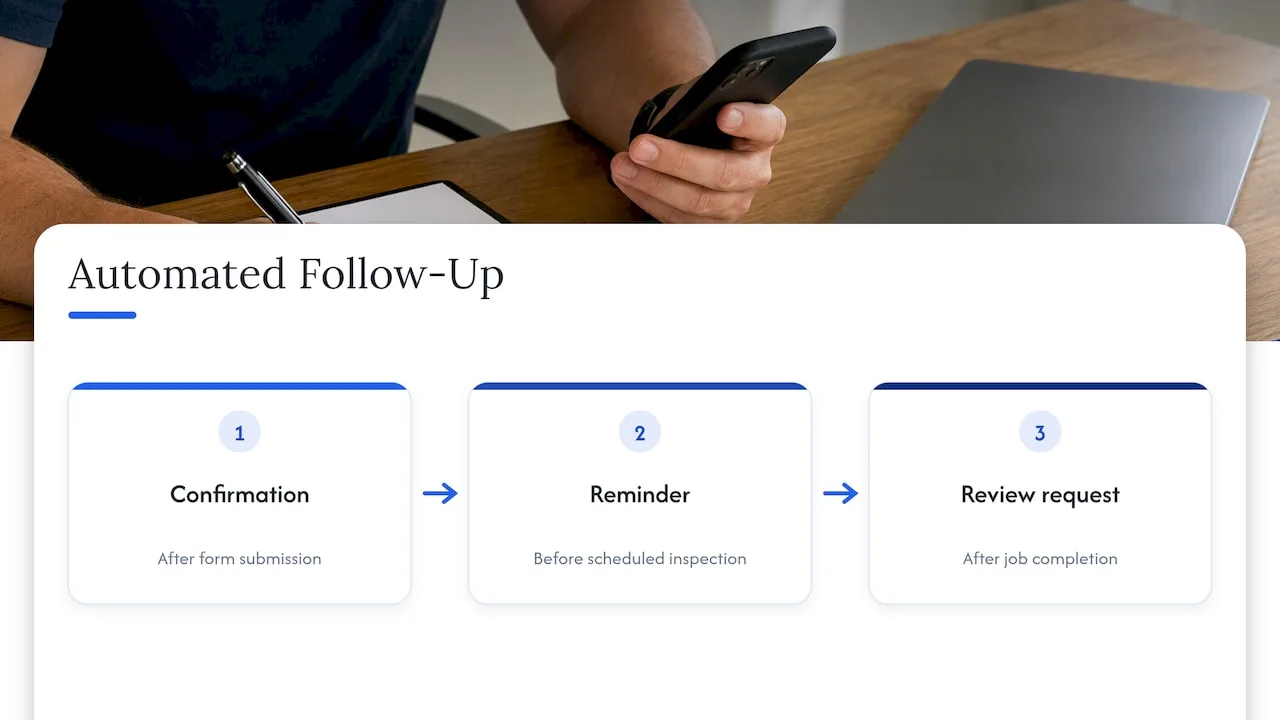
Automated follow-up sequences matter just as much after the first contact. A confirmation message right after a form submission, a reminder before the scheduled inspection, and a review request sent once the job is complete all happen without anyone on your team remembering to send them. For a small crew juggling jobsites, that automation is often the difference between a lead that books and one that goes cold waiting for a callback.
An AI voice agent or AI website chat widget extends the same coverage to nights and weekends, answering basic questions, collecting job details, and scheduling an estimate before a human ever gets involved. For a roofer fielding storm-damage calls at 9 p.m., that coverage alone can capture jobs a competitor’s voicemail loses.
9. AI-Powered SEO Techniques for Roofing Content
AI tools now speed up several parts of roofing SEO that used to take hours of manual work. Keyword research tools can surface local search patterns, like which towns search “roof replacement” versus “roof repair” most often, so you can prioritize which service and location pages to build first.
AI writing assistants help draft first versions of FAQ answers, service page sections, or blog outlines, but they need a human edit pass before publishing, since generic AI output tends toward the same vague claims homeowners already distrust. The strongest roofing content still comes from feeding the tool specific details, your actual process, real material names, your actual service area, rather than asking it to write generically about roofing.
AI is also useful for generating structured data and schema markup quickly, for summarizing customer reviews into themes you can reference on service pages, and for drafting alt text for large photo batches that you then refine for accuracy. The goal isn’t to let AI write your site, it’s to use it to move faster on the groundwork so more of your time goes into the specifics that actually differentiate your business.
10. Mobile Optimization Best Practices for Roofing Websites
Most homeowners searching for emergency roof repair are doing it from a phone, often standing in their driveway looking at the damage. A site that loads slowly or hides the phone number on mobile loses that lead immediately.
Keep your click-to-call button fixed near the top of the screen on mobile, not buried after several scrolls. Compress gallery images so pages load quickly on a cellular connection, and test your cost and service pages specifically on a phone screen to confirm the CTA button is visible without scrolling.
Forms should be short enough to complete with one thumb: name, phone, address, and a brief description is plenty for a first touch. Avoid dropdown menus that are hard to tap accurately, and make sure your map and directions link opens cleanly in a mobile maps app.
11. Incorporating Local Reviews and Reputation Management
Reviews function as a second trust layer alongside your project photos, and homeowners often check them before they ever read your service pages. Embedding recent reviews directly on service and location pages, rather than only linking out to a review platform, keeps that proof visible at the moment someone is deciding whether to call.
Encourage reviews right after job completion, when the work is freshest in the homeowner’s mind, and make it easy by sending a direct link rather than asking them to search for your business. A Google Maps listing with current reviews and accurate location details is often the first thing a homeowner checks before clicking through to your website, so keeping it current matters as much as the testimonials on your own pages.
Respond to every review, positive or negative, in a short, professional tone. A thoughtful response to a critical review often does more for trust than a page full of five-star praise with no replies at all.
Author Perspective: A Pragmatic Content-First Approach for Roofers
The pages that move the needle for roofers aren’t exotic: a real project gallery, a cost page that explains ranges instead of hiding behind “call for pricing,” and one CTA a homeowner can find in five seconds. Most roofing sites fail not because they lack content, but because that content is vague where it needs to be specific.
Pick one page this week, probably your cost page or your gallery, and audit it against that standard. If you’d rather hand the whole project to a team that builds this for contractors daily, we’re glad to talk it through.
— Tyson
Coastal Connect: How We Turn Website Pages Into Booked Jobs
We build the exact page structure covered in this guide, service pages, galleries, cost pages, and FAQs, as websites that book jobs, paired with Local SEO & Google Business Profile management so the pages actually get found by homeowners searching nearby.
We layer in missed-call text-back and CRM so no inquiry slips through after hours, an AI voice agent and AI website chat to catch leads around the clock, and review generation to keep your reputation current.
| Service | What it does |
|---|---|
| Websites that book jobs | Builds the service, gallery, and cost pages from this guide |
| Local SEO & Google Business Profile | Gets those pages found in local search |
| Missed-call text-back & CRM | Captures leads when calls go unanswered |
| AI voice agent & AI website chat | Answers and qualifies leads continuously |
Check our pricing and plans to see which setup fits your crew.
FAQ
What is the sizable portion rule in roofing?
The term usually refers to a provision in some local building codes stating that if more than a significant portion of a roof is being repaired or replaced within a certain period, the entire roof must be brought up to current code. Rules vary by municipality, so homeowners and contractors should confirm the specific threshold with their local building department before planning a partial repair.
How do I promote my roofing business?
The strongest combination is a website built around service pages, a real project gallery, and a cost page, paired with an optimized Google Business Profile and active review generation. Local Services Ads and consistent review responses add visibility on top of that foundation.
What is the best CRM for roofing companies?
The right choice depends on whether you need basic job tracking or a full system with missed-call text-back, automated follow-up, and scheduling built in. Roofers handling a high volume of storm-related inquiries generally benefit most from a CRM that includes automated lead capture rather than a standalone scheduling tool.
What are the current trends in the roofing industry?
Current trends include AI-assisted lead handling like voice agents and chat widgets, structured data for better search visibility, and a stronger emphasis on real project photography over stock imagery. Homeowners also increasingly check Google reviews and local search results before visiting a roofer’s website directly.
How often should a roof be inspected?
NRCA guidance recommends inspecting residential roof systems at least twice a year, typically in spring and fall, and again after any severe storm. Referencing this schedule on service pages and in seasonal content gives homeowners a concrete, trustworthy maintenance benchmark.