
AI SEO for contractors is not a new trick. It is local SEO done well, with the pages, profile and reviews that AI answers pull from, plus automation that answers every lead the moment it arrives. Homeowners now ask ChatGPT, Gemini and Google’s AI features who to call. The contractors who show up are the ones with clean, consistent, believable information across their website and Google Business Profile. We build exactly that for plumbers, HVAC companies, roofers, electricians and landscapers in Rhode Island and Massachusetts, including the local SEO and Google Business Profile work that feeds AI answers.
TL;DR
- Google says its AI features are built on its core ranking and quality systems, so solid local SEO is still the foundation of AI visibility.
- No special AI file or markup is required. Crawlable pages, useful first-hand content and a well-kept Google Business Profile do the work.
- Ranking on page one does not guarantee an AI citation, so broader coverage and real evidence (jobs, photos, reviews) matter.
- Judge AI SEO by calls, booked jobs and revenue, not rankings or impressions.
- Visibility only pays if someone answers: missed-call text-back, AI call handling and review requests turn attention into appointments.
Table of Contents
- What AI SEO means for a contractor
- Is SEO dead? What Google says
- How homeowners use AI to pick a contractor
- The fixes that make AI tools cite you
- What to do first in your trade
- Visibility is half the job: answer every lead
- How to measure whether AI SEO is working
- What AI SEO costs
- Why we do this only for contractors
- Where to start
- FAQ
- Sources
What AI SEO means for a contractor
Strip away the jargon and there are two things going on.
First, search results now include AI-written answers. Google’s own guidance says its generative AI features are rooted in the same core ranking and quality systems as regular Search, which is why SEO best practices remain relevant. Other tools, like ChatGPT and Perplexity, work differently, but they also lean on information about your business that exists across the web.
Second, “AI SEO” is also used for tools that use AI to produce content or automate marketing work. Both meanings matter to a contractor, and they are separate jobs: being found, and handling what the finding produces.
You do not need to master either. You need a short list of things done correctly and kept up.
Is SEO dead? What Google says
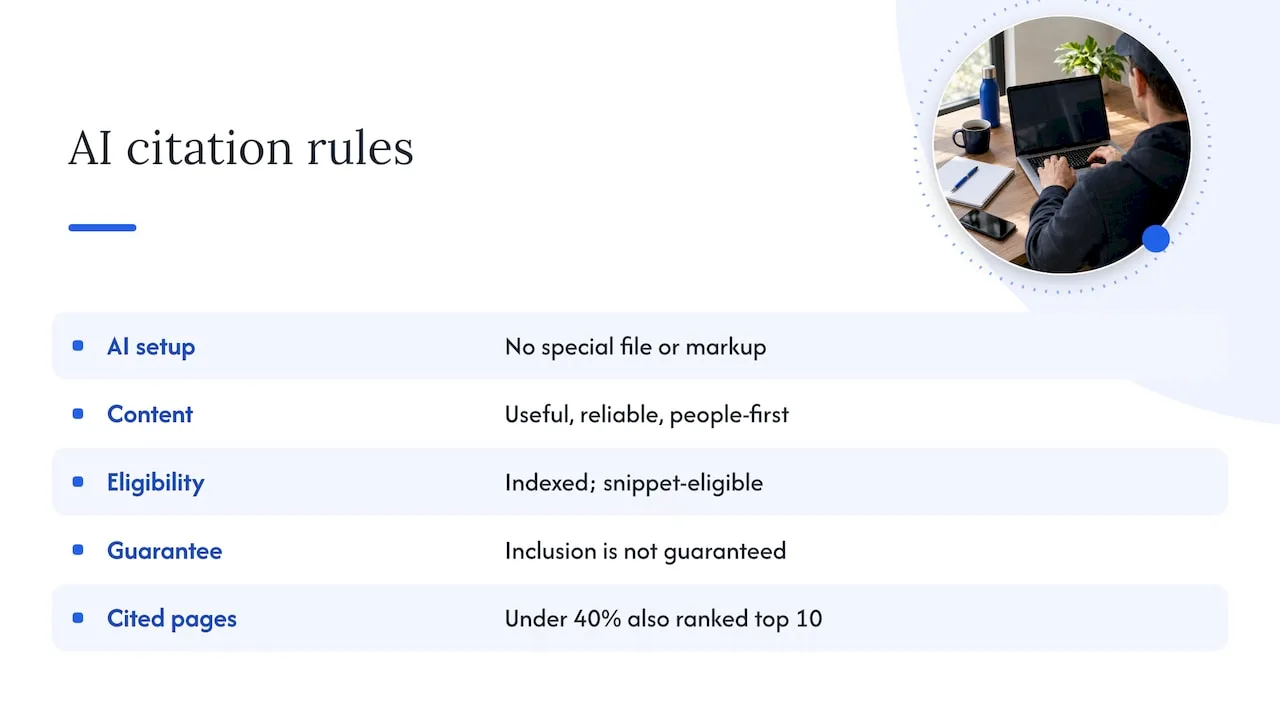
No. Google’s Search Central guide says there is no special AI file and no special markup you need to add for its generative search features. What it keeps recommending is useful, reliable, people-first content and technical accessibility.
The same guide says that to appear as a link in AI features, a page generally has to be indexed and eligible to show a snippet in Search, and that inclusion is not guaranteed. In plain terms: if Google cannot crawl your page, or you have blocked it, it will not be cited.
There is a catch worth planning around. A November 2026 Search Engine Land report notes that a first-page ranking does not guarantee a citation in AI Overviews, and it cites an Ahrefs review finding that fewer than 40% of AI Overview-cited pages also ranked in the top 10 for the same query. Rankings still help. They are just no longer the whole game, so breadth of coverage and original evidence carry more weight.
How homeowners use AI to pick a contractor
The habit is real but still forming. An ACHR News report from October 2026 on a survey of 782 homeowners found that 37% would look for HVAC contractor reviews through AI tools, while 54% would use Google Business Profiles and 45% would use contractor websites (ACHR News). The report does not show a long-term trend, because those questions were new that year.
The takeaway for a contractor is practical. Your Google Business Profile and your website are still the two places most homeowners check, and AI tools draw from the same material. Nobody has to choose between “regular” SEO and “AI” SEO. One set of fixes serves both.
The fixes that make AI tools cite you
Google’s guide points to a short list: create unique, useful, first-hand content, make pages crawlable and indexable, and use Google Business Profiles so local businesses can appear in AI responses and other results. Here is what that means on a contractor’s site, in the order we would work through it.
1. Get the basics indexed and readable
Check that your key pages are not blocked from Google and that each one loads on a phone with a tap-to-call number visible. Google’s Search Console shows which pages are indexed. It also now has a Generative AI performance report that helps you see how people discover your content through Google’s AI features, according to the same Google guide. Pages that Google cannot index cannot be cited, so this comes first.
This is also the point where a slow, template website costs you. Our websites that book jobs are built as lead generation engines, so the page that earns the citation is also the page that captures the call or form.
2. One strong page per service
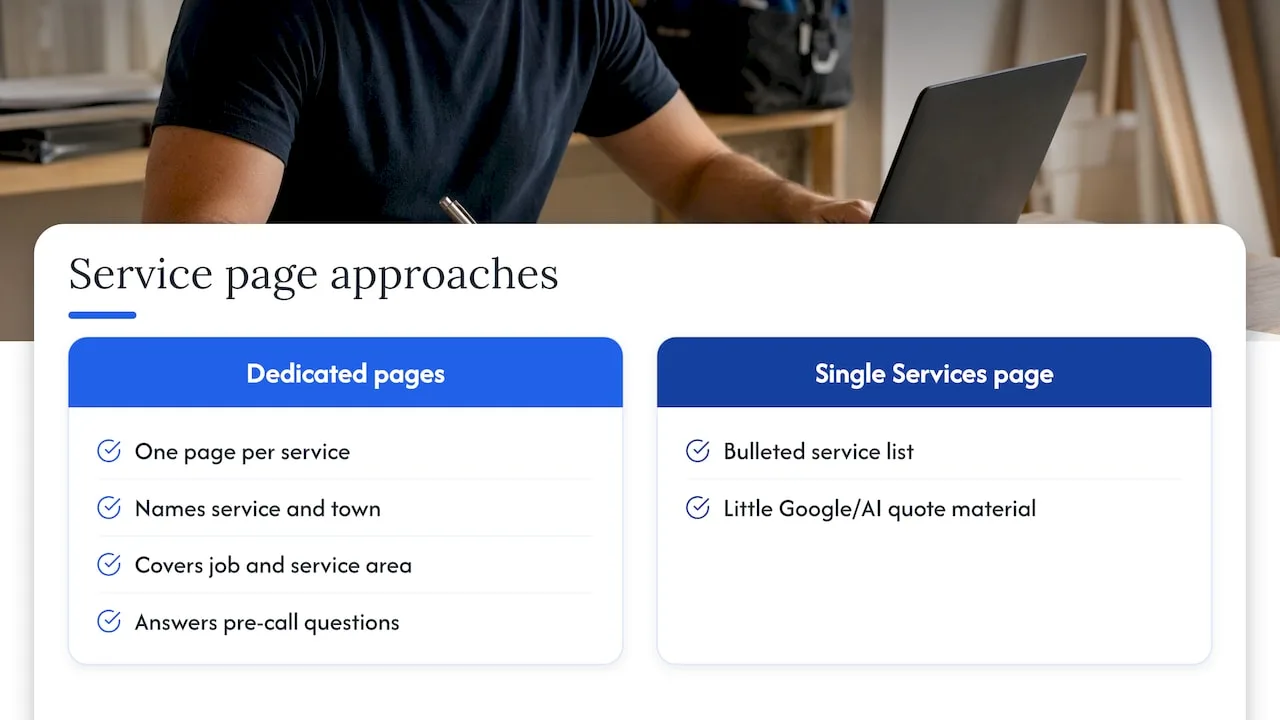
A plumber should have a page for drain cleaning, one for water heater replacement, one for sewer line repair, and so on. Each page names the service and your main town, and covers what is included, how the job goes, the area you serve and the questions customers ask before they call. A single “Services” page with a bulleted list gives neither Google nor an AI tool much to quote.
Write from experience. Describe the job you did in a Warwick basement or a Quincy attic, with real details. First-hand content is exactly what Google says it wants, and it is something a generic AI-generated article cannot fake.
If you want a deeper look at the trade-specific version, our guide on turning HVAC SEO keywords into booked jobs shows how keywords map to pages.
3. City pages only where you have earned them
The temptation with AI tools is to generate fifty near-identical “plumber in [town]” pages in an afternoon. Don’t. Pages that differ only by the town name are the pattern Google’s spam policies treat as doorway abuse. Build a town page only where you have real jobs, photos, reviews and local details such as permit quirks or neighborhoods to put on it. Our resource on service area pages that avoid doorway penalties walks through where the line sits.
4. Treat your Google Business Profile as your second website
For many homeowners the Profile is the first thing they see. Fill it out completely: accurate primary category, services, hours, service areas, photos of real work, and a tracked phone number. Keep the name, address and phone number identical to your website and your listings. Inconsistent details are one of the easiest ways to confuse a search engine, and an AI tool pulling from several sources inherits the confusion.
We cover trade-specific setups in Google Business Profile for HVAC and claiming a plumber Google Business Profile. Landscapers have their own version in local SEO for landscapers.
5. Add accurate structured data
Structured data (schema) is code that tells search engines plainly who you are, where you work and what you do. Google says it requires no special markup for AI features, but accurate business markup still helps machines read your pages correctly. Keep it accurate and matching what is visible on the page. Our guide to local business schema for contractors covers the details, such as coordinates and hours formats.
6. Make trust visible
Show your license number, insurance and years in business. Ask every customer for an honest review, reply to the ones you get, and keep asking. Homeowners read reviews before they call, and AI tools summarize them. Our reviews service automates the request after each job, and our guide to compliant automated review requests shows how to ask within the rules.
What to do first in your trade
The same system applies everywhere, but the first move differs by trade.
| Trade | Where AI visibility is usually won first | Starting point |
|---|---|---|
| Plumbing | Emergency and repair searches, where the call happens in minutes | Google Business Profile, tracked call number, after-hours answering |
| HVAC | Seasonal spikes (heat in winter, cooling in summer) and replacement research | Service pages per system type, review volume |
| Roofing | Higher-ticket research, where homeowners compare several companies | Project photos, reviews, a clear estimate process |
| Electrical | Safety-driven searches and panel upgrades | Service pages per job type, license and insurance shown |
| Landscaping | Seasonal, visual work | Profile photos, reviews, seasonal service pages |
Our roofing lead generation guide is a good next read if you are in that trade.
Visibility is half the job: answer every lead
A citation that produces a call at 7 p.m. and gets voicemail has produced nothing. This is the part most AI SEO pitches skip, and it is where contractors lose the most money.
We pair visibility with systems that catch the lead. Missed-call text-back and CRM sends an immediate text when you cannot pick up. Our AI voice agent handles inbound calls around the clock, and AI website chat responds to visitors on the site. If nights and weekends are a leak for you, our six steps for after-hours answering show how to set it up.
If you run Google’s Local Services Ads as well, speed matters even more, and we explain it in converting Local Services Ads leads in five minutes.
How to measure whether AI SEO is working
Rankings and impressions are easy to report and easy to misread. Measure the things that pay your bills.
- Calls from your Business Profile. Google’s Business Profile performance report counts how many times customers clicked the call button, alongside views, searches and direction requests. Add your phone number so the metric is tracked, and note that the data is updated monthly.
- Tracked calls by source. Use a separate tracking number for your website and your Profile, set up so it does not damage your local listings. Our guide to call tracking that keeps SEO safe lists six checks.
- Booked jobs, not just calls. Record whether each call became an appointment, and each appointment a paid job. A lead that never becomes a booking is a follow-up problem, not an SEO problem.
- Revenue per source. Tie closed jobs back to where the customer found you, so you can see whether the Profile, the website or ads produce your best customers.
- Search Console. Watch which pages are indexed and how people reach you, including the Generative AI performance report Google describes in its guide.
Review this monthly, and judge change over quarters. Local SEO takes weeks to build, and seasonal swings in HVAC or landscaping can look like wins or losses that are really just the calendar. For a structured version, our 90 day AI playbook for local SEO starts with cleaning up your data.
What AI SEO costs
Pricing varies widely by provider, scope and how much is done for you. The honest way to compare is by what is included: pages, profile management, reviews, lead capture and reporting.
Our published plans, read from our pricing page in September 2026, are:
| Plan | Price |
|---|---|
| Foundation | $597 per month |
| Growth | $1,297 per month |
| Scale | $2,497 per month |
Add-ons include an AI employee on Growth at $199 per month, Scale Plus at $249 per month and extra locations from $299 per month. Paid ads management is also available. The pricing page has the full list.
Why we do this only for contractors
We work with contractors in Rhode Island and Massachusetts, and nobody else. That focus changes how we build. We know which towns a Providence plumber actually serves, why a Cape roofer’s calendar looks different from a Worcester electrician’s, and which pages deserve to exist.
Our view is that AI did not replace local SEO. It raised the bar for it. Google’s own guidance keeps pointing to useful first-hand content, accurate business information and a well-maintained profile, and those are the things we build for every trade we serve.
We also think visibility without follow-up is wasted money. That is why our system puts local SEO, AI-powered automation and lead capture in one place: the website that earns the citation, the call handling that answers it, and the review request that follows the job.
Tyson
Where to start
If you want the work done with a local team that knows your trade and your towns, our plans start at $597 per month on Foundation, with Growth at $1,297 and Scale at $2,497. We set up the website, the Google Business Profile, review requests and missed-call handling as one system, so each lead that arrives gets answered.
See the plans and pricing or start from our homepage to see how we work with contractors across Rhode Island and Massachusetts.
FAQ
Is there an AI tool for SEO that contractors can use?
Yes, but no outside tool can see inside Google’s ranking or AI systems. The free data that matters most comes from Google itself: Search Console, including its Generative AI performance report, and the Business Profile performance report. We use AI in our own systems for content support, call handling and follow-up, with a local team directing the work.
Is SEO dead or evolving in 2026?
It is evolving. Google says its generative AI features rest on its core Search ranking and quality systems, so useful pages, accurate business information and a strong Google Business Profile still matter. What has changed is that a first-page rank alone does not guarantee an AI citation.
How much does AI SEO cost for a contractor?
It depends on the scope. Our Foundation plan is $597 per month, Growth is $1,297 per month and Scale is $2,497 per month, with add-ons for extra locations and AI call handling. The right level depends on how many trades, towns and locations you serve.
How long does it take to see results?
Google Business Profile and review improvements can show up in calls within weeks, as our guide to claiming a plumber profile describes with a 4 to 8 week window. Website and service page gains build over months, and seasonal demand can mask early progress.
Sources
- Google Search Central: Guide to optimizing for generative AI features
- Search Engine Land: AI Overviews changed what content needs to do
- ACHR News: homeowner survey on AI and HVAC expertise
- Google Business Profile Help: Understand your Business Profile performance