HVAC PPC management is the work of running paid search ads for your heating and cooling business and keeping them tied to one result: booked jobs, not clicks. The ads are the easy part. What decides your return is what happens after the phone rings or the form comes in: whether the call is answered, whether the page matched the search, and whether you can see which ads produced revenue. We build that whole chain for contractors in Rhode Island and Massachusetts, and this guide shows how it works so you can judge any PPC setup, ours or anyone else’s, by the right measures.
TL;DR
- PPC (pay-per-click) means you pay each time someone clicks your ad on Google. In HVAC, the clicks are expensive, so every missed call or weak landing page costs real money.
- Structure campaigns by service (repair, installation, heat pump, furnace) and by town you can actually serve, with negative keywords to block job seekers and DIY searches.
- Measure cost per booked job and return on ad spend, not clicks or cost per lead.
- Import booked jobs from your CRM back into Google Ads so the system learns which calls were worth buying.
- Fast call answering, missed-call text-back and a page built to book are what make the ad budget pay off. That is where we focus.
Table of Contents
- What HVAC PPC management actually includes
- Why the cost of a click makes everything after it matter
- How to structure an HVAC campaign
- Budget and bidding: what to expect
- The metrics that show whether PPC is working
- Monitoring and optimizing without chasing the wrong numbers
- Where PPC money leaks after the click
- How we handle it for HVAC contractors
- Our perspective
- FAQ
- Sources
What HVAC PPC management actually includes
A managed PPC program is a repeating cycle of six jobs:
- Account and campaign setup: campaigns split by service and area, with call extensions and location targeting.
- Keyword and negative keyword work: choosing the searches you want, and blocking the ones you don’t.
- Ad copy: headlines that match the search and the season.
- Landing pages: a page for each service that makes calling or booking the obvious next move.
- Call and form tracking: knowing which ad, keyword and town produced each lead.
- Reporting and adjustment: weekly changes to bids, budgets and keywords based on booked jobs.
Most owners picture only the first three. The last three are where money is won or lost, and they are the ones that live partly outside the ad account: in your website, your phone handling and your CRM (customer relationship management software, the system that records each lead and what became of it).
Why the cost of a click makes everything after it matter
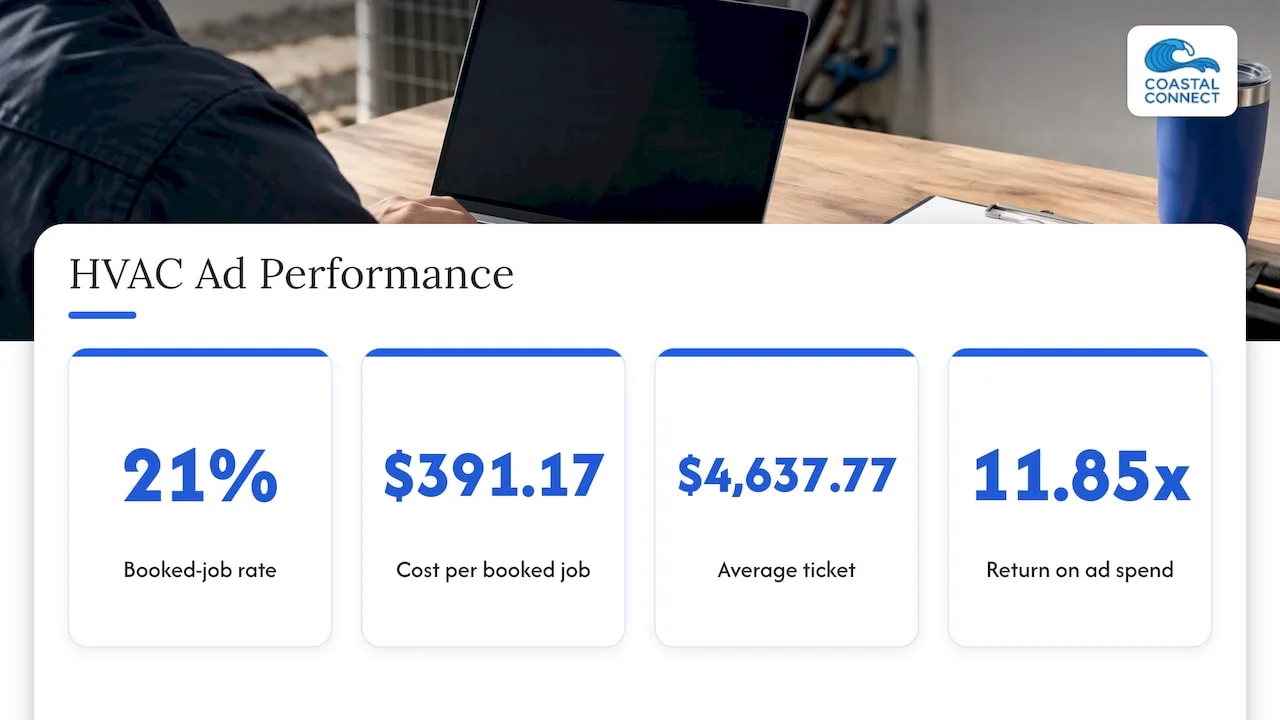
HVAC is one of the pricier categories in paid search. A Google Local Services Ads and Google Ads study of more than 22,000 HVAC leads, reported by ACHR News for November 2021 to June 2022, found a 21% booked job rate, a cost per booked job of $391.17, an average ticket of $4,637.77 and a return on ad spend of 11.85x. Those are US-wide figures from that period, not a promise for your market, but they show the shape of the math: a lead only pays when it turns into a job.
Here is a worked example with round numbers of our own, not a benchmark. You spend $3,000 a month and get 30 leads. If you book 6 of them, you paid $500 per booked job. If better call handling lifts that to 9 booked jobs from the same 30 leads, the same budget now costs about $333 per booked job. Nothing changed in the ad account. The ads did not get cheaper; fewer leads leaked.
That is why the question “who manages my ads?” is only half the question. The other half is “who makes sure each paid lead gets answered and followed up?”
How to structure an HVAC campaign
Split campaigns by service, not by one catch-all
A homeowner searching “furnace not working” is in a different mindset than one searching “new heat pump installation cost.” The first needs a tech today; the second is comparing quotes. Give each its own campaign, budget and landing page:
- Emergency repair: no heat, no AC, furnace repair, boiler repair. Highest urgency, usually the best booking rate.
- Replacement and installation: central air, heat pumps, furnaces. Fewer leads, much larger tickets.
- Maintenance and tune-ups: seasonal, lower urgency, good for filling slow weeks.
Separate budgets keep a flood of cheap tune-up clicks from starving your installation campaign.
Choose keywords that signal intent to hire
Searches with a service and a place, like “AC repair Warwick” or “furnace replacement Worcester,” show someone ready to book. Broad terms like “how does a furnace work” bring readers, not customers. Our guide on turning HVAC keywords into booked jobs walks through the same intent sorting for organic search, and the logic carries straight into paid keywords.
Target only the towns you serve
In Rhode Island and Massachusetts, a 25-mile radius can cross state lines, traffic and your own profitable service area. Target the specific cities and ZIP codes your trucks cover at a sensible drive time. Clicks from a town you can’t reach in a day are pure waste. If you run several locations, keep each location’s campaign and budget separate so you can see which one earns its spend.
Build a negative keyword list on day one
Negative keywords are searches you tell Google never to show your ad for. Start with these groups:
- Job seekers: jobs, careers, hiring, salary, apprenticeship, school.
- DIY and parts: how to, DIY, parts, manual, wholesale, YouTube.
- Out-of-scope: commercial rooftop units if you don’t do them, brands you don’t service, free.
Then review the search terms report every week for the first two months and add new negatives as irrelevant searches appear. Skipping this is among the most common reasons a campaign burns budget.
Send each ad to a page that matches it
Sending every ad to your homepage is a classic mistake. The searcher typed a specific problem; show them that problem on the page, with a tap-to-call button, the towns you cover, proof (reviews, licensing) and a short booking form. Our HVAC website checklist lists 30 checks for a page that books jobs, and the same page can serve both paid and organic traffic.
Budget and bidding: what to expect
HVAC clicks in the US can run into double digits and well beyond, depending on the search, the season and your competition. The cost of a lead depends on your market, your service mix and how you bid. Rather than copy a national number, set your budget backward from the job:
- Decide the cost per booked job you can afford, based on average ticket and margin.
- Estimate your booking rate from your own call records.
- Divide: allowed cost per booked job times booking rate gives the cost per lead you can pay.
- Set the monthly budget so it buys enough leads to learn from, then adjust weekly.
Two things move your cost the most. Competition changes by season, with spikes in heat waves and cold snaps, which we cover in our piece on capturing heat wave HVAC leads. And lead quality changes with how the account is set up. Google’s automated bidding optimizes toward whatever you tell it counts as a conversion. If a conversion is any phone call, it will happily buy short calls.
Pay-per-click versus pay-per-lead formats
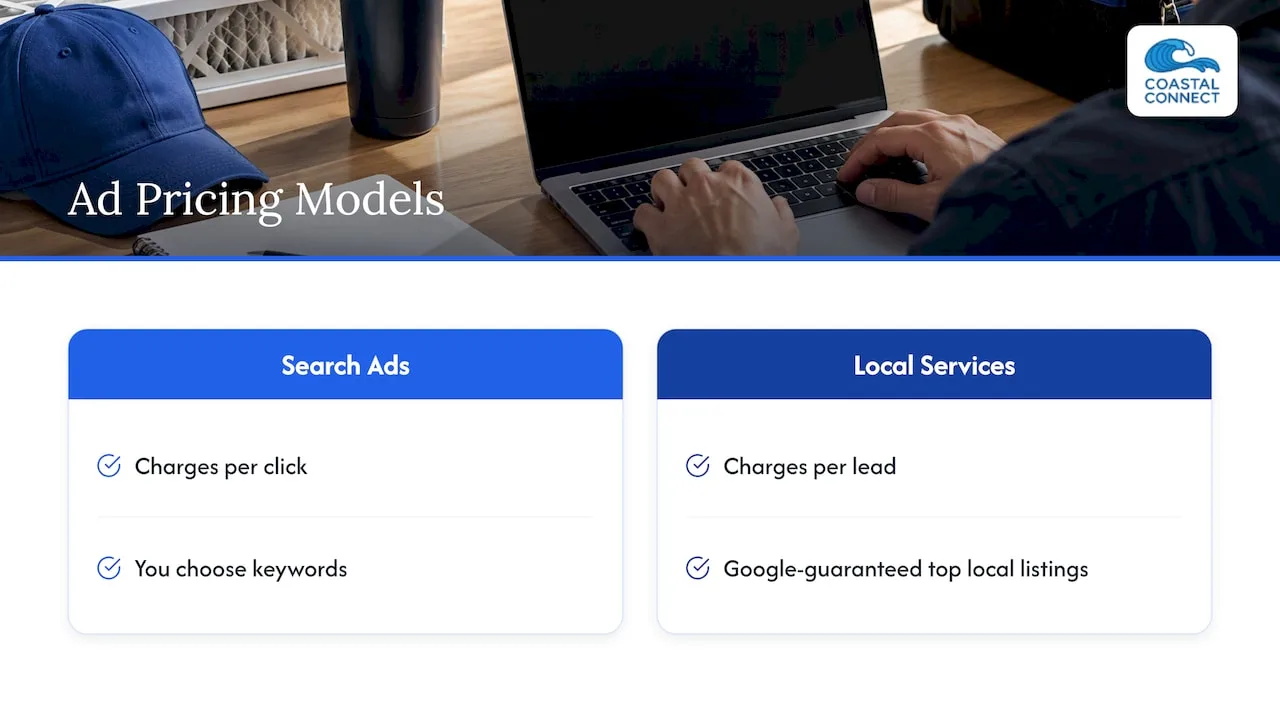
Standard search ads charge per click and you choose the keywords. Local Services Ads, the Google-guaranteed listings at the top of local results, charge per lead instead. Many contractors run both, since they reach customers in different ways. Our Local Services Ads guide covers how to convert those leads in the first five minutes. For a wider look at the channels in home service lead generation, this overview of home service lead generation costs compares what each approach tends to cost.
The metrics that show whether PPC is working
Clicks, impressions and even cost per lead can look healthy while the business gains nothing. Track these instead:
| Metric | What it tells you | How to work it out |
|---|---|---|
| Total leads | Volume from each campaign | Calls, forms and chats, tracked by source |
| Booked job rate | Whether leads are real and answered | Booked jobs divided by leads |
| Cost per booked job | What a job costs you in ad spend | Ad spend divided by booked jobs |
| Average ticket | Value of the work you win | Revenue divided by jobs |
| Return on ad spend (ROAS) | Revenue earned per ad dollar | Revenue from ad leads divided by ad spend |
The ACHR News study above also tracked CRM match rate, the share of ad leads you can find again in your CRM and follow to an outcome. It reported 28%. In plain terms, most leads were never connected to a result, which means most spend could not be judged. If you cannot say which ad produced which job, you are managing by feel.
Monitoring and optimizing without chasing the wrong numbers
Search Engine Land’s home services coverage makes a point that every HVAC owner should hear: monitoring lead quality is critical with automated bidding, otherwise campaigns keep optimizing for three-second phone calls. Its fix is to set a minimum call length, then connect your CRM so booked appointments flow back into Google Ads as offline conversions, meaning sales that happened off the website but are reported back to Google.
This is the single biggest upgrade to most HVAC accounts. We explain the mechanics in our guide to offline conversion tracking for contractors.
A weekly routine that works:
- Monday: check the search terms report and add negatives.
- Midweek: compare booked jobs per campaign, not leads, and move budget toward the winners.
- Friday: listen to a sample of call recordings. Were they answered fast? Did the caller get booked?
- Monthly: compare cost per booked job and ROAS to your target, and refresh ad copy for the season.
Common mistakes
- Sending all ads to the homepage.
- Targeting too wide a service area.
- Ignoring negative keywords.
- Not tracking phone calls.
- Spending without measuring booked jobs.
- Running the same ads all year.
Every one of these is fixable, and most are cheaper to fix than to ignore.
Where PPC money leaks after the click
A paid click reaches you at the moment the homeowner has a problem. If the call goes to voicemail at 7 p.m. or during a job, that homeowner usually calls the next company on the page. You paid for the click and someone else got the job.
Three fixes close most of the leak:
- Answer every call, day and night. An after-hours process matters because emergency heating and cooling calls do not wait for business hours. See our after-hours answering steps.
- Text back missed calls immediately, so the caller stays with you while you finish the job.
- Follow up on every quote. Estimates that go quiet are lost revenue; our proposal follow-up timing and scripts show a cadence that works.
Reviews matter too. A searcher choosing between three ads often picks the company with more and newer reviews, so your ad spend works harder when your profile is strong. Our HVAC Google Business Profile guide covers that side.
How we handle it for HVAC contractors
We work only with contractors in Rhode Island and Massachusetts, and our approach combines local SEO, AI-powered automation and lead capture systems, run by a local team that knows the towns and trades it serves. For PPC, that means the ads are one part of a system built to produce booked jobs:
- Websites that book jobs, so ad traffic lands on a page designed to convert.
- A 24/7 AI voice agent for inbound calls, and missed-call text-back with a CRM, so paid leads are not lost.
- Automated review requests to build the social proof that lifts ad response.
Our plans are Foundation at $597 per month, Growth at $1,297 per month and Scale at $2,497 per month, with paid ads management and other add-ons listed on the pricing page.
If you already run Google Ads and cannot say what a booked job costs, that is the place to start. Talk to us through Coastal Connect and we will look at the path from click to booked job.
Our perspective
Most HVAC owners come to us asking for cheaper clicks. After the first conversation, the real question is usually different: how many of the leads you already pay for end up on the schedule?
We built Coastal Connect around that gap. A contractor in Providence or Worcester does not lose jobs because the ad was badly written. They lose them because the phone rang while the tech was in an attic, because the landing page asked for too much, or because nobody could tell which campaign sent the call.
So we treat paid search as one part of lead capture. The site is designed to book, calls are answered around the clock, missed calls get a text, reviews keep coming, and results are read in booked jobs. Doing this for Rhode Island and Massachusetts trades only means we work in the towns, seasons and service areas our clients actually serve.
Our advice: do not judge any ad program, ours included, by clicks. Judge it by cost per booked job.
Tyson
FAQ
What does HVAC PPC management cost?
There are two costs: the ad spend paid to Google and the management fee. Ad spend depends on your market, season and goals. For our own fees, the Foundation, Growth and Scale plans are $597, $1,297 and $2,497 per month, and paid ads management is listed on our pricing page without a published price.
How long before PPC brings in calls?
Ads can send calls within days of launch, since you are bidding on searches happening now. The first weeks are for learning: which searches convert, which waste money, and which towns book best. Expect to refine the account steadily as booked job data builds up.
Should I run PPC, Local Services Ads or SEO?
They do different jobs. PPC and Local Services Ads put you at the top of the page quickly, while SEO and a strong Google Business Profile build lasting visibility that keeps working. Many HVAC companies use paid ads for urgent demand and local SEO for steady growth. We build both.
What should I ask my PPC manager to report?
Ask for cost per booked job, booked job rate and return on ad spend by campaign, not only clicks and leads. Ask that booked jobs from your CRM be sent back to Google Ads as offline conversions so bidding learns from real results.
Is a landing page really necessary?
Yes. A page for each service, built for mobile with a tap-to-call button and a short form, matches the search and makes the next step obvious. Sending every ad to a homepage usually wastes part of your spend.
Sources
- Google PPC Can Improve Your HVAC Marketing Strategy, ACHR News
- Key PPC ad strategies for home services, Search Engine Land