After hours answering routes calls that come in outside your regular business hours are answered by a live agent or AI system that qualifies the caller, books appointments, and escalates real emergencies to someone on call. It works because it stops calls from dying in voicemail. The right move for most contractors and small service businesses is simple: forward nights and weekends to a managed or AI-backed service, define your emergency criteria up front, and pilot it for a few weeks before committing long term.
TL;DR:
- Most providers offer live answer services with AI backup, capturing lead information and booking appointments directly into your system, not just taking messages.
- Pricing typically involves flat monthly rates with potential setup fees, overage charges, and holiday surcharges, so reviewing historical call volume helps estimate true costs.
- Implementing after-hours answering can be completed within one month by configuring call forwarding, defining emergencies, and testing during peak call seasons.
- Emergency-driven trades and property management see the greatest benefit, especially when missed calls lead to losing customers or immediate safety issues.
- Verify vendor response times, escalation clarity, and references before signing to ensure your provider can deliver quick answers and reliable service.
Table of Contents
- What After-Hours Answering Is and Why It Matters
- Core Features and Capabilities to Expect
- Pricing Models: How Providers Bill and What It Actually Costs
- How to Implement After-Hours Answering: A Step-by-Step Checklist
- Which Industries Benefit Most From After-Hours Coverage
- How to Choose the Right After-Hours Answering Approach
- The Coastal Connect Take on After-Hours Answering
- Get After-Hours Coverage Built Into Your Whole Marketing Stack
- Sources
What After-Hours Answering Is and Why It Matters
After-hours answering covers calls that arrive outside of regular business hours, including evenings, nights, weekends, and holidays, when your office phones roll to silence. It differs from standard 9-to-5 handling in one critical way: nobody on your payroll is there to pick up, so the call either goes to voicemail or to a system built specifically for those hours.
That distinction has real financial weight. Vendors in the live answering space report that many callers sent to voicemail simply hang up without leaving a message. A homeowner with a burst pipe at 11 p.m. isn’t going to wait until Monday. They’re calling the next name on their list.
After-hours coverage pays off fastest in a few specific situations:
- Emergency-driven trades like plumbing, HVAC, and electrical, where the caller needs someone now, not tomorrow
- Property management, where a tenant lockout or heating failure at 2 a.m. can’t sit in a queue
- Any business where a missed call at night routes straight to a competitor’s number
Core Features and Capabilities to Expect
Not every after-hours provider does the same job. Some just take a message. Others qualify the lead, book the job, and wake up the right person if it’s a genuine emergency. Before you sign anything, confirm the service handles:
- Live answer with AI backup. A human or well-trained AI picks up in real time, with fallback logic if call volume spikes.
- Lead capture fields. Name, address, service needed, and urgency level, captured consistently every time.
- Appointment booking tied to your calendar. The service should book directly into your existing calendar or CRM, not just relay a callback request.
- Escalation workflows. Clear rules for what counts as urgent and who gets called, texted, or paged.
- Call logs and transcripts. Your morning team needs a record, not a summary from memory.
- Surge capacity. The ability to handle ten calls at once during a storm or cold snap without dropping any of them.
Pro Tip: Ask any provider to show you a sample call transcript and a sample escalation alert before you sign. If they can’t produce one, that tells you how mature their process actually is.
Pricing Models: How Providers Bill and What It Actually Costs
Traditional answering services typically bill per minute or per call, and many of those billing structures pile on premiums for nights, weekends, and holidays. That structure punishes you exactly when you need coverage most: during a cold front, a holiday weekend, or any stretch when call volume spikes because everyone else’s pipes are freezing too.
Newer AI-driven services tend to flip that model, offering flat monthly pricing regardless of when calls come in. Before you commit to either model, watch for:
- Setup or onboarding fees charged separately from the monthly rate
- Overage charges once you cross a bundled minute allotment
- Holiday surcharges stacked on top of already-elevated night rates
- Minimum contract terms that lock you in before you’ve seen real call volume
To estimate real cost, pull your last three months of after-hours call logs (even just missed-call counts from your phone provider) and multiply by the provider’s rate. Guessing gets expensive fast.
How to Implement After-Hours Answering: A Step-by-Step Checklist
Getting after-hours coverage running doesn’t require a big technical lift. Most contractors can go from decision to live calls in under a month.
- Pick your coverage window. Decide whether you need nights only, weekends only, or full off-hours coverage, and which phone lines forward.
- Set up time-based call forwarding. Your existing business number can route to the after-hours service automatically based on time of day, no new number needed.
- Define emergencies in plain language. “No heat below 40 degrees” or “active water leak” gives the answering team a clear trigger, not a judgment call.
- Write short scripts. Give the service three or four qualifying questions per emergency type, not a script that reads like a legal document.
- Connect your calendar and CRM. Appointments booked overnight should land directly in your existing scheduling system.
- Pilot for two to four weeks. Track real calls, listen to a sample of transcripts, and adjust the escalation rules based on what actually happened.
Pro Tip: Start your pilot during a season you know generates real call volume. A quiet week in April won’t tell you anything about how the service handles a July heat wave.
Which Industries Benefit Most From After-Hours Coverage
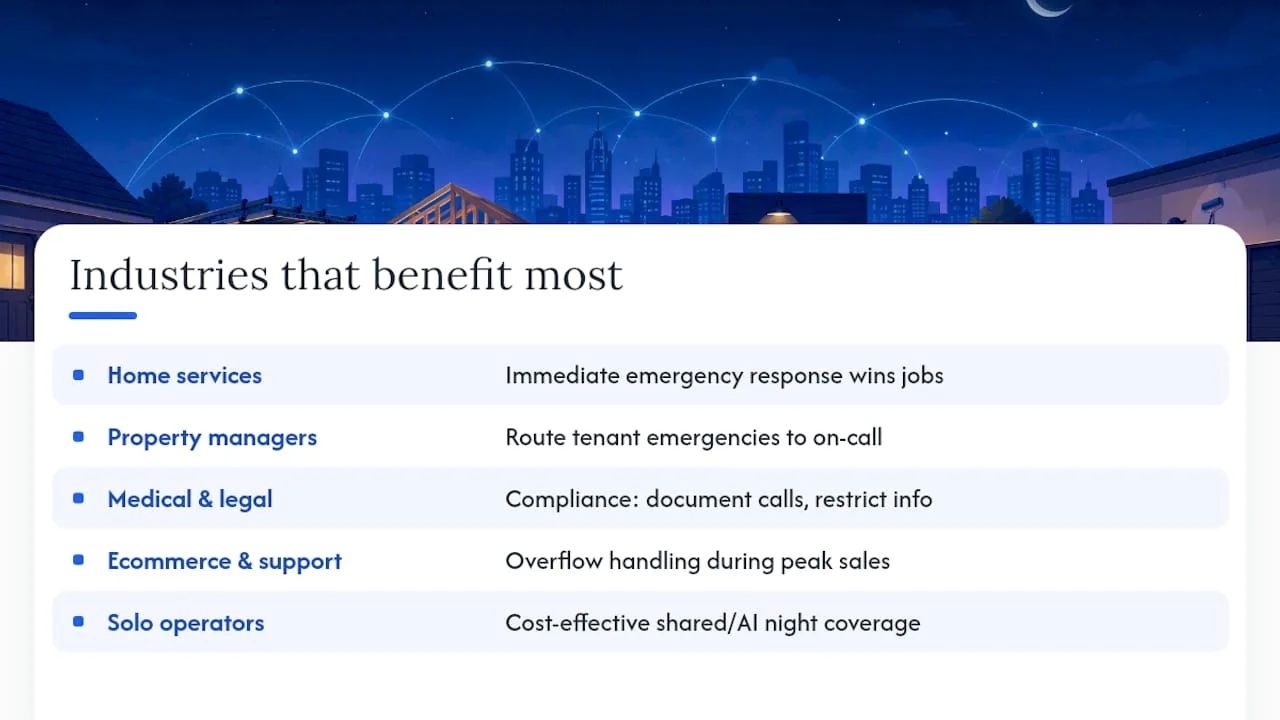
Home service trades see the clearest return, since a burst pipe or a dead furnace can’t wait for business hours and the first company to answer usually wins the job. Property managers rely on after-hours coverage just as heavily, routing tenant emergencies to on-call contractors while non-urgent maintenance requests wait for morning.
Medical and legal practices need a version of this built around compliance, since after-hours service desks in regulated fields have to document handling and limit what gets shared over the phone. Ecommerce and support teams use after-hours answering mostly for overflow during peak sales events, when daytime staff simply can’t keep up. Solo operators get the biggest relative lift: coverage that would cost a full night-shift salary runs a fraction of that through a shared or AI-backed service.
How to Choose the Right After-Hours Answering Approach
Start with five criteria: answer-time SLA, integration depth with your calendar and CRM, the clarity of the escalation protocol, any compliance requirements your industry carries, and how fast the provider can actually get you live. Some vendors advertise pickup in seconds with automatic transfer to an on-call number for defined emergencies. Others quote answer times measured in rings, not seconds. Ask which one you’re getting before you sign anything.
During vendor discovery, ask directly:
- What’s your average answer time, and can you show it, not just claim it?
- How do you decide what counts as an emergency, and who do you call?
- What does onboarding look like, and how long until we’re live?
- Can I see a reference from a business in my industry?
Watch for red flags: vague answers about escalation, pricing that’s only available after a sales call, or no references you can actually verify. Checking independent review platforms before signing gives you a read on reliability that marketing pages won’t.
Launch timelines vary by complexity. A basic setup can go live in one to four weeks, while HIPAA-aware or multichannel integrations often take six to eight. Once live, track three numbers: answer rate, appointments booked, and missed-call reduction compared to your prior baseline. Those three tell you whether the service is paying for itself.
The Coastal Connect Take on After-Hours Answering
Most contractors treat after-hours coverage as an afterthought, something bolted onto a website redesign months later. That’s backwards. Coastal Connect builds high-converting websites and automation for contractors across Rhode Island and Massachusetts specifically because a lead capture form is worthless if the phone behind it goes unanswered at 9 p.m.
The trades this serves best, plumbing, HVAC, electrical, roofing, are exactly the ones where emergency calls spike outside business hours. A missed call at midnight isn’t a missed opportunity when the system is built to catch it.
— Tyson
Get After-Hours Coverage Built Into Your Whole Marketing Stack
Some providers offer integrated solutions combining answering services, websites, and follow-up systems for trade businesses. Instead of stitching three vendors together, you get 24/7 inbound call handling built directly into a website and automation stack designed to capture and convert every lead that comes through it.
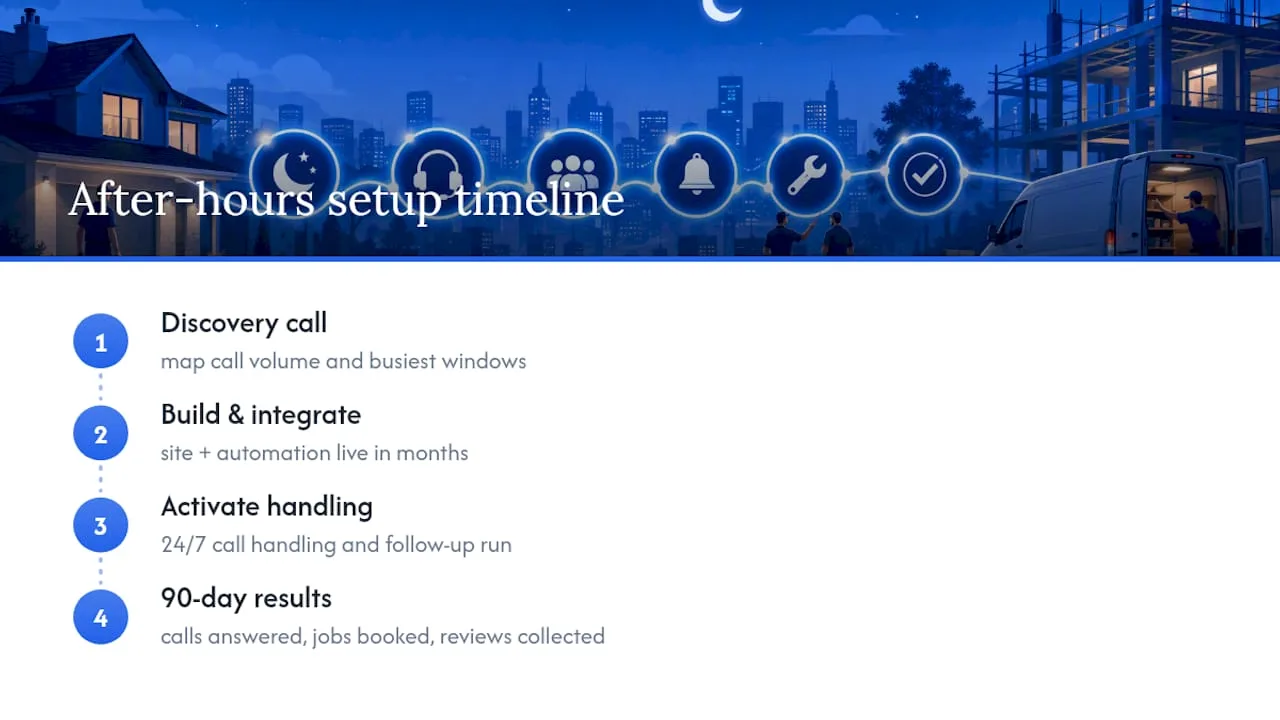
A typical engagement may start with a discovery call to map current call volume, booking process, and busiest after-hours windows. From there, a new site and automation can be live within a few months, with call handling and follow-up sequences running from the start. After about 90 days, users can expect measurable results such as calls answered, jobs booked, and reviews collected.
If you’re tired of losing jobs to voicemail, see how Coastal Connect builds this for contractors and get a plan specific to your trade and your call volume.
Sources
For pricing norms and escalation practices referenced above, see ThrottleNet, GDC IT Solutions, and AfterHoursAnswering.com.