The best local links for a contractor come from people who already know you: your chamber of commerce, your trade association, the suppliers you buy from, the charities you sponsor, and the local press that covers your jobs. Skip bulk directories and paid link packages. In Rhode Island and Massachusetts, a handful of relevant links from real local organizations beats hundreds of generic ones, and it is safer too.
This guide is for plumbers, HVAC techs, electricians, roofers and landscapers who want their website to rank in Providence, Boston and the towns around them. It covers where links fit next to everything else that moves local rankings, ten ideas that work for the trades, what to avoid, and a 30-day plan.
TL;DR
- Links matter, but less than most contractors think for map results. Proximity and reviews explain far more of local ranking than link authority does.
- Aim for relevance over authority: a link from a neighborhood association or town event page beats a high-authority site with no tie to your service area.
- Start with the organizations you already belong to or pay: chamber, builders association, suppliers, manufacturers, sponsored teams.
- Never pay for links, join link networks or list a fake address to get into directories. Both can cost you rankings or your Google Business Profile.
- Pair links with reviews and a tight Google Business Profile, because that is where most of the local ranking weight sits.
Table of Contents
- Where links fit in local rankings
- Links versus citations: what is the difference?
- Ten local link building ideas that work for the trades
- What to avoid
- Our perspective: links are the third step, not the first
- A 30-day plan you can run yourself
- Where we can help
- Local Services Ads and links: separate levers
- FAQ
- Sources
Where links fit in local rankings
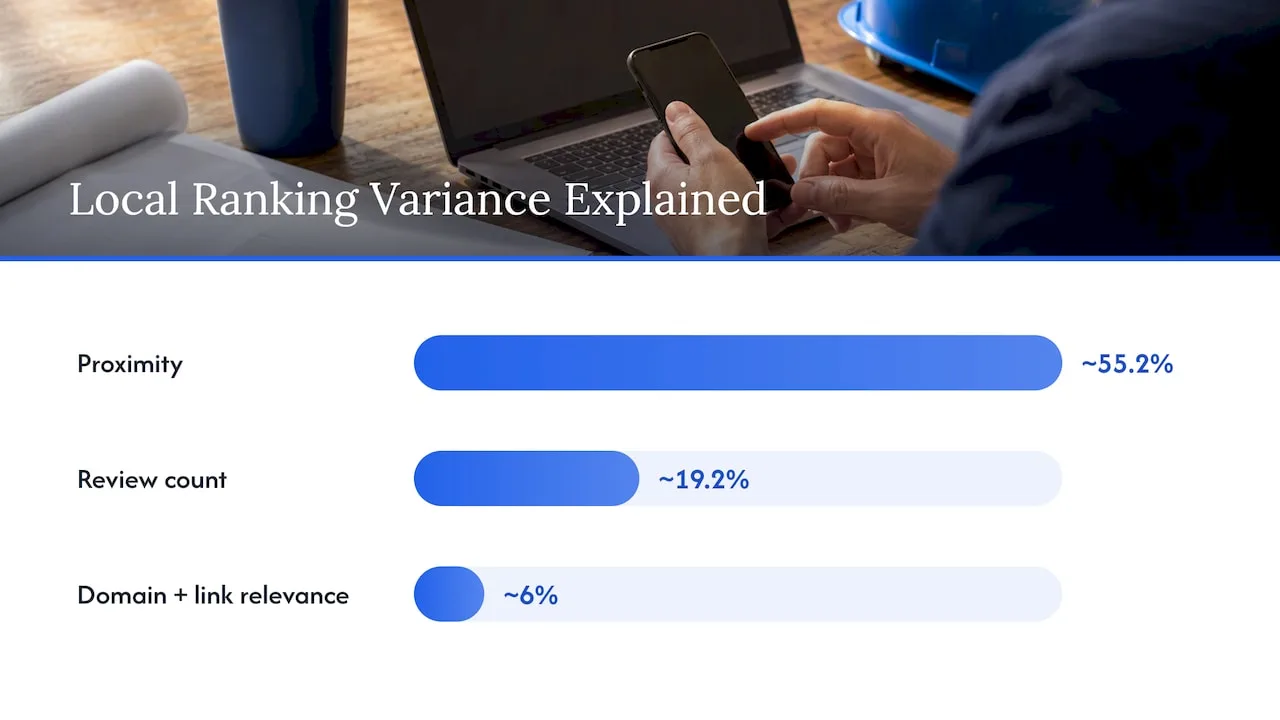
Before spending a Saturday chasing links, know what they do. A Search Atlas analysis from August 2025 found proximity explains about 55.2% of the variance in local ranking and review count about 19.2%. Domain authority and link relevance together accounted for roughly 6%.
That does not make links useless. They still help your website rank in the regular organic results below the map, and they help Google see you as an established business in a specific place. But if you have 12 reviews and a half-filled Google Business Profile, fix those first. Our reviews service exists for exactly that gap.
Links also have a newer job. Analysts argue that mentions on trusted, locally specific sites help a business get cited in AI-generated answers as a legitimate local expert. Treat that as an informed view rather than settled fact, but it points the same direction as everything else here: earn real local mentions.
Links versus citations: what is the difference?
Contractors mix these up constantly.
| Backlink | Citation | |
|---|---|---|
| What it is | A clickable link from another site to yours | A mention of your business name, service and location, with or without a link |
| Example | A link to your site from a Little League sponsor page | Your name and town in a local blog post about a project |
| Main job | Passes authority and referral traffic | Confirms who you are and where you work |
| Risk | Spammy or paid links can trigger penalties | Inconsistent details confuse search engines |
For service-area businesses, citations carry real weight. Guidance for service-area businesses notes that geographic citations, such as a chamber listing or a community blog covering a project, can build city-level relevance even when they are not clickable. Keep your business name, phone number and service area identical everywhere. Then spend your link-building effort on the harder, more valuable backlinks.
Ten local link building ideas that work for the trades
1. Join the chamber of commerce and fill out the profile
Chambers publish member directories sorted by trade. The Northern Rhode Island Chamber of Commerce directory, for example, has categories for electrical contractors, roofing contractors, landscaping and home improvement. A listing there is a relevant, local, human-reviewed link. Use the full profile: description, service towns, photos and your website address, not just a name.
This fits the general rule that a link from a local chamber or regional industry association is worth more than dozens of generic directory stubs.
2. Get listed with your trade or builders association
The Rhode Island Builders Association, founded in 1945, counts home builders, remodelers, suppliers and other building professionals among its members. If you do residential work, membership usually comes with a member listing that points to your site. Massachusetts has its own regional and state builder and trade groups, so check the ones covering your county. Confirm current dues and listing benefits with each association directly.
3. Ask your suppliers and manufacturers
If you install a brand of boiler, panel, shingle or water heater, check whether the manufacturer has a “find an installer” or certified contractor page. Your local supply house may also list customers or run a pro program. These links are relevant by definition, and the audience is people looking to hire an installer.
4. Sponsor something visible and local
Little League teams, high school programs, road races, fire department fundraisers and town festivals usually thank sponsors on their websites. Sponsoring a team in Cranston or Quincy costs a few hundred dollars at most in many cases, and you get a link from a site that real residents visit. Ask for a link to your homepage or your local service page, and make sure the page names your town.
5. Be a good neighbor to local charities
Do a free repair day, donate a roof for a family in need, or run a winterization drive for seniors. Charities and local news will usually link to you. Google has said that reciprocal linking is natural in many cases, so linking back to the charity from your community page is fine. What gets flagged is mass-produced link deals arranged behind the scenes.
6. Pitch the local press with a real story
Local papers, town-focused news sites and neighborhood blogs cover storm response, heating tips during a cold snap, and projects on historic homes. Offer something timely and specific: what nor’easter damage looks like on a roof, why pipes burst in unheated Fall River three-deckers, how to prepare an old Providence panel for an EV charger. Do not pitch “our company is great.”
7. Publish local project pages and case studies
A page titled “Boiler replacement in a Somerville triple-decker” with photos, the problem, the fix and the town name does two things. It ranks for town-specific searches, and it gives chambers, neighbors and local blogs something concrete to link to. Do this for every town you want more work in, within a realistic drive of your base. Guidance for service-area businesses suggests keeping your service area to roughly a two-hour drive to stay credible.
8. Get on local event calendars and neighborhood associations
Analysts describe the current shift as relevance over authority: links from the places your customers actually read. Neighborhood associations, town event calendars and community Facebook-adjacent sites fit. Host a free “how to shut off your main water valve” workshop at a library or senior center and ask for the event listing.
9. Partner with complementary trades
A plumber, an electrician, a general contractor, a real estate agent, a home inspector and a landscaper all share customers without competing. Swap referral pages: “Trusted local partners” on both sites. Keep it to businesses you would honestly recommend. Because these relationships recur, they tend to be the safest links you can earn. Practitioners advise building recurring relationships with local partners over chasing one-off placements.
10. Use the useful directories, ignore the rest
Some directories send actual customers. Yelp is one example: the link may be nofollowed, but the traffic and brand exposure still make it worth maintaining. Claim the big, trade-relevant ones, make your details match, and stop there. Google’s spam policies have grown less forgiving of one-off, low-quality directory footprints, so submitting to 200 sites is a bad trade.
What to avoid
- Paid links and link networks. Local SEO expert Andrew Shotland’s takeaway, as summarized in a grid rank study write-up, is that quality beats volume, and that paying for links invites ranking suppression.
- Fake addresses. Listing a home address or a rented mailbox to qualify for directories can violate Google Business Profile guidelines and risk suspension. If you work at customers’ homes, set a service area and hide your address.
- Generic guest posts. A post on an unrelated national site does little for a plumber in Warwick.
- Inconsistent names. “Smith Plumbing LLC” on one site and “Smith Plumbing & Heating” on another muddies the signals your citations are supposed to send.
Our perspective: links are the third step, not the first
We work only with contractors in Rhode Island and Massachusetts, and the pattern is consistent. The shops that gain the most from link building are the ones whose basics are already solid. Their Google Business Profile is complete, reviews arrive every week, their website has a page for each trade and town, and the phone gets answered.
If the phone goes to voicemail, a new link only sends more people to a missed call. That is why we pair local SEO with missed-call text-back and CRM follow-up and an AI voice agent that handles inbound calls around the clock. Links bring attention. Capture turns it into booked jobs.
On links themselves, our advice is plain. Do the boring local things you would do anyway: join the chamber, sponsor the team, tell your project stories, partner with the electrician you already trust. Do not buy a package of 50 links. In a market as tight as Rhode Island, where everyone seems to know someone, a real local reputation is also the most durable ranking asset you can build.
— Tyson
A 30-day plan you can run yourself
Week 1: Clean up. Make sure your business name, phone and service area match on your site, your Google Business Profile and your main listings. Check that your website has a page for each core service and each town you want more work in.
Week 2: Claim the easy ones. Apply to your local chamber and your trade or builders association. Check each manufacturer you install for an installer locator. Claim the two or three consumer directories that your customers use.
Week 3: Create something linkable. Write up two recent jobs as local project pages with photos and the town name. Plan one community event or free service day.
Week 4: Ask. Email the sponsored team, the charity, two complementary trades and one local reporter. Make each request specific: which page, what to link, and why it helps their readers.
Then track it. Note which links arrived, which pages they point to, and whether calls from those towns rise. If you cannot tell, that is a measurement problem worth solving before you do more outreach.
Where we can help
If you would rather spend your time on jobs than outreach, our Local SEO and Google Business Profile service covers profile optimization, town and service pages, and local citations for Rhode Island and Massachusetts contractors. Our Websites that book jobs build the pages that earn links and turn visits into calls. Plans on our pricing page start at $597 per month for Foundation, $1,297 per month for Growth and $2,497 per month for Scale.
If you work in a specific area, see our pages for Rhode Island and Massachusetts.
Local Services Ads and links: separate levers
Some contractors ask whether Google Local Services Ads replace link building. They do not. Local Services Ads are a paid placement, available to categories such as plumbing and contracting, that put Google Guaranteed listings at the top of local searches. They can fill your calendar quickly. They stop when the budget does, while earned links and reviews keep working. Many shops run both: ads for immediate leads, organic work for the long game.
FAQ
Do contractors really need backlinks to rank locally?
You need some, but fewer than you might expect. Proximity and reviews drive most of the variation in map rankings, so build those first. Then add a few relevant local links to help your website rank in organic results.
Are citations or backlinks more important for a service-area business?
Both matter, in different ways. Citations confirm your name, service and area, and they do not always need a clickable link. Backlinks from relevant local sites add authority and referral traffic. Get your citations consistent first, then earn backlinks.
Is it safe to swap links with other local businesses?
Yes, when it is natural. Google has said that reciprocal linking is fine in many cases, such as linking to a supplier or charity you work with. It becomes a problem when links are traded at scale as a scheme. Link only to businesses you would genuinely recommend.
How much should I pay for link building?
For most local contractors, the best links cost little or nothing: memberships, sponsorships and community work you would do anyway. Paying for links in bulk is the riskiest option, since spam updates are good at spotting low-quality patterns. If you hire help, pay for strategy and outreach, not a guaranteed number of links.
Sources
- Search Atlas: Google Business Profile ranking factors, feature-level analysis
- Indexed: How to do local SEO without a physical address
- GMBapi: What 1,000,000 grid ranks teach us about local SEO
- GMBapi
- Geneo: Hybrid SEO and GEO best practices
- Jasmine Directory: Are directories good for SEO or are they spam?
- Search Engine Journal: Google affirms reciprocal linking is natural in many cases
- Northern Rhode Island Chamber of Commerce member directory
- Rhode Island Builders Association: About
- Google Local Services Ads