
NAP consistency means your business’s Name, Address, and Phone number appear identically everywhere customers and search engines can read them, especially your website and Google Business Profile. The single highest-leverage move is picking one master version of each and syncing your site and profile to match it before touching anything else. That one fix, done right, resolves the majority of local search visibility problems most small businesses never diagnose correctly.
TL;DR:
- Ensuring your business name, address, and phone number match exactly across all listings can significantly improve local search rankings and customer trust.
- The most common inconsistencies include outdated addresses, mismatched phone formats, and conflicting business names or suffixes, often caused by relocations or duplicate listings.
- Auditing your website’s contact details and schema first creates a stable reference point, with corrections typically taking 30 to 120 days to propagate across platforms.
- Fixing major platforms like Google Business Profile, Apple Maps, and Bing Places in order of importance is essential, as they influence the visibility of your other listings.
- Maintaining NAP consistency requires ongoing checks every three months or after significant changes, to prevent old data from re-entering and diluting your local SEO efforts.
Table of Contents
- What Nap Consistency Means In Practice
- Why Nap Consistency Drives Local Rankings And Trust
- Common Nap Mismatches And How To Catch Them
- Step-By-Step Nap Audit You Can Run In 30 To 90 Minutes
- Fixing Nap Errors: What Order And How Long It Takes
- Technical Traps: Schema, Call Tracking, And Multi-Location Setups
- Keeping Nap Consistency After The First Fix
- How Coastal Connect Applies Nap Consistency For Contractors
- A Contractor’s Priority List When Time And Budget Are Both Tight
- A Managed Path To Nap Consistency And Local Lead Generation
- Sources
- FAQ
What Nap Consistency Means In Practice
NAP consistency refers to your business name, address, and phone number matching across the online citations that search engines and customers rely on. It sounds simple until you try to audit it, because “matching” doesn’t mean identical punctuation everywhere. It means no substantive conflicts.
Local SEO professionals often talk about NAP+, which adds your website URL and business hours to the core three fields. During an audit, NAP+ matters because a wrong URL or outdated hours creates the same trust problem as a wrong phone number: it tells a search engine (and a customer) that your listing might be stale.
Here’s where a lot of business owners overcorrect. Google has gotten better at tolerating minor formatting differences like “St.” versus “Street” or “(401) 555-0100” versus “401.555.0100.” Those are cosmetic. What actually hurts you:
- A different phone number entirely (your old landline still listed on Yelp)
- A different suite or unit number (moved offices, forgot to update three directories)
- A different legal business name (LLC suffix on one listing, dropped on another)
- An address from a location you closed two years ago
Your master NAP record should include: the canonical business name exactly as it appears on your storefront and legal documents, any DBA variant you use, the full USPS-formatted address, the phone number in a consistent format, your primary URL, and current hours. Write this down once, in one spreadsheet, before you touch a single directory.
Why Nap Consistency Drives Local Rankings And Trust
Search engines build confidence in a business listing the same way a bank builds a credit score: by cross-referencing data points across independent sources. When your name, address, and phone number agree everywhere, Google’s algorithms treat your business as a verified, stable entity. When they don’t agree, the algorithm has to guess which version is correct, and it often hedges by ranking you lower or suppressing your local pack appearance entirely.
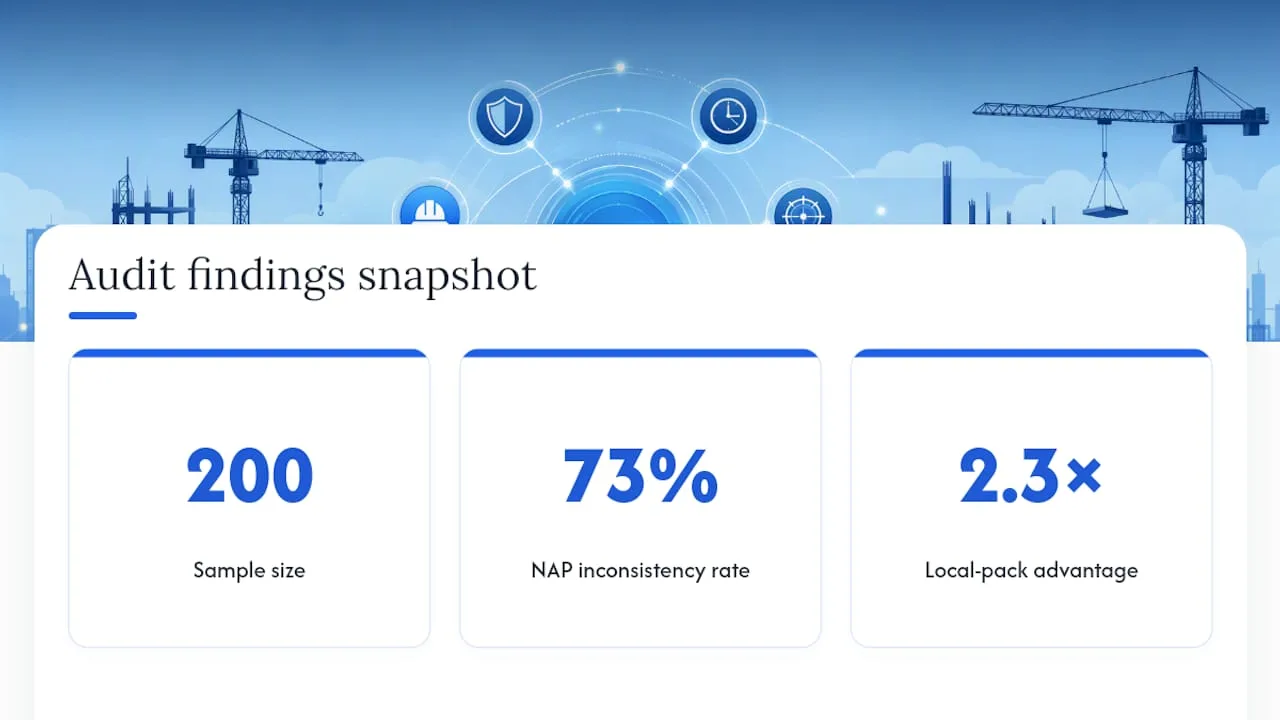
The scale of the problem is bigger than most owners assume. An audit of 200 local businesses found that 73% had at least one NAP inconsistency somewhere in their citation footprint. Businesses with fully consistent NAP data appeared in the local pack roughly 2.3 times more often than competitors with mismatched listings.
That gap isn’t abstract. It’s the difference between showing up when someone searches “plumber near me” at 7 a.m. with a burst pipe, and not showing up at all. A customer who finds two different phone numbers for your HVAC company doesn’t call the second one to check which is real. They call your competitor.
This is why fixing your website’s crawlable NAP and your Google Business Profile comes before any broad citation cleanup. Your website’s contact page and its embedded schema function as the reference document search engines check against every other listing. Get those two right first, and every subsequent fix has a stable target to match.
Common Nap Mismatches And How To Catch Them
Most inconsistencies fall into a short list of repeat offenders. Knowing what to look for cuts audit time dramatically.
- Suite and unit variance. One directory lists “Suite 200,” another drops it entirely, a third says “Ste 2.” Pick one format and apply it everywhere.
- Phone format mismatches, or worse, multiple numbers. Parentheses versus dashes are cosmetic. A completely different number, often left over from a call-tracking campaign or an old provider, is substantive and needs immediate correction.
- Stale addresses after a move. Old locations linger on directories for years because nobody remembers Yelp exists until a customer complains.
- Business name suffix drift. “Smith Plumbing LLC” on your website, “Smith Plumbing” on Facebook, “Smith Plumbing Inc.” on an old directory listing.
- Duplicate listings created by franchise or ownership changes. These generate two competing “correct” versions of your NAP that confuse both customers and algorithms.
To spot these quickly, search your business name plus city in Google and scan the knowledge panel against your top five directory results. Call every phone number you find listed publicly, including old ones, to see which still ring through. Check your website’s contact page source code for a tel: link and confirm it matches your Google Business Profile primary number exactly.
Step-By-Step Nap Audit You Can Run In 30 To 90 Minutes
- Build a master NAP spreadsheet first. Fields: canonical name, DBA, USPS-formatted address, phone in a consistent format (use E.164, like +14015550100, if you’re implementing schema), primary URL, current hours, and who owns the login for each platform.
- Audit your website first. Check the contact page text and the JSON-LD schema behind it against your spreadsheet.
- Check Google Business Profile second. This is your single source of truth for everything downstream.
- Move to Apple Maps, then Bing Places, then Yelp, then Facebook. These carry the most customer traffic after Google.
- Finish with your top three to five industry directories relevant to your trade (HVAC, plumbing, electrical, or roofing associations often run their own listings).
- Run a final search-result scrape. Google your business name and city, and note every discrepancy that surfaces in the knowledge panel or map pack.
For every mismatch you find, document the platform, the wrong value, the customer risk (a dead phone number is higher risk than a missing suite number), and whether you need to claim, merge, or mark a duplicate as closed.
Pro Tip: Duplicates are the silent killer here. If you find two Google Business Profile listings for the same location, don’t just update one. Request a merge through Google or mark the outdated one closed, or the algorithm keeps splitting your review count and local signals between two competing entities.
Fixing Nap Errors: What Order And How Long It Takes
Fix your website and its schema first, then Google Business Profile, then the major platforms, then niche directories. This order matters because everything downstream gets checked against your site and your profile.
- If you don’t have login access to an old listing, most platforms have a formal claim or ownership-transfer request process. Use it rather than creating a duplicate.
- Keep your real phone number as both the GBP primary number and the number in your website’s crawlable HTML. If you use call tracking for attribution, restrict dynamic number insertion to sessions that aren’t crawled by search bots.
- Once you’ve made corrections, expect them to take time to show up everywhere. Propagation across the web typically takes 30 to 120 days, and ranking improvements from consistency fixes commonly appear in 60 to 90 days.
- Recheck your top directories at the 30 day and 90 day marks to confirm updates actually stuck, since some platforms silently revert edits pulled from third-party data aggregators.
Technical Traps: Schema, Call Tracking, And Multi-Location Setups
A few technical details cause more damage than the basic listing errors above, mostly because they’re invisible unless you know to check.
- Your Schema.org LocalBusiness JSON-LD must list the exact same telephone, address, and URL fields as your Google Business Profile, and mismatches here are a frequently overlooked source of inconsistency that plain-text audits miss entirely.
- Call tracking numbers should never appear in a crawlable
tel:link or as your GBP primary number. Dynamic Number Insertion that swaps numbers at the session level, while keeping your real number in the HTML search engines see, avoids this trap. - Multi-location businesses need separate GBP listings, unique phone numbers per location, and distinct schema
@idvalues so search engines don’t merge or confuse locations. - Service-area businesses need identical service-area values on both GBP and the website, without exposing a private home address unnecessarily.
Pro Tip: If you’re a service-area roofer or electrician working from a home office, list your service area consistently but never publish your home address as a public storefront location. Doing so both compromises privacy and confuses Google’s map-pack logic about where you actually operate.
Keeping Nap Consistency After The First Fix
A one-time cleanup fades without maintenance. Data ages, employees leave, phone providers switch, and third-party aggregators pull stale records back into circulation.
- Run a full re-audit quarterly at minimum, and monthly if you compete in a crowded local market.
- Trigger an immediate audit any time you move locations, change phone providers, or rebrand.
- Track a simple NAP consistency score, your duplicate listing count, local pack appearance frequency, and how many of your top ten directories currently show a live mismatch.
- For tools, start with free manual checks (Google search plus a GBP dashboard review) for a single location. Paid citation audit tools earn their cost once you’re managing multiple locations or don’t have the internal time for quarterly manual sweeps.
How Coastal Connect Applies Nap Consistency For Contractors
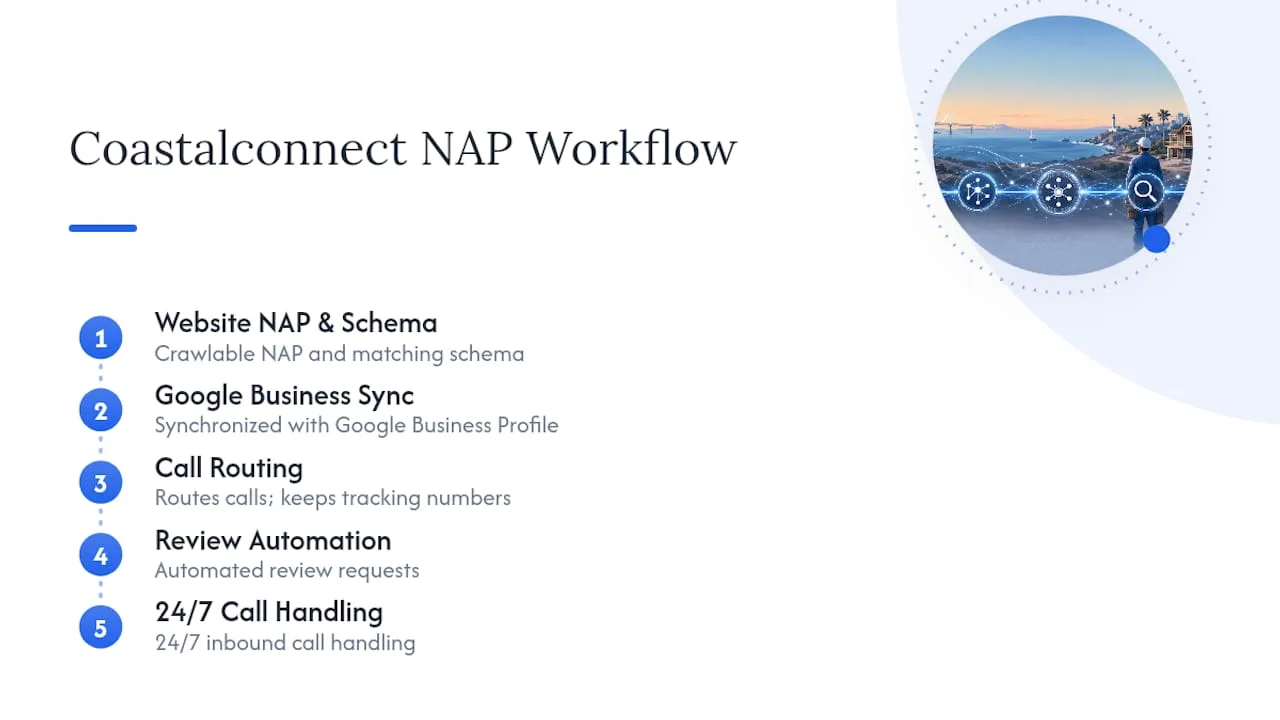
For contractors, NAP work isn’t a one-time cleanup. Coastal Connect builds crawlable NAP and matching schema directly into every website that books jobs, syncs it with the Google Business Profile, and routes calls correctly so tracking numbers never break the chain. That NAP foundation pairs with automated review requests and 24/7 inbound call handling, so the consistency work actually protects the leads it’s meant to capture.
A Contractor’s Priority List When Time And Budget Are Both Tight
Fix your website’s crawlable NAP and Google Business Profile alignment first. Short on time? Chase phone and address mismatches before cosmetic ones. Short on budget? Fix the platforms your customers actually use, not every directory that exists. If you want a managed, done-for-you rollout instead of DIY spreadsheets, that’s when it’s worth a conversation.
— Tyson
A Managed Path To Nap Consistency And Local Lead Generation
If you’d rather not spend a Saturday cross-referencing eight directories, Coastal Connect handles the whole rollout, and does it as part of a system built specifically for contractors in Rhode Island and Massachusetts rather than as a one-off cleanup.
The advantage isn’t just fixing your listings. It’s that Coastal Connect’s local SEO and Google Business Profile service builds crawlable NAP, matching schema, and correct call routing into a system that also handles missed-call text-back, review requests, and 24/7 inbound answering, so the consistency work directly protects the leads it generates instead of sitting as a standalone technical task. DIY works fine if you have the hours and the discipline to recheck quarterly. A managed approach makes sense once you’d rather spend that time on jobs than on directory logins.
Coastal Connect’s plans start with Foundation at $597 per month, scaling up through Growth and Scale for contractors who need more locations or deeper automation. If you’re ready to see what a synced, audited NAP footprint looks like for your trade, the pricing and service details are the place to start.
Sources
- What is NAP in Local SEO?
- NAP Consistency Checker 2026: We Audited 200 Local Businesses. 73% Had Citation Inconsistencies Hurting Rankings.
- NAP Consistency: Why Your Business Details Must Match Everywhere (Local SEO NAP) - Shortlist
- NAP Consistency 2026 — Step-by-Step Business Data Audit
FAQ
What Is Nap Consistency?
NAP consistency means your business name, address, and phone number appear identically across your website, Google Business Profile, and other directories. Minor formatting differences are fine; conflicting phone numbers or addresses are not.
How Do I Check My Nap Consistency?
Search your business name and city on Google, then compare the knowledge panel against your website, Google Business Profile, Apple Maps, Bing Places, and Yelp. Call every phone number you find to confirm which ones are still active, and check your website’s schema against your Google Business Profile fields.
What Does Nap Stand For In Local Seo?
NAP stands for Name, Address, and Phone number, the three core identity fields search engines use to verify a local business exists and operates where it claims. Some audits extend this to NAP+, adding website URL and hours.
How Do I Improve My Nap Consistency?
Start by fixing your website’s crawlable contact information and schema, then align your Google Business Profile to match, since that sequence gives every other platform a stable reference point. From there, work through Apple Maps, Bing Places, Yelp, and your top industry directories, expecting corrections to fully propagate within 30 to 120 days.
Can Poor Nap Consistency Hurt Customer Trust?
Yes. A customer who finds two different phone numbers or addresses for the same business often assumes one listing is outdated or fraudulent, and calls a competitor instead. Businesses with consistent NAP data also appeared in the local pack about 2.3 times more often than businesses with mismatches, which compounds the trust problem with a visibility problem.