Optimize your Google Business Profile and build service-specific pages before touching anything else. That combination generates calls within weeks, while steady reviews and location pages compound into organic growth over the following months. Google Business Profile rewards complete, active profiles with map pack visibility. A firm like Coastal Connect builds these systems for contractors who don’t have time to chase it themselves.
TL;DR:
- Prioritize optimizing and verifying your Google Business Profile with specific categories and consistent photos for faster visibility gains.
- Focus on creating targeted service, location, project, and seasonal pages accurately, publishing them 60 to 90 days before demand peaks.
- Maintain a steady review flow by asking for reviews immediately after jobs and responding promptly to enhance local ranking signals.
- Ensure your business information is consistent across high-value directories like Houzz, Yelp, and Nextdoor, and fix mismatches quarterly.
- Expect initial results within three to six months, with organic growth and lead flow improving significantly after a year of consistent effort.
Table of Contents
- Why Local SEO Matters for Landscaping Companies
- Google Business Profile Optimization: Categories, Photos, and Activity
- Keyword Research for Landscapers: Which Terms Actually Convert
- Which Website Pages Turn Visitors Into Calls?
- How Do You Build Review Velocity That Converts?
- Citations, NAP Consistency, and Which Directories Matter
- When Should You Publish Seasonal Landscaping Content?
- What KPIs and Timeline Should You Expect?
- Common Landscaping SEO Mistakes and the Fastest Fix Order
- What Actually Moves the Needle in Landscaping SEO
- How Coastal Connect Turns This Playbook Into Booked Jobs
- Where to Verify This Information
- Sources
- FAQ
Why Local SEO Matters for Landscaping Companies
A homeowner searching “landscaper near me” on a Saturday morning isn’t browsing. They want a quote by Monday. That’s what makes local search different from most marketing channels: the buyer intent is already baked in, and the map pack is where those leads land first.
Map pack leads and organic website leads work together rather than competing. Someone might spot your business in the map pack, click through to your site to check pricing and past projects, then call. Miss either piece and you lose the job to a competitor with a tighter setup.
Here’s what separates independent landscapers who outrank national directories:
- Consistent, specific service categories instead of vague “landscaping services” listings
- Location pages that name actual neighborhoods and towns, not just a city
- Review volume that keeps climbing month over month
- Photos that show real crews and real yards, not stock imagery
National directories can’t match that specificity at scale. A focused local profile beats a generic listing almost every time.
Google Business Profile Optimization: Categories, Photos, and Activity
Your Google Business Profile is the single highest-leverage asset in landscaping local SEO. Google’s own guidance confirms that complete and accurate profile information increases your odds of showing up for relevant local searches, and verification signals that you’re authorized to represent the business at all.
Work through this sequence:
- Claim and verify your listing through Google, using a real business address or your defined service area.
- Choose one primary category that matches your core offering (Landscaper, Landscape Designer, or Lawn Care Service) and add secondary categories like Tree Service or Irrigation only if you actually do that work.
- Set your service area accurately. If you don’t have a public storefront, hide your address and list the towns you cover instead of guessing at a radius.
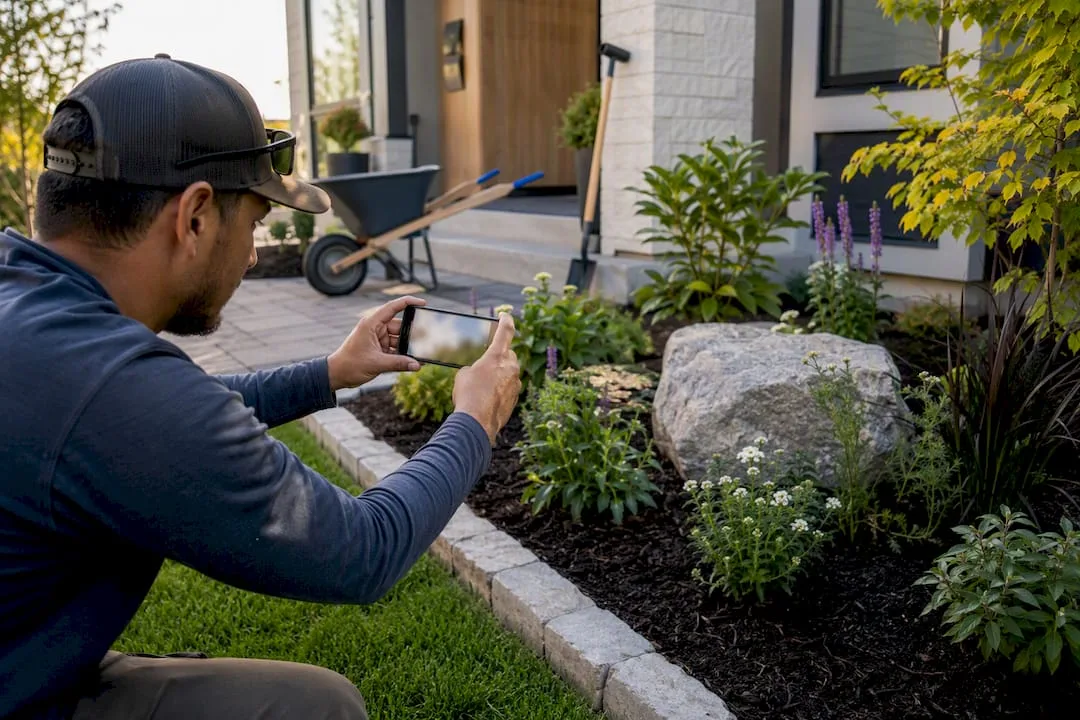
- Upload photos weekly: exterior job shots, crew at work, and before/after pairs with brief captions describing the project and location.
- Fill out the Services section line by line and post updates at least twice a month; answer every question in the Q&A section, even the ones you plant yourself.
Google recommends adding category-specific photos because they help customers evaluate a business before ever visiting the website. For landscapers, that means real dirt under real fingernails, not a sunset stock photo of a manicured lawn nobody on your crew has touched.
Pro Tip: Batch your photo uploads. Have whoever runs the crew snap five photos at every job site, then load them into GBP every Friday. Consistency matters more than perfection.
Keyword Research for Landscapers: Which Terms Actually Convert
Not every keyword deserves equal attention. Rank them by how close the searcher is to hiring, not by search volume alone.
- Service plus location terms (“landscape design in [town],” “retaining wall installation [town]”) capture people who already know what they want and where they live.
- Cost and pricing queries (“how much does sod installation cost,” “average price for a paver patio”) convert unusually well because homeowners typing price terms are already comparing quotes and ready to call.
- How-to content that funnels to a service (“when to aerate lawn in New England”) builds trust with people who eventually hire out the job once they realize the effort involved.
- Seasonal modifiers (“spring cleanup,” “fall leaf removal,” “irrigation startup”) catch demand spikes tied to the calendar.
Prioritize buyer-intent phrases first, then narrow by local specificity, then weigh difficulty last. A low-volume phrase like “drainage solutions [your town]” often beats a high-volume, low-intent phrase like “landscaping ideas,” because the second one attracts browsers, not buyers.
You don’t need an expensive toolset to run this. Google’s autocomplete, the “People also ask” boxes, and a basic keyword tool checked quarterly will surface most of what you need. Revisit your list every three months, since seasonal demand shifts and new services (mosquito treatments, holiday lighting) create fresh opportunities worth targeting.
Which Website Pages Turn Visitors Into Calls?
Generic “our services” pages rarely rank and rarely convert. Landscapers who win local search build focused pages instead, and the data backs that structure: practitioner research recommends 5 to 20 targeted service, location, and project pages as the sweet spot for most independent landscaping companies.
Four-page types do the heavy lifting:
- Service pages (one page per service, not one page for all of them): scope of work, materials used, typical timeline, a price range if you’re comfortable sharing one, and a clear call-to-action.
- Location pages: unique local detail specific to that town (soil type, HOA quirks, common drainage issues), plus real project examples from that area. Swapping only the town name across identical pages creates thin duplicate content that hurts more than it helps.
- Project pages: before-and-after photos, a scope summary, how long the job took, and an approximate cost band so future customers can self-qualify.
- Seasonal pages: published 60 to 90 days ahead of demand and refreshed annually rather than rebuilt from scratch.
That 60 to 90 day publishing window matters enough to repeat: it’s the difference between ranking when someone searches “spring cleanup near me” in March and posting the content in March, when it’s already too late to catch the search spike.
How Do You Build Review Velocity That Converts?
Total review count matters less than most landscapers assume. Review velocity, meaning a steady flow of new reviews every month, tends to be a stronger local ranking signal in competitive markets than a big static total sitting untouched for a year.
Build a repeatable process:
- Ask for the review in person, right after the final walkthrough, while the client is still looking at finished work.
- Send a direct review link by text or email within 24 hours, before the memory fades.
- Send one polite reminder at day three and a final one at day seven if there’s no response.
- Automate the ask-and-remind sequence wherever possible so it doesn’t depend on someone remembering to do it.
Respond to every review, positive or negative, within 48 hours. Thank the good ones by name-checking the project. For a negative review, acknowledge the specific complaint, offer to make it right offline, and skip the defensive tone. Aim for at least 4 to 8 new reviews a month and a response rate close to 100%.
Pro Tip: A negative review handled well often does more for conversions than five generic five-star reviews. Prospects read the response, not just the rating.
Citations, NAP Consistency, and Which Directories Matter
NAP consistency means your business Name, Address, and Phone number read identically everywhere they appear online. The most common failure points: a tracking phone number that doesn’t match your GBP listing, an old address still live on a directory, or a “DBA” variant (Smith Landscaping vs. Smith Landscaping & Design) splitting your citations across two entities.
Prioritize quality over sheer directory count:
- Houzz and Yelp for general contractor credibility
- Nextdoor for hyper-local trust with homeowners in your service towns
- State or regional landscaping association directories, which carry industry-specific weight
Run a quarterly audit: search your business name plus phone number, note every listing that surfaces, and fix mismatches starting with the highest-traffic sites first. Google has been direct about this: there’s no way to pay for a better ranking, and prominence is shaped by real signals like links and reviews, not directory volume.
When Should You Publish Seasonal Landscaping Content?
Timing is everything with seasonal pages. Publish 60 to 90 days before the season actually starts so Google has time to index and rank the page before the demand spike hits.
- Late winter (January to February): spring cleanup and mulching pages
- Early spring (March): irrigation startup and planting service pages
- Mid to late summer (July to August): fall prep, aeration, and overseeding pages
- Fall (October): snow removal and holiday lighting pages, depending on your region
Reuse the same URLs year to year instead of building new pages every season. Update the content with fresh photos, current pricing, and this year’s availability dates rather than publishing a near-identical duplicate page under a new slug. That keeps the accumulated ranking authority intact instead of starting from zero every twelve months.
What KPIs and Timeline Should You Expect?
Track these numbers weekly, not quarterly, so you catch a slide before it becomes a real problem:
- GBP discovery searches and profile views
- GBP-generated calls and direction requests
- Organic website clicks from search
- Phone calls and quick-quote form submissions
- New reviews per month
Timeline expectations, realistically: 0 to 3 months is foundational work (profile cleanup, page builds, citation fixes) with little visible movement. 3 to 6 months typically brings the first real lifts in calls and map pack position. 6 to 12 months is where reviews, pages, and citations compound into steady organic lead flow. Given that many landscaping searches still surface no clear local recommendation on AI and discovery platforms, an early, complete profile gives you a head start competitors without one simply don’t have.
Common Landscaping SEO Mistakes and the Fastest Fix Order
Most landscapers lose ground to the same five mistakes: an incomplete GBP, inconsistent NAP across directories, thin location pages that just swap a town name, no structured review process, and a slow-loading mobile site that visitors abandon before it finishes loading.
Fix them in this order:
- Complete and verify GBP first. It’s the fastest win and the foundation everything else builds on.
- Fix your review process second, since reviews influence both ranking and conversion.
- Fix site conversion third: make your phone number visible on every page and add a quick-quote form above the fold.
- Run the citation audit fourth to clean up NAP mismatches once the bigger levers are in place.
If you’ve worked through this list and calls still aren’t climbing after three or four months of consistent effort, that’s usually the point to bring in a specialist rather than keep guessing.
What Actually Moves the Needle in Landscaping SEO
Most landscaping SEO advice treats every tactic as equally urgent, and that’s the wrong mental model. GBP completeness and review velocity do more work than a technically perfect website with zero reviews and a half-filled profile. The businesses that pull ahead aren’t the ones with the fanciest site; they’re the ones who post a photo every week and ask for a review after every job, without fail.
The mistake I see most often isn’t skipping SEO entirely. It’s front-loading the site build and treating the profile and reviews as an afterthought, when the order should run the other way. Conversion-focused websites are key because a slow, phone-hidden site can undo the calls that GBP and reviews just generated.
— Tyson
How Coastal Connect Turns This Playbook Into Booked Jobs
Reading a checklist and executing it every week while running crews and bidding jobs are two different things. That’s the gap Coastal Connect exists to close for landscaping business owners in Rhode Island and Massachusetts.
The service mapping is direct: Local SEO & Google Business Profile handles the categorization, photo cadence, and posting schedule covered above. Reviews that keep coming automates the ask-and-remind sequence so review velocity doesn’t depend on someone remembering to send a text after every job. Websites that book jobs fixes the mobile conversion problem with a prominent phone number and a quick-quote form on every page, and the missed-call text-back system through Missed-call text-back & CRM catches the calls your crew can’t answer while they’re on a job site.
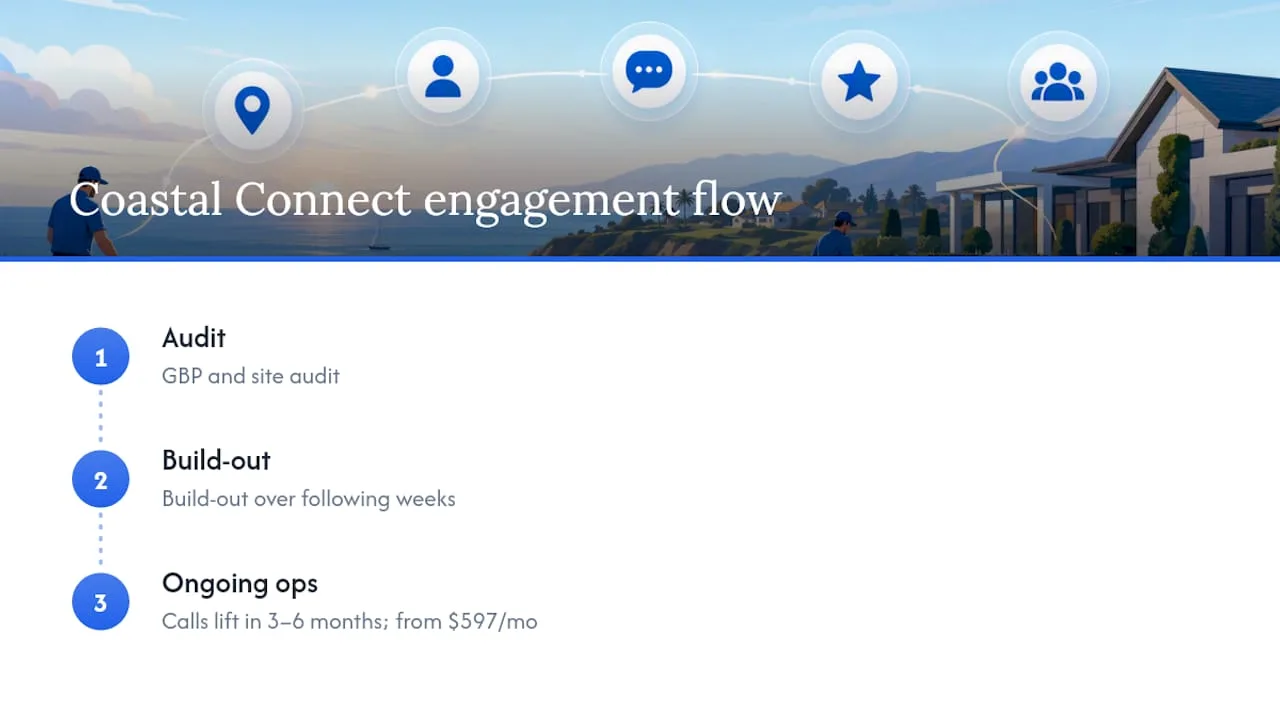
A typical engagement starts with a GBP and site audit, then moves into build-out over the following weeks, with the first measurable lifts in calls showing up in the 3 to 6 month range described earlier. Plans start at Foundation for $597 per month, scaling up as your call volume and service area grow. If you’d rather have a local team run this system than build it yourself, get in touch through Coastal Connect and ask for a profile and site audit.
Where to Verify This Information
For the official rules behind everything in this guide, start with Google’s own local ranking guidance and its breakdown of the factors behind local ranking, including verification and profile completeness. For photo standards specifically, see Google’s guide on adding photos to your profile. For page-structure and timing benchmarks, the practitioner research at Refact and the pricing-query conversion insight from Rank on Repeat both back the recommendations above.
Sources
- Tips to improve your local ranking on Google - Google Business Profile Help
- SEO for Landscaping Companies That Books Jobs | Refact
- Florida Landscaper AI Visibility Study | Local Vitals
FAQ
How Much Should I Pay for Local SEO?
Pricing varies widely by market size and how much work your GBP and site currently need. Coastal Connect’s plans start at $597 per month for Foundation, with Growth and Scale tiers available as your service area and call volume expand.
Is $100 an Hour Too Much for Landscape Work?
That question is about labor pricing, not SEO, and rates depend heavily on region, job complexity, and local competition. If you’re publishing pricing pages for your own services, list a range rather than a flat number so it stays accurate across job types.
Is Local SEO Worth It for a Landscaping Business?
Yes. Local searches carry strong buyer intent, and a complete, active Google Business Profile combined with steady reviews consistently outperforms a bare-bones online presence in map pack visibility and calls.
Is SEO Still Worth It in 2026?
It’s arguably more important now, since research shows many landscaping searches on AI and discovery platforms still surface no clear local recommendation at all. An active, photo-rich profile with real reviews gives you a visibility edge competitors without one won’t have.
How Long Does Landscaping Local SEO Take to Work?
Expect foundational work in the first 0 to 3 months, initial lifts in calls and map pack position between 3 and 6 months, and compounding organic growth from 6 to 12 months onward as reviews and pages accumulate.