

A contractor website costs anywhere from about $1,800 to $14,000 to build, depending on the trade, the number of cities you serve and whether it connects to your booking system. The build is only part of the bill. Search work, call handling and review requests are what turn visitors into booked jobs, and they are monthly costs. That is why we price Coastal Connect as a monthly plan, from $597 per month, instead of a one-time build followed by a pile of add-ons.
This guide breaks the cost into its real parts so you can read any quote, ours or anyone else’s, and know what you are buying.
TL;DR
- Build costs vary widely. For HVAC, one June 2026 dataset puts the full range at $1,800 to $14,000, with most contractors landing between $3,500 and $6,500.
- Booking and dispatch integration is a separate line item, often $1,200 to $6,000 depending on who builds it.
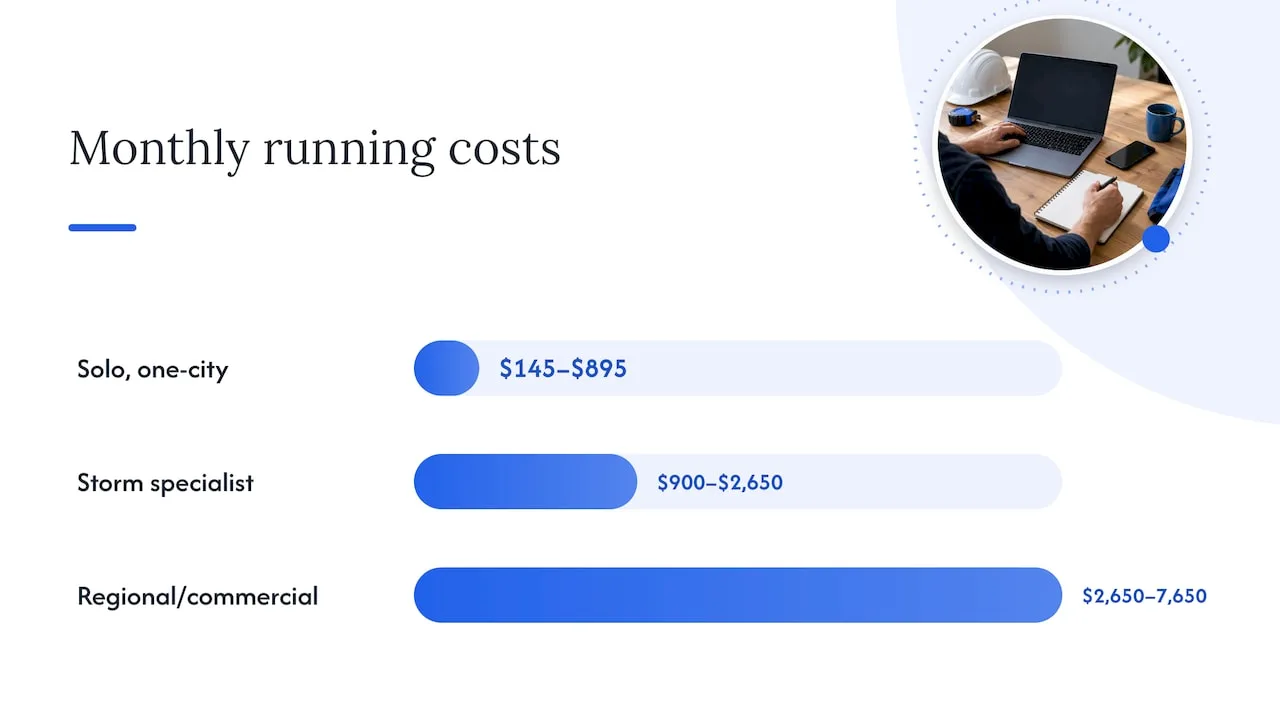
- Running costs matter as much as the build. For roofers, monthly costs range from $145 for a solo one-city shop to over $2,650 for regional operations.
- Judge a quote by what it does for booked jobs: lead capture, call answering, follow-up and reviews, not by page count.
- Coastal Connect plans run $597, $1,297 and $2,497 per month for contractors in Rhode Island and Massachusetts.
Table of Contents
- What a contractor website costs to build
- What pushes the price up or down
- The costs after launch
- Why the build price is the wrong number to compare
- How to compare website proposals
- Is $1,000 or $1,500 a reasonable price?
- What a contractor site needs to convert
- Our view on what contractors should pay for
- How our plans are priced
- FAQ
- Sources
What a contractor website costs to build
The cleanest recent numbers we found come from ProjectCostEstimator’s June 2026 data on HVAC companies. It puts the total range at $1,800 to $14,000. Most contractors land at $3,500 to $6,500 for a 12-page local SEO build covering five to ten cities. (SEO means search engine optimization: the work that gets your pages to show up when a homeowner searches “furnace repair near me.”) You can see the full breakdown in their HVAC website cost report.
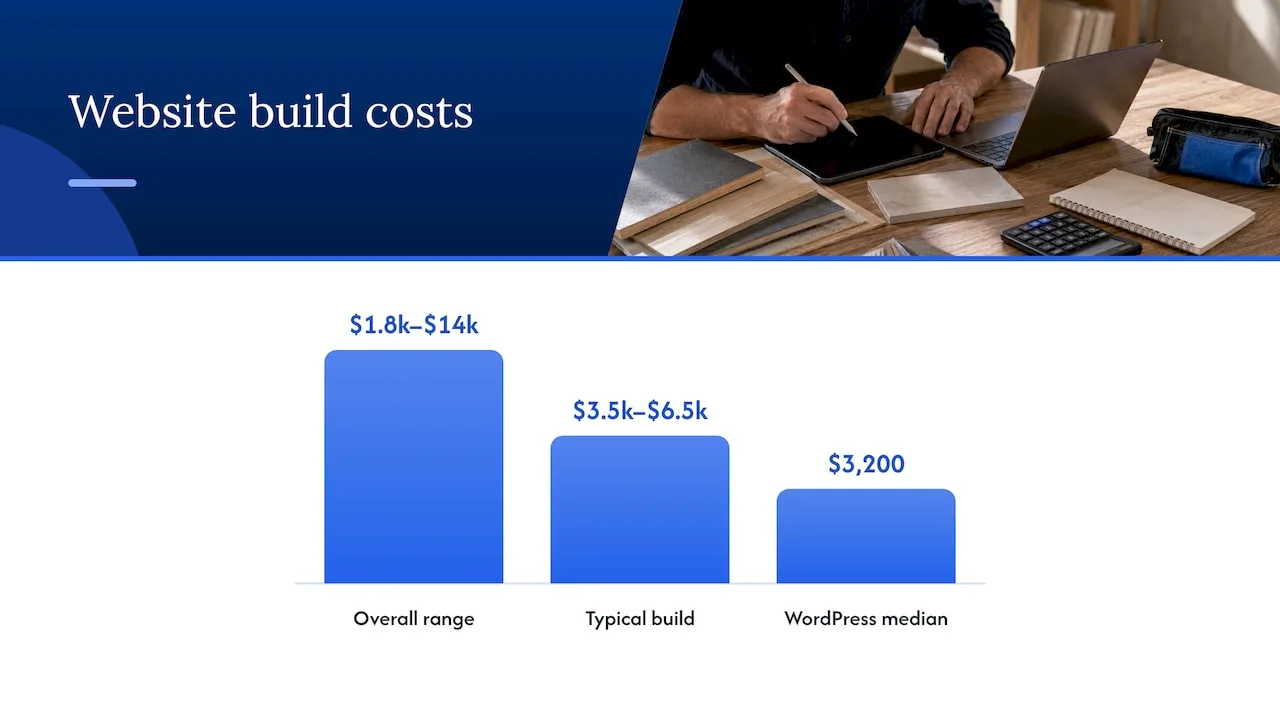
The same report names a WordPress baseline with a median of $3,200 as the right build for about 70% of HVAC contractors. It says custom React or Next.js builds cost about 2.5 times as much and rarely pay back for a single-location shop. Those are HVAC numbers, but plumbing, electrical and roofing sites are built from the same parts, so the ranges are a fair starting point for any trade.
A simple way to read the range:
| Build type | Typical scope | What drives the price |
|---|---|---|
| Template or WordPress baseline | Core service pages, contact form, basic local SEO setup | Number of pages, number of cities |
| Local SEO build | About 12 pages covering 5 to 10 cities | Unique content for each service and town |
| Custom stack | Fully custom design and code | Design hours, developer rates, maintenance |
If you are weighing custom development against a standard platform, this breakdown of what custom development costs shows how scope and complexity push a build price up. For a single-truck or few-truck contractor, the more custom the build, the longer it takes to earn back.
What pushes the price up or down
Four things move a contractor website quote more than anything else.
Number of services. A plumber who lists drain cleaning, water heaters, repiping, sewer lines and emergency service needs a page for each if every one should rank on its own. Ten services means ten pages of real writing.
Number of towns. A shop serving Providence, Cranston, Warwick and Pawtucket needs pages that speak to each area. The research above prices a 5-to-10-city build at the middle of the range for exactly this reason.
Booking and dispatch integration. Connecting the site to field-service software such as ServiceTitan or Housecall adds $1,200 to $3,500 from a freelancer or $2,500 to $6,000 from an agency, per the same HVAC data. If your quote leaves this out and you use that software, expect the line item to show up later.
Custom design and code. This is where cost balloons. A custom stack for one location rarely changes how many calls you get. It changes how long the project takes.
The costs after launch
A site that was built and left alone does not collect leads. The monthly side is where contractors are most often surprised, so budget for it up front.
ProjectCostEstimator’s roofing data shows the scale of it, with monthly running costs of:
- $145 to $895 for a solo, one-city roofer
- $900 to $2,650 for a storm specialist covering five to ten metro areas
- $2,650 to $7,650 for regional or commercial operations
The same report estimates that an $1,800 monthly SEO retainer producing eight extra storm-roof jobs at a $14,000 average ticket equals $112,000 a year in attributable revenue. That is an estimate from one dataset, not a promise, but it shows how to think about the cost: against the job value, not against the price of the site.
For HVAC, the report’s perspective is that top local results go to contractors who spend the right amount on the right things, not the most. It notes that every $400 of monthly retainer typically generates $3,000 to $8,000 in attributed pipeline for a regional HVAC company above $4 million in revenue.
Run the arithmetic on your own shop. If your average job is $450 and a $597 monthly plan books two extra jobs a month, it has paid for itself. If your average job is $9,000 for a roof, one extra job covers most of a year of the Foundation plan. The question is never whether the number looks small. It is how many more jobs you book than you did before.
Why the build price is the wrong number to compare
Two quotes can both say “$4,000” and deliver completely different results. One is a handsome brochure that waits for homeowners to find it. The other captures leads. The gap shows up in what happens to a visitor.
Picture a homeowner with a flooded basement at 9 p.m. They search, land on three sites and call the first number. If nobody answers, they call the next. A site that only looks good does nothing for that call. A site built as a lead generation engine has a number that gets answered, a text-back when it is missed and a form that reaches you quickly.
That is the idea behind how we build. Our websites are designed to capture leads and book jobs, and they sit alongside 24/7 inbound call handling, missed-call text-back, automated follow-up and review requests. When the website, the phone and the follow-up are one system, the monthly fee covers the whole path from search to booked appointment. When they are three separate vendors, you pay three invoices and nobody owns the gap between them.
How to compare website proposals
When you have two or three quotes in hand, line them up on these points.
- What is in the build. Number of pages, number of towns, whether service pages get original writing and whether mobile layouts are included. Most of your visitors will be on a phone.
- Who owns what. Ask whether you own the domain, the Google Business Profile and the content if you leave. Those assets should belong to your company.
- Booking connection. Does the quote include the integration to your scheduling or dispatch software, or is that extra?
- Call and form handling. What happens when a call comes in at night or while your crew is on a roof?
- Hosting, security and updates. These are recurring. Find the monthly or annual figure in writing.
- Reviews. Check whether review requests go out automatically after a job. Reviews drive both rankings and the decision to call.
- Reporting. You should see calls, forms and booked jobs, not just traffic. Our guide to proving contractor marketing ROI walks through tracking this with call tracking and a CRM (customer relationship management software, the tool that records every lead and what happened to it).
- Term and exit. Know the contract length and what you take with you.
A quote that answers all eight in plain numbers is a quote you can compare. One that answers three is leaving the rest for later invoices.
Is $1,000 or $1,500 a reasonable price?
A price in that range sits below the $1,800 floor of the HVAC range above, so it can cover a compact site. The useful question is what it includes. For a price like that, expect a small number of pages and a single town focus. Local SEO across several cities, a booking integration, call handling and review requests would be separate work and would be priced separately.
If you serve one town and your goal is a clean, professional presence, a lean build is a rational choice. If your goal is more booked jobs across a metro area, the budget has to cover the pages for each town and the follow-up systems that convert the traffic. That is where a monthly plan tends to fit better than a small one-time fee.
What a contractor site needs to convert
The pages and features that matter most are the same across trades, and they are the ones to ask about in any proposal:
- A phone number that is tappable on mobile and visible without scrolling.
- Service pages for each job you want, with your towns named on them. Our roofing website content guide lists the five pages to build first.
- A contact page that makes it easy to act. See these contractor contact page examples.
- Local business details in the site’s code, so search engines read your address and service area correctly, covered in our local business schema guide.
- A claimed and optimized Google Business Profile, since for local searches it often decides whether you get the call. For HVAC, see our Google Business Profile guide.
- Chat or call answering for the moments you cannot pick up. Our chatbot scripts for contractors show what those flows look like.
- Review collection after every finished job.
Trade-specific search terms also differ. Plumbers, electricians and HVAC companies each have their own high-intent phrases, which we cover in our guides to plumbing SEO keywords, electrician SEO and HVAC SEO keywords.
Our view on what contractors should pay for
We work only with contractors in Rhode Island and Massachusetts, and the same pattern shows up in how we think about website cost: the shops that grow are the ones that stop treating the website as a one-time purchase.
A website that is built once and left alone is a brochure. A website that is connected to local SEO, a Google Business Profile, call answering, missed-call text-back, follow-up and review requests is a system that books jobs. That is why our plans are monthly and why we keep the pieces in one place, run by a local team that knows the towns and trades we serve.
We design every site around one question: when a homeowner lands here with a problem, what is the fastest path to a booked appointment?
Pay for the path, not the pages.
Tyson
How our plans are priced
Our plans are published, so you can budget before you talk to anyone:
| Plan | Price |
|---|---|
| Foundation | $597 per month |
| Growth | $1,297 per month |
| Scale | $2,497 per month |
Over twelve months that works out to $7,164 for Foundation, $15,564 for Growth and $29,964 for Scale. Optional additions include an AI employee on Growth at $199 per month, Scale Plus at $249 per month and extra locations from $299 per month. Paid ads management is also available, quoted separately.
Lay those figures next to the roofing running-cost ranges above and the monthly structure is familiar: a solo shop and a multi-city operation sit in different tiers, and the plan scales with you.
If you want to see what is behind each plan, start with our websites that book jobs page, then compare plans on the pricing page.
When you are ready to turn missed calls into booked jobs, our team in Rhode Island and Massachusetts can walk through which plan fits your trade and your service area. Start at Coastal Connect.
FAQ
How much does a contractor website cost?
Build prices run from roughly $1,800 to $14,000 in the HVAC dataset, with most contractors at $3,500 to $6,500. Ongoing costs come on top, from a few hundred dollars a month for a solo shop to several thousand for regional operations. Our plans run $597 to $2,497 per month.
Does a contractor need a website?
Yes. Homeowners search before they call, and your site, Google Business Profile and reviews are what they see first. A site that captures leads and answers every call gives you the best chance of being the one they dial.
What should a website quote include?
It should list pages, towns, mobile design, booking integration, hosting and updates, call and form handling, review requests and reporting. Each item should have a price or be marked as included. Anything left out is likely to appear as an extra later.
Why choose a monthly plan over a one-time build?
Leads come from ongoing work: local SEO, reviews, call handling and follow-up. A monthly plan puts those under one fee with one team, so the site keeps working after launch day.
Sources
- HVAC Company Website Cost in 2026 (Real Data), ProjectCostEstimator
- Roofing Contractor Website Cost in 2026 (Real Data), ProjectCostEstimator
- What custom development costs