
Generative engine optimization (GEO) is the practice of shaping your content and site so AI-powered search systems like Google’s AI Overviews and ChatGPT cite and use your pages when answering a question. The single most important move is to add verifiable citations, concrete statistics, and answer-first paragraphs while confirming your pages are actually crawlable. Google Search Console’s generative AI reports now track this visibility directly, and the pattern holds even in specialized fields: contractor marketing teams see the same citation-first content win placement in AI answers for trade-specific searches.
TL;DR:
- Benchmark testing found that combining citations, direct quotations, and statistics lifted generative visibility by 30% to 40%, especially for informational topics with abundant data.
- Allow OpenAI’s search and ads crawlers in robots.txt, inspect firewall and CDN rules, and test direct access; ChatGPT indexing can take about 24 hours.
- Place the core answer in the first two or three sentences, then add a dated, attributed statistic, an expert quote, and references.
- Use Search Console’s generative AI reports alongside clicks, time on page, and conversions; test one page change at a time and log its date.
Table of Contents
- SEO vs GEO: what to keep doing and what to change
- Why GEO matters for traffic quality and conversions
- High-impact GEO tactics: citations, statistics, and technical eligibility
- Implementing GEO: an ordered checklist for content and engineering teams
- Measuring GEO: metrics, reports, and simple experiments
- Applying GEO to contractor lead pages: a practitioner example
- Author perspective: where to focus the next two quarters
- Turning GEO into booked jobs for contractors
- FAQ
- Sources
SEO vs GEO: what to keep doing and what to change
Traditional SEO work is not wasted. Crawlability, clean indexing, fast load times, and clear on-page structure remain the foundation generative engines build on, since a page that cannot be crawled cannot be cited either way. What shifts is the layer on top of that foundation.
GEO asks you to prioritize:
- Explicit citation signals that point to primary sources
- Concrete statistics tied to a date and an attributed source
- Short, direct answers placed at the top of the page rather than buried under narrative
Before chasing trendy “GEO hacks,” check what the platforms themselves say. Google’s guide to optimizing for generative AI features states plainly that core SEO best practices remain relevant and that special machine-readable files like llms.txt are unnecessary. Forced content chunking and other workaround tactics circulating in marketing forums are not backed by Google’s own documentation.
Pro Tip: Before adding any new markup or file format for AI crawlers, check Google’s and OpenAI’s own documentation first. Most “GEO hacks” you’ll see recommended online aren’t mentioned in either.
Why GEO matters for traffic quality and conversions
Generative answers change how people click. When a system synthesizes an answer directly on the results page, some searchers get their answer and never click through, while others click specifically because a source was named as trustworthy enough to cite. That second group tends to arrive with higher intent, since they chose your page from among several the engine considered.
A benchmark from GEO-bench found that combining citation, quotation, and statistics tactics improved visibility in generative responses by up to 30% to 40% on position-adjusted metrics, a meaningful gain for any team competing to be the cited source rather than an uncited one.
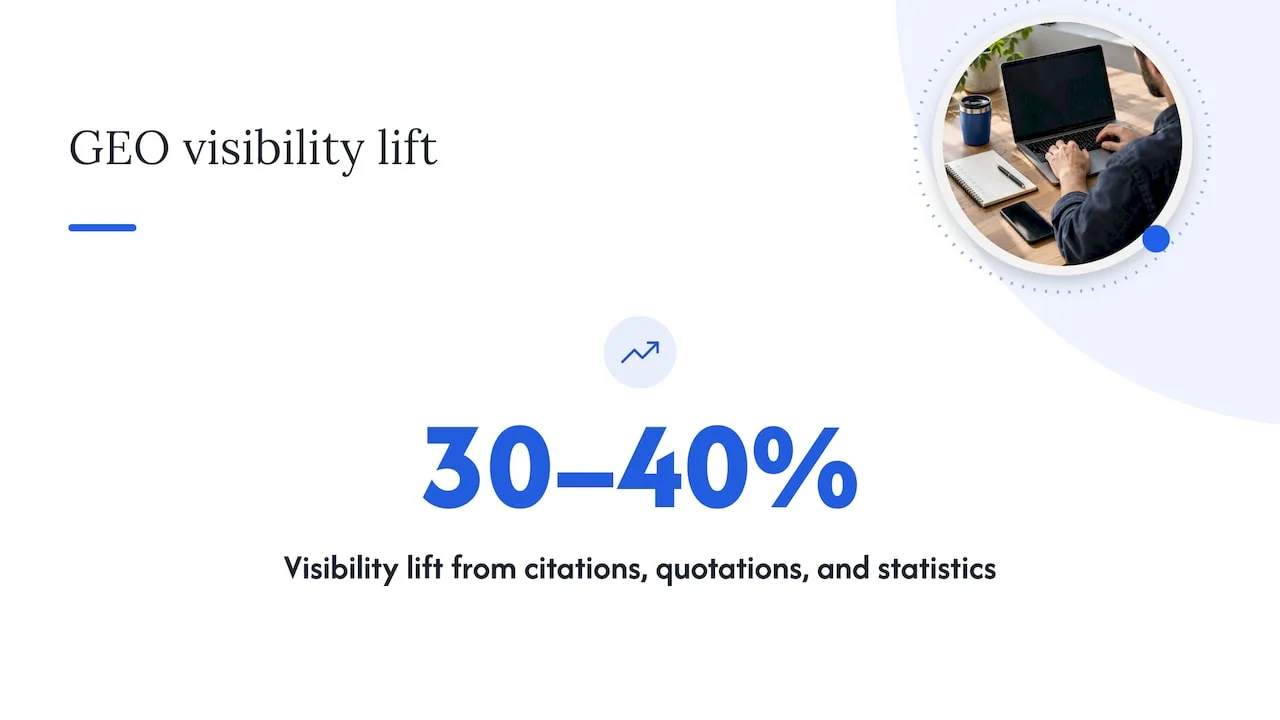
Citations and statistics function as trust signals in two directions at once: they help the generative engine verify a claim, and they help the human reader decide whether to click through for more detail. This effect is not uniform across content types. Informational, data-rich topics such as pricing benchmarks, technical comparisons, and how-to guidance tend to benefit more than purely navigational or brand-name searches, simply because generative engines have more raw material to synthesize from data-dense pages.
High-impact GEO tactics: citations, statistics, and technical eligibility
Once you have answer-first content, the next priority is making every claim verifiable and making sure crawlers can actually reach it.
- Cite sources inline, naming the organization or study, and keep a references section so the page reads as self-contained evidence.
- Add short, quoted expert statements where they fit naturally. A direct quote reads as a stronger signal than a paraphrase.
- Include statistics with a clear date and attribution rather than a vague “many” or “most.”
- Write the core answer in the first two or three sentences of a section, before any throat-clearing context.
- Confirm technical eligibility: a page cannot be cited if it cannot be crawled.
Technical eligibility deserves its own checklist, since it is where many otherwise strong pages fail silently:
- Review your robots.txt file and confirm it does not block the crawlers generative engines rely on.
- Allowlist OAI-SearchBot and OAI-AdsBot specifically. OpenAI’s developer documentation recommends allowing OAI-SearchBot in robots.txt, and notes that indexing for ChatGPT search can take roughly 24 hours after an update.
- Check your CDN and web application firewall settings. Bot-mitigation tools frequently block AI crawlers by default, even when robots.txt looks correct.
- Test with a direct user-agent request rather than assuming a passing robots.txt check means the crawler can actually reach the page.
- Use a general technical SEO checklist, such as this 20-point review from Westcode, as a baseline audit before layering GEO-specific fixes on top.
Note the OpenAI documentation also flags that systems tend to treat citation differently from recommendation: being named as supporting evidence and being named as the suggested solution are separate outcomes, and each calls for slightly different phrasing in your content.
Implementing GEO: an ordered checklist for content and engineering teams
Turning GEO strategy into execution works best as a short list split by team, run in order rather than all at once.
- Editorial: rewrite the top paragraph of priority pages as a direct, answer-first statement.
- Editorial: add at least one sourced statistic and one short quote callout per page.
- Editorial: build or update a references list at the bottom of long-form pages.
- Engineering: confirm pages return a 200 status and are not excluded by a noindex tag.
- Engineering: update robots.txt to explicitly allow OAI-SearchBot and OAI-AdsBot alongside existing search crawlers.
- Engineering: review CDN and WAF rules for unintended bot blocking, a common and often invisible failure point according to OpenAI’s advertiser guidance.
- Workflow: run small, page-level A/B tests rather than rewriting an entire site at once.
- Workflow: log every change with a date so results can be traced back to a specific edit.
- Workflow: resubmit updated pages through normal indexing channels after technical fixes.
Pro Tip: Change one variable at a time, a single statistic, a single citation, a single rewritten paragraph, so you can tell which edit actually moved your visibility.
Measuring GEO: metrics, reports, and simple experiments
You cannot manage what you cannot see, and until recently GEO visibility was nearly invisible. That changed when Google Search Console added generative AI performance reports, which break down impressions by page, country, device, and date for appearances in generative AI features.
A useful measurement routine combines a few data sources:
- Pull generative AI impressions and page-level visibility from Search Console.
- Cross-reference those pages against standard Analytics metrics: clicks, time on page, and conversion events.
- Watch for a lag between a content change and a visibility change, since reindexing and reprocessing by generative systems are not instant.
The GEO-bench research found visibility gains of roughly 30% to 40% from combined citation and statistics tactics, which gives you a reasonable target range when designing your own page-level tests: a change that produces no measurable shift after several weeks likely needs a different tactic, not just more patience.
Applying GEO to contractor lead pages: a practitioner example
Contractor websites are a useful stress test for GEO, since the content is often thin, generic, and light on verifiable detail. On the service pages we build, the pattern that works is the same one the research points to: an answer-first opening paragraph, a cited statistic or standard where relevant, and a short quoted detail about the work itself.
Operationally, this means:
- Confirming OpenAI’s crawlers are allowlisted in robots.txt rather than assuming default settings cover it
- Checking that landing pages load cleanly for bots, not just for human visitors, since firewall rules on hosting platforms can quietly block crawler access
- Pairing content fixes with automated review collection, since fresh, specific review text gives generative engines more concrete material to cite
The underlying principle holds across industries: a page that states facts plainly, attributes them clearly, and loads without friction outperforms a page that reads like a brochure.
Author perspective: where to focus the next two quarters
If you only run three experiments this year, make them citation addition, a statistics A/B test, and a crawler allowlist audit, in that order. Give editorial the first two, since they are low-risk and fast. Give engineering the allowlist audit immediately, since a blocked crawler makes every other fix irrelevant. Report results monthly, tied to Search Console’s generative AI data, not guesswork.
— Tyson
Turning GEO into booked jobs for contractors
Visibility in an AI answer means nothing if the page behind it cannot convert a visitor into a booked job. That is the gap we built around: AI-powered SEO, websites that book jobs, local SEO and Google Business Profile work, and review automation that keeps fresh, citable content flowing.
For contractors who want this handled end to end rather than piecing it together, our pricing and plans page lays out the available Foundation, Growth, and Scale options and what each one covers.
FAQ
What is generative engine optimization in simple terms?
Generative engine optimization is the practice of structuring content so AI systems like Google’s AI Overviews or ChatGPT cite it when generating an answer. It relies on clear, sourced, answer-first writing combined with technical crawlability, as outlined in Google’s generative AI optimization guide.
How is GEO different from traditional SEO?
Traditional SEO focuses on ranking a page in a list of links, while GEO focuses on being synthesized into, or cited within, an AI-generated answer. The technical basics of crawlability and indexing still apply to both, but GEO adds emphasis on citations, statistics, and concise answer-first structure.
Do I need an llms.txt file for AI search visibility?
No special file like llms.txt is required. Google’s own documentation states that standard SEO practices remain sufficient and that this type of file is unnecessary for generative AI features.
How do I check if OpenAI’s crawlers can access my site?
Review your robots.txt file to confirm OAI-SearchBot and OAI-AdsBot are not blocked, then check your CDN or web application firewall settings, since these tools often block AI crawlers by default. OpenAI’s developer documentation and its advertiser guidance both cover this verification process in detail.
Where can I measure my site’s visibility in AI search results?
Google Search Console includes dedicated generative AI performance reports showing impressions by page, country, device, and date. These reports, launched by Google, are the most direct way to track whether your GEO changes are producing measurable visibility.
Sources
Generative engines do not simply rank pages, they synthesize answers from multiple sources at once, a process often called retrieval-augmented generation or grounding. The system pulls passages from several web pages, blends them into a response, and then decides which sources to cite as supporting evidence. That distinction matters: a page can be used as a footnote without ever being recommended in the generated text, and a page can be named as the recommended option without carrying a visible citation link. Both outcomes count as visibility, but they call for different content choices.
Academic research on this problem gives marketers a real benchmark. The GEO paper on arXiv tested which content changes actually move the needle in generative responses, using a benchmark the authors call GEO-bench. The top-performing methods were:
Combined, these techniques improved visibility by roughly 30% to 40% on position-adjusted metrics in benchmark testing, according to the GEO research. The same research found that effectiveness varies by topic domain, and that stacking multiple tactics together outperforms using any single one in isolation.