This page gives you a ready-to-use, categorized HVAC keyword inventory and a step-by-step playbook to map those keywords to pages that drive calls and booked jobs. Use the lists below on your service pages, your Google Business Profile, and your blog, then follow the mapping and prioritization steps to turn the right terms into booked work. Start by copying the keywords that match services you already offer.
TL;DR:
- Local “near me” and emergency terms like “furnace repair near me” should be prioritized for quick conversions and high relevance.
- Transactional keywords belong on service pages and Google Business Profiles, while informational terms are best placed in blogs and FAQ sections.
- Validating keywords through tools and Google Search Console ensures alignment with actual performance, not just initial estimates.
- Building content around specific, scored keywords helps improve rankings and ensures they lead to booked jobs.
- Focusing on Google Business Profile optimization and local signals enhances visibility more effectively than broad keyword chasing.
Table of Contents
- Categorized HVAC keyword lists for service pages and local search
- How to map HVAC keywords to your site
- Prioritizing HVAC keywords by lead value, not just volume
- Researching and validating HVAC keywords: a repeatable process
- Local SEO and Google Business Profile tactics that capture keyword demand
- Content ideas and page templates built from your keyword list
- Tracking whether your keywords are turning into booked jobs
- Why a contractor-first approach to SEO works better than generic marketing
- How Coastal Connect turns your keyword list into booked jobs
- Primary sources and further reading
- Sources
- FAQ
Categorized HVAC keyword lists for service pages and local search
HVAC keywords fall into a handful of buckets, and knowing which bucket a term belongs to tells you where it should live on your site. Short, generic terms like “HVAC repair” carry high search volume but weak intent signals: the searcher could be a homeowner, a student, or a competitor. Long-tail terms like “ductless mini split installation cost in a two-story home” carry lower volume but much clearer intent, and they convert at a higher rate because the person typing that phrase is closer to hiring someone.
Service-specific terms map directly to the jobs you book:
- AC repair, AC installation, AC tune-up: transactional intent, best placed on dedicated service pages.
- Furnace repair, furnace replacement, furnace won’t turn on: mixed intent; the diagnostic phrases (informational) can link to the repair page (transactional).
- Heat pump installation, heat pump vs furnace: the comparison phrase is informational and works well as a blog post that links to your installation service page.
- Ductwork cleaning, ductwork repair, duct sealing: transactional, often searched alongside indoor air quality concerns.
- Commercial HVAC maintenance, commercial rooftop unit repair: transactional, but with a different buyer and a different page than residential service pages.
Local variants add geography to any of the above: “AC repair near me,” “furnace repair [city],” or “emergency HVAC [city].” These phrases often convert faster than their national equivalents because the searcher wants someone today, not research. According to Google’s local ranking guidance, relevance, distance, and prominence decide which businesses show up for these searches, which means your Google Business Profile and localized service pages matter as much as the page content itself.
Seasonal clusters shift through the year: “AC not cooling” spikes in summer, “furnace maintenance checklist” spikes in fall, and “heat pump not heating” spikes in winter. Building a content calendar around these shifts keeps traffic flowing instead of relying on one evergreen page.
A rough intent label helps you decide where each term goes:
- Transactional (“schedule AC repair,” “furnace installation quote”): service pages and GBP.
- Informational (“why is my furnace short cycling,” “how often to replace AC filter”): blog posts and FAQ sections.
- Navigational (“[your company name] reviews,” “[your company name] hours”): handled by your GBP and homepage.
Volume varies heavily by city size and season, so treat any number you see in a keyword tool as a rough range rather than a fixed figure, and validate it against your own Search Console data once your pages are live.
How to map HVAC keywords to your site
Matching the right keyword to the right page type is the difference between a ranking page and a converting one. Google’s own guidance on people-first content warns against stuffing keywords and instead recommends placing them naturally where users already expect to see them: titles, headers, meta descriptions, and image alt text.
- Transactional keywords (“furnace repair,” “AC installation near me”) go on service pages and your Google Business Profile, where a searcher ready to book can find your phone number immediately.
- Informational keywords (“how long do furnaces last,” “signs your AC needs freon”) go on blog posts and FAQ entries, which should then link internally to the matching service page.
- Title and H1: use the primary service term once, naturally, such as “Furnace Repair in [City].”
- Meta description and alt text: repeat the service term once, and describe images accurately rather than stuffing keywords into them.
- Schema markup: use LocalBusiness and Service schema so search engines can connect your page to the right service and location without guessing.
A service page template might open with the service and city in the H1, follow with a short paragraph on the problem you solve, list the specific jobs covered as subheadings, and close with a call to action and your service area. A blog post template opens by answering the question in the first sentence, expands with the mechanics or cost factors, and ends with a link to the relevant service page.
Prioritizing HVAC keywords by lead value, not just volume
Not every keyword deserves the same effort, and volume alone is a poor guide for a trade business. A better system scores each keyword on four axes: search intent, estimated volume, ranking difficulty, and the revenue a booked job from that term is worth.
- Intent: transactional terms score highest because they are closer to a phone call.
- Volume: higher is generally better, but only after intent is confirmed.
- Difficulty: a term dominated by national directories may not be worth chasing compared to a local variant with less competition.
- Revenue fit: a heat pump installation lead is worth more than a filter replacement lead, so weight accordingly.
Say “emergency furnace repair near me” scores high on intent and revenue fit but moderate on difficulty, while “what size furnace do I need” scores high on informational value but low on immediate revenue. The first deserves a dedicated, well-optimized service page and GBP attention; the second deserves a blog post that funnels readers toward that same service page.
Triage your list by tackling local “near me” and emergency or seasonal terms first, since these convert fastest and usually face less competition than broad national phrases. Reserve paid search for terms you need visibility on right now and can’t yet rank for organically, and lean on GBP optimization for any term tied to “near me” or a specific neighborhood.
Pro Tip: Score your highest-priority keywords on a simple 1 to 5 scale for each axis, then build pages for those that rank best overall first.
Researching and validating HVAC keywords: a repeatable process
A simple seed-expand-validate workflow keeps keyword research from becoming a guessing game. The Forbes Agency Council’s HVAC SEO guidance recommends prioritizing high-intent local terms and confirming choices with tools like Google Search Console rather than relying on instinct alone.
- Seed: list every service you offer and every city or town you serve.
- Expand: run those seeds through Google Keyword Planner, Ahrefs, SEMrush, or Ubersuggest to surface variants and rough volume ranges.
- Filter by intent: sort the expanded list into transactional, informational, and navigational buckets.
- Validate: cross-check performance in Google Search Console once pages are live, and compare against the search terms already appearing in your GBP insights.
- Document: keep a simple spreadsheet with columns for keyword, intent, target page, estimated volume range, and status.
Run a basic QA pass before publishing anything: confirm the keyword appears in the title and H1 once, confirm internal links point to the right service page, and confirm no page targets the same keyword as another page on your site.
Local SEO and Google Business Profile tactics that capture keyword demand
Local search works differently than national search, and understanding why changes how you write every page. Google’s own support documentation states that local ranking depends mainly on relevance, distance, and prominence, meaning a complete, accurate Google Business Profile often outperforms a generic high-volume keyword chase. That single fact should shape how much time you spend on GBP versus chasing national rankings.
- Services section: list every service using the same phrasing a customer would search, not internal jargon.
- Business description: include your core services and service area naturally, once, without repeating the same phrase in every sentence.
- Attributes and Q&A: fill in accurate attributes and seed a few Q&A entries with the questions customers actually ask.
- Citations: keep your business name, address, and phone number identical across every directory listing.
- Reviews: ask for reviews that naturally mention the service performed, since review text itself becomes a relevance signal.
Google Business Profile information is also pulled from multiple sources, including owner-submitted data and third-party contributions, so inaccuracies elsewhere on the web can quietly work against you. A partner resource like Local Growth Direct walks through GBP field management in more depth if you want a deeper how-to on the profile side.
Content ideas and page templates built from your keyword list
Every keyword bucket above maps to a specific page type, and building from that map keeps your content calendar focused instead of random.
- Service pages: one page per core service per city, with the transactional keyword in the title, a short trust section, and a clear call to action.
- Blog posts: built from informational long-tail terms like “how often should I replace my furnace filter” or “signs you need a new AC unit,” each linking back to its matching service page.
- FAQ sections: seed five to eight questions per service page using the exact phrasing customers search, since these often win featured snippets and support internal linking.
- City or neighborhood pages: useful once you serve multiple towns, each targeting the local variant of your top two or three services.
This structure keeps new content tied directly back to a keyword that has already been scored and prioritized, rather than written for its own sake.
Tracking whether your keywords are turning into booked jobs
Rankings mean nothing if they don’t turn into calls, so measurement has to tie keywords to revenue, not just traffic.
- Set KPIs first: track organic sessions by page, GBP actions (calls, direction requests, website clicks), total leads, and estimated lead value by service type.
- Instrument tracking: set up GA4 events for form submissions and click-to-call buttons, connect Google Search Console for query-level data, and use call tracking so phone leads aren’t invisible.
- Check rankings on a cadence: review rank tracking weekly for your top priority terms and monthly for the rest of your list.
- Iterate: when a page ranks but doesn’t convert, revisit the trust elements and call to action before touching the keyword targeting itself.
A page that ranks for “furnace repair near me” but gets no calls usually has a conversion problem, not a keyword problem.
Why a contractor-first approach to SEO works better than generic marketing
Generic marketing advice treats HVAC like any other business, but HVAC searches carry a mix of urgency, safety concerns, and seasonal swings that most marketing playbooks ignore. Because furnace and gas-related issues touch on safety and expertise, search engines favor sites that demonstrate real technical knowledge over sites that simply repeat keywords.
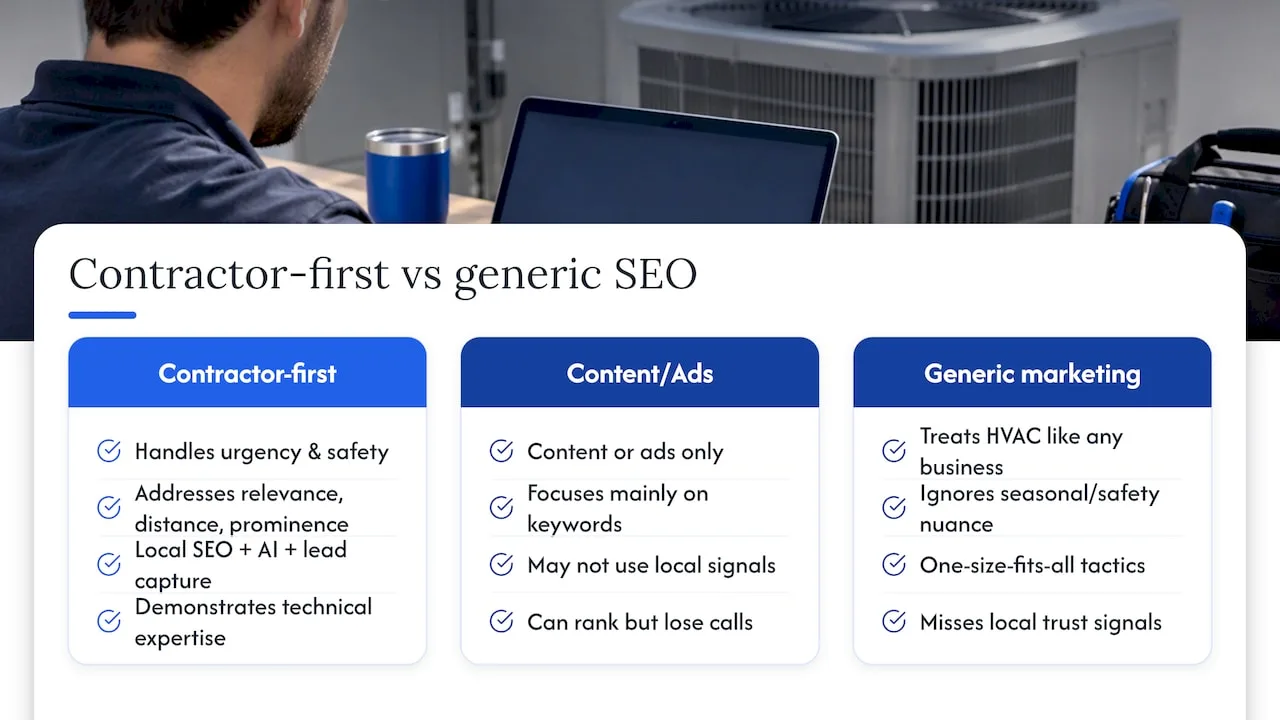
An integrated approach, pairing keyword strategy with the local signals that actually move rankings, tends to outperform content-only or ads-only strategies because it addresses relevance, distance, and prominence at the same time rather than one in isolation. An integrated approach combines local SEO, AI-powered automation, and lead capture systems built around how homeowners actually search for HVAC help.
The bigger mistake contractors make isn’t picking the wrong keywords. It’s building a page that ranks and then losing the call anyway because no one answers the phone or follows up fast enough.
— Tyson
How Coastal Connect turns your keyword list into booked jobs
Picking the right keywords is only half the job: you still need a website built to convert that traffic and a system that catches every lead who calls. This company builds websites that book jobs paired with local SEO and Google Business Profile management so the keyword work in this guide actually shows up where homeowners search.
The process typically starts with an audit of current pages and GBP, moves into a keyword and content plan built around the service area, and ends with deployment, including missed-call text-back and CRM to help leads stay engaged.
- 24/7 coverage: an AI voice agent and AI website chat catch leads outside business hours.
- Review growth: Reviews that keep coming builds the review volume that supports local prominence.
- Flexible plans: Foundation, Growth, and Scale plans are listed on our pricing page, with add-ons like extra locations or paid ads management available as you grow.
If you’re a contractor in Rhode Island or Massachusetts ready to turn this keyword list into real appointments, check plan availability and pricing and start with an audit.
Primary sources and further reading
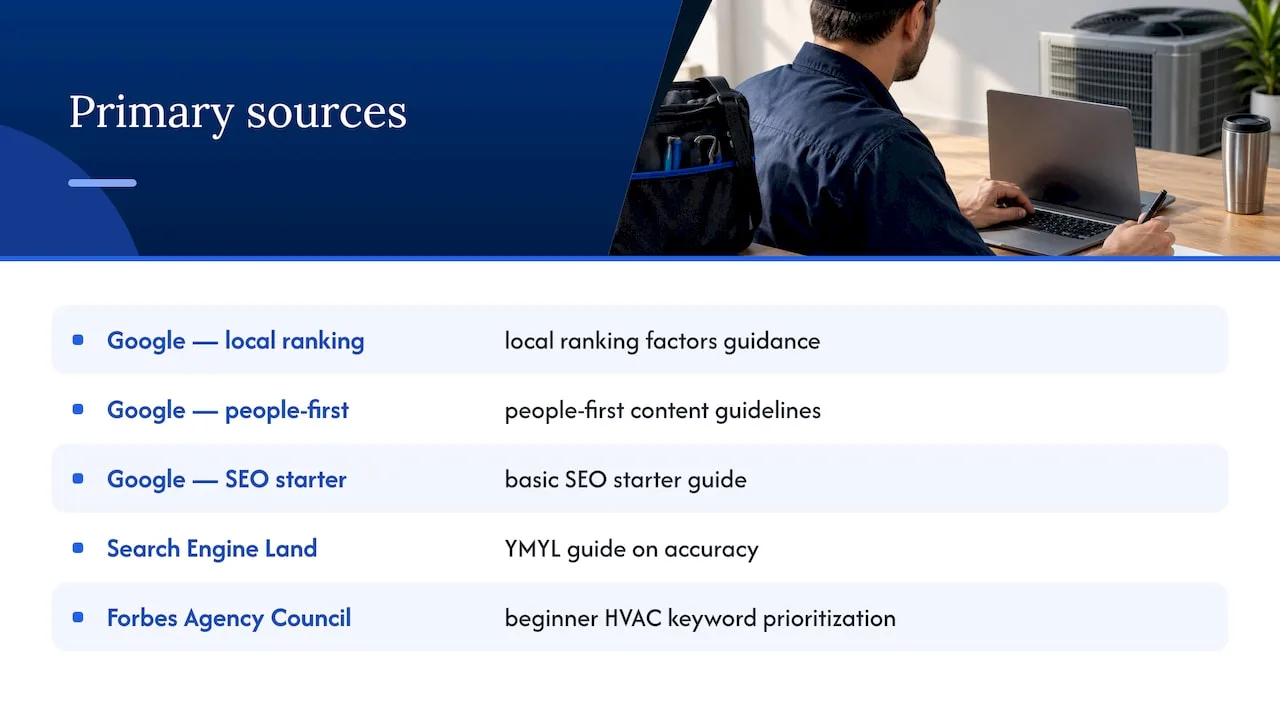
The local ranking and content guidance in this article comes from Google’s own documentation: its explanation of local ranking factors, its people-first content guidelines, and its SEO starter guide. Additional context on why HVAC content requires extra care around accuracy comes from Search Engine Land’s YMYL guide, and beginner-level HVAC keyword prioritization guidance comes from the Forbes Agency Council.
Sources
- Tips to improve your local ranking on Google - Google Business Profile Help
- Creating helpful, reliable, people-first content | Google Search Central
- YMYL: Why it matters for search (Search Engine Land)
- A Beginner’s Guide To SEO For HVAC Companies (Forbes Councils)
FAQ
What keywords should I use for SEO?
Choose keywords that match what your customers actually type, mixing short transactional terms like “furnace repair” with longer, local phrases like “furnace repair near me in [city].” Google’s people-first content guidance recommends writing naturally for these variations rather than forcing exact-match phrases into every sentence.
What are some key terms used in HVAC?
Common HVAC terms include AC repair, furnace installation, heat pump, ductwork, indoor air quality, and HVAC maintenance, each of which can be paired with a city name or “near me” for local searches. Seasonal variants, like “AC not cooling” in summer or “furnace won’t start” in winter, round out a full keyword list.
What is a good tagline for an HVAC company?
A strong tagline names the core promise, such as fast response, reliable comfort, or honest pricing, in a few words that fit your actual service area and specialty. There’s no single correct tagline; the best ones reflect what customers specifically value about your business rather than a generic industry phrase.
What are 5 skills a HVAC technician should have?
HVAC technicians generally need strong diagnostic skills, hands-on mechanical ability, knowledge of electrical systems, customer communication skills, and familiarity with safety codes for gas and refrigerant handling. These skills matter for SEO too, since content that reflects real technical expertise is favored for HVAC’s safety-adjacent topics.