Emergency and transactional terms like “emergency plumber near me” and “water heater replacement” drive the most booked jobs, and the first move is claiming and optimizing your Google Business Profile while building a handful of service pages set up for click-to-call. This guide breaks down keyword types, shows you how to prioritize them by revenue, and gives you a 30 to 60 day checklist you can start today.
TL;DR:
- Emergency and service keywords like “burst pipe repair” and “water heater replacement” should be prioritized for quick conversions and high revenue potential.
- Google Business Profile must accurately describe services and areas without keyword stuffing, with a focus on real reputation building through reviews and engagement.
- Service and city pages need distinct, intent-focused content, optimized with local keywords, proofs, and a clear call-to-action to boost rankings and conversions.
- Mobile site speed, proper schema markup, and technical SEO fixes are essential to ensure local searches result in calls rather than lost opportunities.
- Focusing on high-intent keywords and implementing a systematic tracking and content strategy over 30 to 60 days drives better booked jobs than chasing high search volume alone.
Table of Contents
- 1. Types of plumbing keywords you should target first
- 2. How Google Business Profile turns keywords into calls
- 3. Building service and city pages that rank and convert
- 4. The technical fixes most plumbing sites are missing
- 5. What to publish: FAQ pages, blog posts, and how they connect
- 6. A scoring framework for prioritizing keywords by revenue
- 7. Tools and KPIs that prove the work is paying off
- 8. A 30 to 60 day checklist to put this into action
- Why conversion-first keywords beat chasing search volume
- How Coastal Connect turns this checklist into booked jobs
- Sources
- FAQ
1. Types of plumbing keywords you should target first
Not every plumbing keyword deserves the same attention. Some bring in a customer with a burst pipe ready to pay whatever it takes; others bring in someone reading a blog post at midnight who will never call anyone.
Transactional and emergency keywords carry the highest intent and the shortest path to a booked job. Terms like “emergency plumber,” “24 hour plumber,” and “burst pipe repair” signal a customer who needs help now and is already reaching for the phone. Core service keywords such as “drain cleaning,” “water heater replacement,” or “sewer line repair” describe a specific job and convert well when paired with location.
Geo-modified keywords combine a service or brand with a place, and this is where most local plumbing traffic lives. “Plumber near me” alone accounts for enormous search volume, but “plumber [city]” and “[service] [city]” variants let you target specific towns directly. Informational keywords like “how to fix a leaky faucet” or “why is my water heater leaking” bring traffic but rarely bring calls, since most of that audience is trying to avoid hiring anyone.
A practical keyword list mixes all four types but weights budget and content toward the first two:
- Emergency: “emergency plumber [city] open now,” “24 hour plumber near me,” “burst pipe repair [city]”
- Service: “water heater replacement cost [city],” “drain cleaning near me,” “sewer line repair [city]”
- Geo: “plumber [city],” “[city] plumbing company,” “licensed plumber near me”
- Informational (lower priority): “how to unclog a drain,” “signs you need a new water heater”
Each type calls for a different landing spot. Emergency and service keywords should point straight to a service page with a phone number above the fold. Informational keywords work better as blog posts that link back to the relevant service page rather than competing for the same real estate.
2. How Google Business Profile turns keywords into calls
Google’s own local ranking guidance ties visibility to three factors: relevance, distance, and prominence, and a fully completed Business Profile improves your odds on all three. Keywords matter here, but not in the way most plumbers assume. You are not stuffing your business name with services; you are making sure the profile’s structured fields accurately describe what you do and where you do it.
Start with these field-level moves:
- Keep your business title as your actual legal or trade name, since Google’s representation guidelines prohibit adding unrelated keywords or extra descriptors to that field.
- Choose the most specific primary category available (Plumber, not just Contractor), then add relevant secondary categories.
- List every service you offer in the Services section using the exact phrasing customers search for: drain cleaning, water heater installation, gas line repair.
- Write a business description that naturally includes your core services and service area without keyword stuffing.
- Set your service area accurately if you don’t have walk-in customers at a storefront address.
- Post weekly updates for time-sensitive offers, seasonal reminders, or emergency availability.
- Answer the Q&A section proactively with the questions customers actually ask, and monitor it for new ones.
- Build a steady review cadence rather than a burst of requests once a year.
Prominence is earned, not bought. Google’s help documentation is direct that there is no way to pay for a better organic local ranking; links, reviews, and real-world reputation do the work.
Pro Tip: Use a Google Post every time you have same-day availability. “Open today, no extra charge for emergency calls” outperforms generic promotional posts for click-through.
3. Building service and city pages that rank and convert
A service page has one job: turn a search into a phone call, and the structure should reflect that from the first line. Open with an intent-first headline, follow with a short verdict paragraph that answers the visitor’s likely question, then move into how the service works, pricing expectations, proof of past work, and a click-to-call button that stays visible as the visitor scrolls.
Keyword placement follows a predictable pattern across the page:
- Title tag: primary keyword plus city, kept under 60 characters
- Meta description: service, city, and a reason to call now
- H1 and H2 headings: natural variations of the target keyword, never repeated verbatim
- URL slug: short and keyword-clean, like /water-heater-replacement-providence
- Image alt text: describes the job and location, not just “plumber”
- FAQ schema: markup around common questions so answers can appear in featured snippets
Emergency and transactional searches often convert at far higher rates than informational ones, according to practitioner guidance on plumber marketing, which means a single well-optimized emergency page can outperform a dozen blog posts in booked revenue.
City pages fail when they read like the same page with a find-and-replace on the town name. Make each one distinct with ZIP-specific proof points, photos of your crew working in that town, and reviews pulled from customers in that specific market rather than a generic pool.
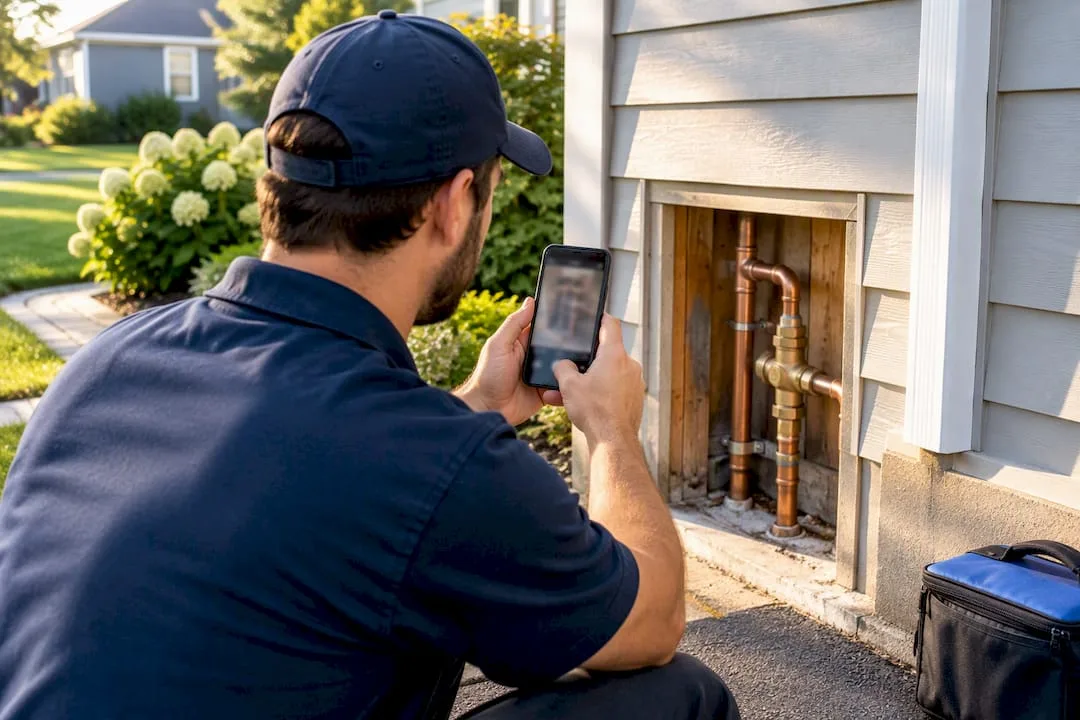
4. The technical fixes most plumbing sites are missing
Technical SEO rarely gets attention until it quietly caps how many calls a site can generate. Most plumbing searches happen on a phone, often from someone standing next to a leaking pipe, so mobile experience and call flow deserve the first look.
- Test your click-to-call button on actual phones across a few browsers, not just a desktop preview.
- Compress images and lazy-load anything below the fold so pages load fast on cellular connections.
- Limit third-party widgets and heavy scripts that slow down mobile rendering, especially chat widgets and tracking pixels stacked on top of each other.
- Submit an updated XML sitemap and keep robots.txt from accidentally blocking service pages.
- Use canonical tags to prevent duplicate city pages from competing against each other.
- Add LocalBusiness and Service schema so search engines understand what you offer and where.
- Mark up your FAQ content with schema to improve the odds of landing in a featured snippet.
None of these fixes are exciting, but a slow, uncrawlable site undercuts every keyword decision made elsewhere on this list.
5. What to publish: FAQ pages, blog posts, and how they connect
Not all content earns its place on a plumbing site. FAQ pages and emergency-focused posts with a clear call to action tend to convert because they meet a customer close to the moment of hiring. General DIY how-to content can bring in traffic, but much of that traffic is trying to solve the problem without calling anyone.
- Publish FAQ pages built around real customer questions (“How much does drain cleaning cost,” “Is a slow drain an emergency”) with a direct link to the matching service page.
- Write emergency-focused posts (“What to do when a pipe bursts”) that answer the immediate question fast, then push toward a phone call before the reader looks elsewhere.
- Use DIY how-to posts sparingly, and only when they naturally funnel toward a service you offer for the harder version of the same problem.
- Interlink with discipline: one offer and one landing page per campaign, with every FAQ and blog post pointing back to a single relevant service page rather than splitting attention across several.
Industry guidance on plumbing SEO increasingly favors helpful, scannable content that demonstrates real experience over pages built purely to rank for a keyword. A short, clear answer to a common question tends to outperform a padded 2,000-word post nobody finishes reading.
6. A scoring framework for prioritizing keywords by revenue
Chasing search volume alone leads plumbers toward keywords that look impressive in a tool and produce almost nothing in booked jobs. Score each keyword instead on intent, likely conversion rate, average ticket size for that service, and how difficult it will be to rank for.
- Weight transactional and emergency terms highest, since they convert at the highest rate regardless of volume.
- Favor high-ticket services like water heater replacement or sewer repair over low-ticket ones like faucet repair when competition is similar.
- Exclude pure DIY informational queries from paid campaigns and add them as negative keywords in Google Ads.
- Build your first month around a short list: emergency plumber [city], water heater replacement [city], drain cleaning near me, and sewer line repair [city].
This approach mirrors what experienced plumbing marketers already practice: a conversion-focused keyword strategy built around ticket size and conversion likelihood consistently outperforms one built around raw traffic.
7. Tools and KPIs that prove the work is paying off
Keyword work only matters if it shows up in booked jobs, so track it with tools that connect search activity to revenue.
- Google Search Console for keyword impressions and click trends on target terms.
- GA4 for organic traffic behavior and page-level performance.
- A rank tracker for weekly position checks on priority keywords.
- Call tracking tied to specific pages and campaigns.
- CRM lead source fields so every booked job traces back to its origin keyword.
Watch impressions on target terms, organic clicks, click-to-call rate, and booked jobs from organic search as your core KPIs. Check for tracking errors and wasted ad spend weekly, and review performance against booked jobs monthly.
8. A 30 to 60 day checklist to put this into action
You do not need a six-month plan to start seeing results from this. Break it into three phases and work through them in order.
- Week 1: claim and verify your Google Business Profile, enable call tracking on your main number, and confirm you have 4 to 6 service pages live with visible click-to-call buttons.
- Weeks 2 to 4: optimize page titles, meta descriptions, and schema markup, start a consistent review request cadence, and set up rank tracking on your priority keyword list.
- Days 30 to 60: publish 2 to 4 FAQ or emergency-focused posts, run a negative keyword pass on any paid campaigns, and analyze call and conversion data to adjust which keywords get the next round of budget.
Pro Tip: Set a recurring 15-minute Friday check on Search Console before the weekend rush, since weekend emergency searches often reveal which pages need faster attention.
Why conversion-first keywords beat chasing search volume
Plumbers who chase search volume end up with traffic that never picks up the phone. The shops that grow consistently target fewer keywords with higher intent and build the systems around them, missed-call text-back, review requests, fast page speed, so every call that comes in actually gets answered and every lead gets followed up. Keyword research without a capture system behind it is just an expensive way to generate impressions.
— Tyson
How Coastal Connect turns this checklist into booked jobs
Everything on this checklist takes time most plumbing business owners don’t have between service calls, and that’s the gap some specialized services fill for contractors.
Our websites that book jobs are built around the exact service-page structure covered above, paired with Local SEO & Google Business Profile management so your profile stays optimized without you touching it. Missed-call text-back & CRM catches the calls you’d otherwise lose during a job, and an AI voice agent handles inbound calls around the clock. Clients working with us have seen an average ROI increase within the first 90 days as these systems work together instead of sitting on separate tools. If you want to see what a conversion-first setup looks like for your shop, view pricing and plans or reach out for a consult.
Sources
For deeper reference, see Google’s local ranking guidance, its profile representation rules, and GBP optimization tactics for 2026.
- Tips to improve your local ranking on Google - Google Business Profile Help
- 11 Ways to Boost Your Plumbing Company’s SEO | Contractor Magazine
- Plumber Marketing: Complete Guide 2026 | Enrich Labs
FAQ
What are some good SEO keywords for plumbers?
The strongest keywords combine a service or emergency term with a location, such as “emergency plumber near me” or “water heater replacement [city].” These convert better than broad informational searches because they signal a customer ready to book a job now.
What is the — in plumbing?
This isn’t a recognized SEO or plumbing industry standard, and no authoritative source defines a “—” for plumbing marketing or keyword strategy. If you’ve seen it referenced elsewhere, treat it as informal shorthand rather than an established framework.
What are some effective taglines for a plumbing company?
Effective taglines tend to pair a clear promise with speed or reliability, such as availability around the clock or same-day service. The specific wording should reflect what you can actually deliver, since a tagline that overpromises hurts trust faster than it builds it.
Is SEO still worth it in 2026 for plumbing businesses?
Yes, SEO remains one of the most reliable ways for plumbers to generate consistent local leads, especially when paired with a fast, mobile-friendly site and an optimized Google Business Profile. Practitioner guidance on plumber marketing in 2026 frames it as one piece of a local capture system rather than a standalone tactic, working alongside Local Services Ads and a steady review cadence.