
Focus on cost per acquisition paired with return on marketing investment, and start tracking leads by source today using call tracking numbers and a simple CRM field. These two numbers tell you whether a job came from a channel worth paying for again. Everything else, including click-through rates and impressions, is secondary until you know what a lead actually costs you and what it returns.
TL;DR:
- Channel-specific costs per acquisition must include source tracking phone numbers and CRM fields to accurately measure ROI.
- Comparing ROMI across channels requires sufficient data, at least 20 to 30 closed jobs, and consistent offline conversion imports.
- Focusing on marginal ROMI and setting target CPA based on desired profit per job prevents overspending and diminishing returns.
- Improving website load speed, matching landing pages to ad intent, and optimizing lead follow-up can significantly boost ROI without extra ad spend.
- Small lead volume and limited data require controlled testing and simple attribution methods, such as assisted conversions, to avoid misleading conclusions.
Table of Contents
- Core metrics and exact formulas contractors must use
- Essential tracking: call tracking, CRM fields, and offline conversion imports
- Measuring ROI by channel and avoiding common measurement traps
- Worked example: from spend to ROMI and checking marginal returns
- High-impact optimizations that raise ROI without simply increasing ad spend
- Attribution models and sensible rules when your data is thin
- A measurement stack in practice
- Budgeting tests and setting realistic expectations
- How we can help you put this measurement stack to work
- FAQ
- Sources
Core metrics and exact formulas contractors must use
Two formulas carry most of the weight. Cost per acquisition (CPA) is total channel spend divided by the number of jobs booked from that channel. Spend $2,000 on pay-per-click ads and close 8 jobs, and your CPA is $250.
ROMI goes further by factoring in gross margin: (Revenue from marketing × gross margin) minus marketing cost, divided by marketing cost.
Marginal ROMI measures the return on your next dollar, not your average dollar, because the American Marketing Association notes that marketing returns are non-linear and a single aggregated ROMI figure hides where spending stops paying off.
- CPA: total spend ÷ jobs booked
- ROMI: (revenue × margin minus cost) ÷ cost
- Average job value: total revenue from a channel ÷ number of jobs, always calculated after applying your gross margin, not gross revenue
Essential tracking: call tracking, CRM fields, and offline conversion imports
You cannot calculate CPA by channel without source-level data, and most contractors are flying blind here. A handful of changes fix that.
- Assign a unique tracking phone number to each major channel (Google Ads, Local Services Ads, organic search, referrals) so every call logs its source automatically.
- Add CRM fields for source, campaign, medium, lead outcome, final job value, and close date, filled in at the moment a lead comes in rather than reconstructed later.
- Set up offline conversion imports into Google Ads so closed-job data flows back into the platform, which the Think with Google lead gen playbook shows unlocks Smart Bidding toward actual revenue rather than just form fills.
- Give each channel at least 4 to 6 weeks and a minimum of 20 to 30 closed jobs before trusting its CPA number.
Pro Tip: Log the source field the same day a lead arrives. Reconstructing it later from memory is where most attribution data quietly falls apart.
Measuring ROI by channel and avoiding common measurement traps
Channel CPA only means something when you compare channels at similar spend levels, since every channel shows diminishing returns past a certain budget. A channel that looks cheap at $500 a month can get expensive fast at $3,000.
- Organic and SEO: credit assisted conversions and expect value to build over months, not days, since search rarely closes on the first visit.
- Paid search and Local Services Ads: import offline conversions and set a target ROAS once you have enough closed-job data to bid against actual revenue.
- Referrals and repeat business: track lifetime value separately and weight these channels higher long-term, since they usually carry a lower CPA and higher close rate than paid channels.
- The most common mistake is tracking cost per lead alone and ignoring win rate and job value, which makes a channel full of cheap, low-quality leads look better than one producing fewer but larger jobs.
A roofing contractor paying $40 per lead from one source but closing only 10% of them is often worse off than paying $90 per lead with a 35% close rate and a bigger average ticket.
Worked example: from spend to ROMI and checking marginal returns
Here is a full walkthrough using one spending band, then a second band to check for diminishing returns.
- Spend a certain amount on a campaign, generate an estimated number of leads at a given CPA.
- Close a proportion of jobs at a specific close rate, averaging a particular revenue per job.
- Apply a gross margin to calculate gross profit against spend, deriving ROMI.
- Increase spend in a subsequent period, generate more leads but possibly close fewer or slightly more jobs at a changed close rate, producing increased revenue and gross profit with a lower ROMI.
This is the exact dynamic the AMA’s coverage of return on marketing investment warns against ignoring when budgeting purely off an average ROMI number. Set your target CPA by working backward from desired profit per job, not from what competitors claim to spend.
High-impact optimizations that raise ROI without simply increasing ad spend
Spending more is the slowest way to raise ROI. Fixing what already exists is usually faster and cheaper.
- Mobile site speed matters more than most contractors assume: a Think with Google study found that a 0.1 second improvement in load time was tied to measurable gains in conversions and engagement across retail and lead-generation brands.
- Match landing pages to ad intent so a visitor searching “emergency plumber” lands on a page built for urgency, not your general homepage.
- Fix the intake side: missed-call text-back, automated follow-up sequences, and online scheduling close leads that would otherwise go cold before you ever call back.
- Once offline conversion data is flowing, feed it into Smart Bidding with a target ROAS so the platform optimizes toward revenue instead of raw lead count.
Pro Tip: Before raising your budget, audit how fast your team responds to a new lead. A one-hour response delay often costs more in lost jobs than any campaign optimization.
Attribution models and sensible rules when your data is thin
Last-click attribution gives full credit to the final touchpoint, which overvalues paid search and undervalues organic and referral influence earlier in the journey. Multi-touch models spread credit across every interaction but need more traffic volume than most contractor accounts generate to be statistically reliable.
- Use assisted conversions and conversion path reports in Analytics to see where organic and search influence deals that technically closed through another channel.
- With a small lead volume, run short, controlled tests, typically one channel change at a time, and track win rate directly in your CRM rather than relying on a sophisticated attribution model you don’t have the data to support.
A measurement stack in practice
We built our own approach around this exact framework: a website meant to book jobs, local SEO and Google Business Profile work, missed-call text-back and CRM automation, and review systems that keep profile ratings current, all feeding the same CRM fields described above.
Source, campaign, job value, and close date all live in one record, so a contractor can see which channel actually paid for itself without stitching together three spreadsheets.
For deeper outcome tracking across campaigns, a resource like Storyline Pros’ case study library shows how measurement-driven results get documented over time.
Budgeting tests and setting realistic expectations
Set aside 10% to 20% of your marketing budget purely for testing new channels or creative, and judge that slice by marginal ROMI, not average ROMI, since a new channel almost always looks worse on paper in month one.
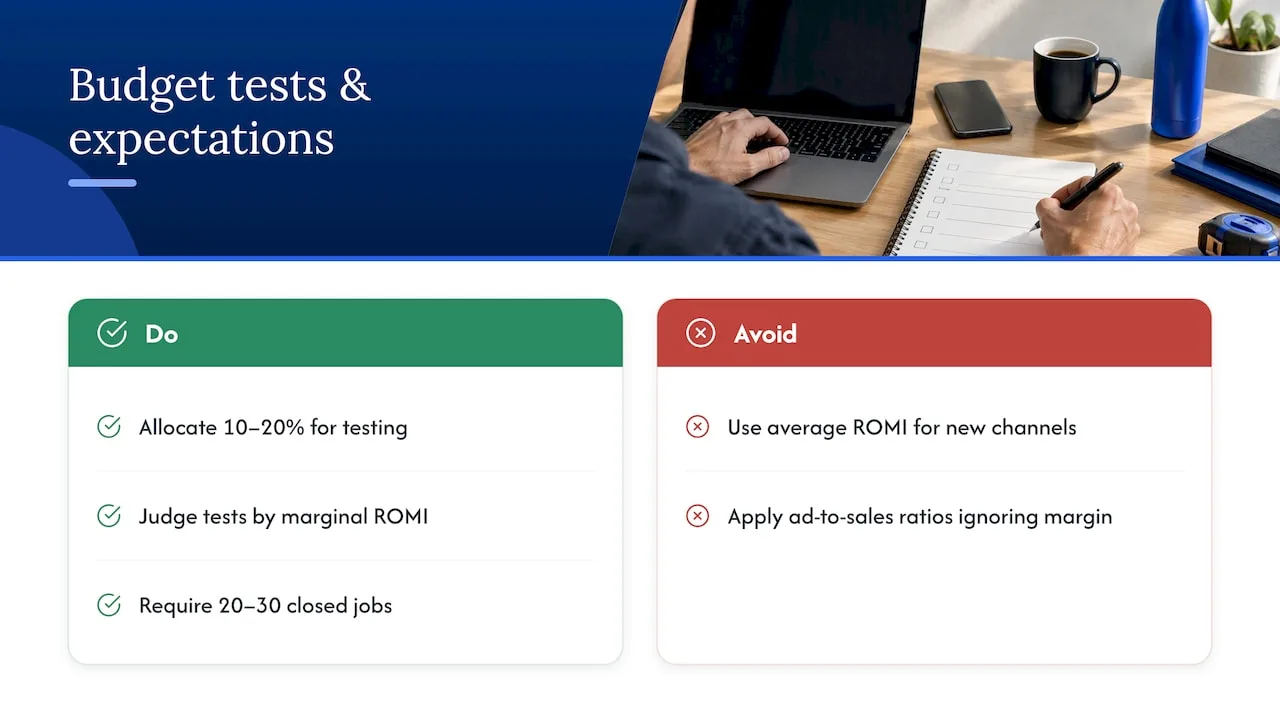
Give any test a minimum of 20 to 30 closed jobs before trusting its numbers. A plumbing contractor with a $400 average ticket needs a different sample size than a roofer closing $12,000 jobs.
Avoid blind advertising-to-sales ratio rules borrowed from other industries. A ratio that ignores your margin tells you nothing about whether a channel is actually profitable.
— Tyson
How we can help you put this measurement stack to work
If building call tracking, CRM fields, and offline conversion imports from scratch sounds like more than your team has time for, we built our services around doing exactly that for contractors in plumbing, HVAC, electrical, and roofing. Our work spans conversion-focused websites, local SEO, missed-call text-back and CRM automation, AI voice and chat intake, and review systems, all reporting into one place so you can see channel-level ROI without guesswork.
- Websites built to book jobs, not just display a portfolio
- Missed-call text-back and CRM automation to stop losing leads after hours
- AI voice and chat tools that capture leads around the clock
Check our pricing and plans to see what fits your business, or reach out for a measurement audit of your current setup.
FAQ
What is the 70/20/10 rule in marketing?
For contractors, that 10% testing slice is where you track marginal ROMI most closely since it reveals whether a new channel deserves a bigger share of next quarter’s budget.
What is a good ROI for marketing?
There is no universal benchmark, since a good ROI depends on your margin, job value, and channel mix. The more useful question is whether your marginal ROMI stays positive as you scale spend, which the American Marketing Association points to as a better signal than any single target number.
What is the 3-3-3 rule for marketing?
Definitions vary across industries, and no standardized contractor version of a “3-3-3 rule” appears in established marketing sources. Rather than chase a borrowed heuristic, contractors are better served tracking CPA and ROMI by channel with the tracking setup described above.
What is the 40-40-20 rule in marketing?
For contractor marketing, the audience and offer (your service area and the deal or guarantee you lead with) usually matter more to ROI than ad design.