
Multi-location contractor SEO means making each town or office you serve earn its own visibility. That takes three things: a Google Business Profile set up the way Google’s rules allow, a real page for each market that shows real work there, and reviews and local links from each area. Copying one page and swapping the city name does not do it. Below is how to build each piece, what it costs you in effort, and how to tell whether it is working.
TL;DR
- Google ranks local results on relevance, distance and prominence, so a contractor will usually rank best near its base and weaker in farther towns. That is normal, and you can work on it.
- Follow Google’s profile rules: one profile for a central office, or one per genuinely separate location with its own staff. Do not create profiles for towns where you have no presence.
- Build a service page that explains the work, then local pages that show local projects, response details and reviews. No city-name swaps.
- Collect reviews and local links market by market, and track calls and booked jobs per location, not just rankings.
- If you run crews in Rhode Island and Massachusetts and want this handled for you, see our Local SEO & Google Business Profile service.
Table of Contents
- Why you can rank in one city and vanish in the next
- Set up your Google Business Profile the way Google allows
- Build location pages that earn their place
- Keep your business details consistent everywhere
- Reviews: the market-by-market signal
- Local links: earn them where you work
- Track results by location
- A practical rollout for a two-state contractor
- What this looks like with us
- Our perspective
- FAQ
- Sources
Why you can rank in one city and vanish in the next
Google says local results are based mainly on relevance, distance and prominence. Distance is how far a business is from the searcher or from the place named in the query. Prominence draws on links, articles, directories and your review count and score, as Google’s local ranking explanation, summarized here, puts it.
That explains the pattern most multi-town contractors see. A roofer might sit first within five miles of the office, fourth in the next city and twelfth twenty miles out, and that does not necessarily mean anything is broken. Distance is the factor you cannot edit. Relevance and prominence are the ones you can.
So the goal of multi-location SEO is not to be first everywhere overnight. It is to raise relevance and prominence in each market until you are competitive in the towns where you want jobs, and to put your effort first where a booked job is worth the most.
What does not work
Adding dozens of town names to one page is the classic shortcut. Local ranking experts report it rarely moves rankings, because Google has become better at telling whether a business genuinely serves an area or just mentions it. The fix is evidence: real work, real reviews and real local connections.
Set up your Google Business Profile the way Google allows
Most contractors go wrong here first, and the damage is hard to undo. Google’s own guidelines say a service-area business, one that serves customers at their locations, should have one profile for its central office or location with a designated service area. The same page says a business with different locations, separate service areas and separate staff at each may have one profile per location. It also says service-area businesses cannot list a virtual office unless that office is staffed during business hours.
Service areas, step by step
For a contractor working out of one shop and driving to several towns:
- Keep one profile, tied to the real base.
- Add your service areas. Google lets a service-area business set up to 20 areas based on cities, postal codes or other areas.
- Keep the whole area realistic. Google’s guidance is that the overall boundary should not extend more than about two hours of driving time from where you are based.
- If customers do not come to your address, hide the address and rely on the service-area setting.
In Rhode Island, two hours covers the entire state from almost anywhere. In Massachusetts, it covers a lot of ground too, so the question is less about the limit and more about which towns you actually want to work in. Pick the towns by job value and crew travel time, not by the maximum Google allows.
When a second profile is legitimate
A second profile fits when you run a genuinely separate operation: a second shop, different staff serving that area, and a business presence that exists in the real world. Opening a profile at a mailbox or shared desk to chase a new town breaks the rules and puts the profiles you already have at risk of suspension. If you are unsure whether a new branch qualifies, read the guidelines page above before you submit anything.
Once you have more than one profile, keep the business name exactly as it appears on your signage and paperwork, choose the fewest categories that describe your core business, and make hours accurate for each location. Holiday hours matter more than most owners expect, and we cover them in our guide to holiday hours on Google Business Profile. Category choice can also be tested over time, which we explain in our 60 to 90 day categories test.
Build location pages that earn their place
Your website is where relevance gets proven. The structure that works is simple: service pages explain the work, and location pages show where and how you deliver it.
Search Engine Land’s geographic page guidance says a location page should carry practical local facts: the services available, staff, hours, directions and what a customer can expect. For a contractor, that translates into this checklist.
| Element | Service page (for example, water heater replacement) | Location page (for example, Warwick, RI) |
|---|---|---|
| Job of the page | Explain the work, process, options and pricing factors | Show you do this work in this town |
| Proof | General process, certifications you hold, warranty terms | Real local projects, photos, customer reviews from that area |
| Local detail | None needed | Response times, travel details, local permit or code notes where relevant |
| FAQ | Questions about the job itself | Questions specific to the town or area |
| Links | To related services | Back to the service page, plus nearby locations you serve |
This hub-and-spoke setup keeps the core sales explanation in one strong place, while the area pages add local evidence and link back to it. You can reuse accurate shared process information, but do not publish pages that answer the same question with only the city name changed.
How to avoid doorway pages
Google treats mass-produced pages that exist only to rank for place names as a spam problem. A page earns its place if a homeowner in that town would find something on it that they would not find on the page for the town next door. If you cannot write at least a few paragraphs of true local material, wait until you have a project, a review or a response detail to include. Our guide to service area pages and doorway penalties walks through the checks.
Structured data helps search engines read each page. Each location needs its own accurate details, and we explain the formatting in our local business schema guide.
Visibility without repeating city names
Multi-location marketing does not stop at pages. Scheduling and operations matter too: a contractor with several sites needs a way to keep crews, bookings and customer records straight so the experience matches the promise on each page. Practical advice on that is in this guide to multi-location scheduling, which pairs well with a local SEO plan because a fast, reliable response is part of what turns a visit into a booked job.
Keep your business details consistent everywhere
Google’s guidelines tell you to represent your business as it appears in the real world, across signage, stationery and other branding. Apply that to every listing you control. For each location, decide on one version of the name, phone number, service area and hours, then use it on your website, your profile and every directory.
A short routine keeps this under control:
- Keep a single spreadsheet with the approved name, phone number, website URL and hours for each location.
- Use a distinct tracking number per location where you need to measure calls, and keep your main number listed on the website and in directories. Our call tracking checks show how to do this without confusing search engines.
- Audit the main directories and your profile once a quarter, and fix anything that drifted after a move, a rebrand or a new phone line.
- Keep your customer records clean too, since duplicate or outdated contacts undermine follow-up. See our CRM data cleanup playbook.
Reviews: the market-by-market signal
Reviews feed prominence, and they also decide whether a homeowner picks up the phone. BrightLocal’s 2026 survey of 1,002 US consumers found that 97% of consumers read reviews for local businesses, 47% will not use a business with fewer than 20 reviews, 74% only care about reviews from the last three months, and 31% will only use a business with 4.5 stars or more.
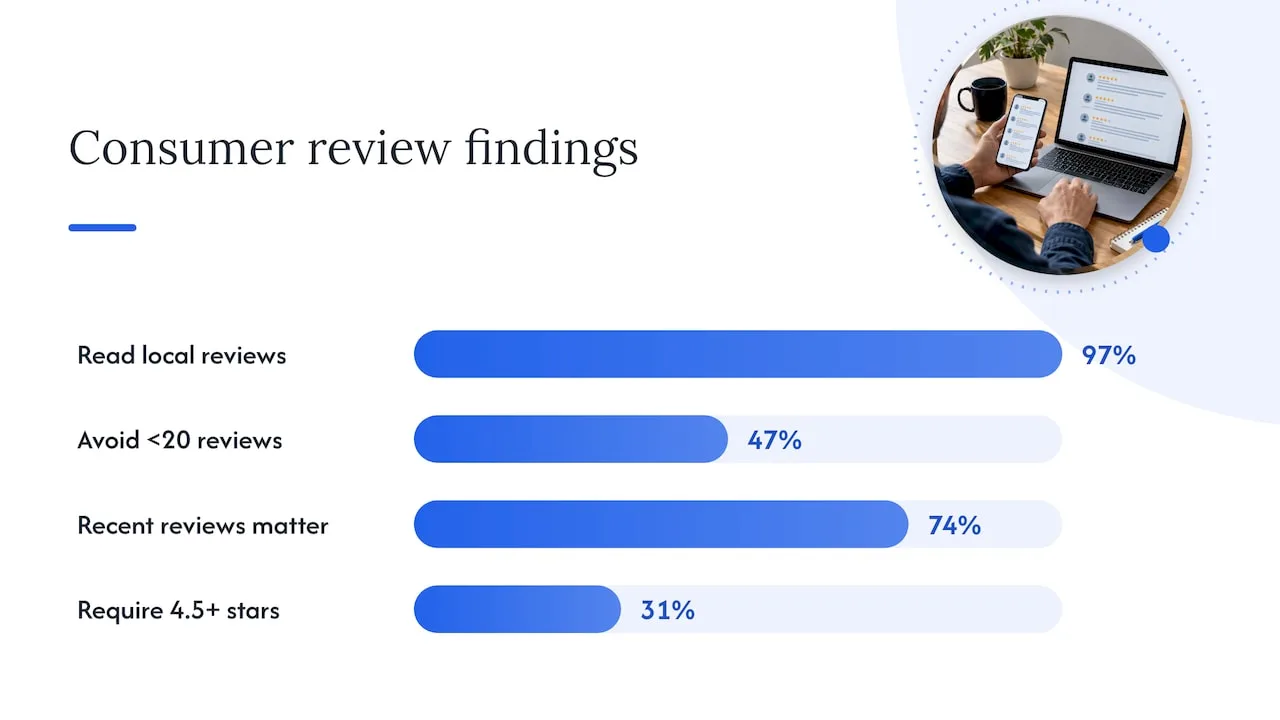
For a multi-town contractor, those numbers point to a practical rule: reviews need to be recent and spread across the areas you serve. A hundred reviews from one town do little for a customer searching from another. Ask for a review right after each job while the crew is still fresh in the customer’s mind, and note which town each review covers.
An automated request after job completion makes this routine instead of occasional. Our reviews service is built around that idea. Respond to every review, positive or not, in a way that mentions the work done and the area where appropriate.
Local links: earn them where you work
Links from local organizations signal that you are a real part of each community. Think sponsorships of youth teams, chambers of commerce and trade associations, local news mentions and supplier or partner pages. Each one should live in the market it supports. We list practical options in our local link building ideas for Rhode Island and Massachusetts contractors.
Do not buy links in bulk. Five relevant links from organizations in your target towns beat fifty from unrelated directories, and they are easier to defend if anyone ever looks closely.
Track results by location
Rankings alone do not pay anyone. What matters is how many calls, forms and booked jobs each market produces. A workable tracking setup has four parts:
- Calls by location: a separate tracking number or source tag for each profile and each location page.
- Leads by source: forms, chat and missed-call text-backs logged in your CRM with the town attached.
- Booked jobs: the step that matters. Connect each lead to the job it became and its value.
- Rankings by area: check results from within each market, since a search from the shop will not show what a customer three towns away sees.
If you run paid local ads alongside organic work, Google says U.S. advertisers can review leads in the Local Services lead inbox, including phone leads, messages, booked appointments and, where available, phone recordings. Our local services ads guide shows how to follow those leads up quickly.
Compare locations on cost per booked job, not on traffic. A town that sends fewer visitors but books more jobs deserves more of your budget.
Do not let the leads you earn go unanswered
A multi-location plan fails quietly when the phone rings during a job and nobody picks up. Capture that demand with a missed-call text-back, after-hours answering or an AI voice agent. We cover the steps in our after-hours answering guide.
A practical rollout for a two-state contractor
Here is a sequence that fits a business with one or two shops serving several towns:
- Weeks 1 to 2: Audit every profile and listing. Fix names, phone numbers, service areas and hours. Remove or merge duplicates.
- Weeks 2 to 4: Strengthen your core service pages. Make sure each trade you offer has one clear page with process, proof and a call to action.
- Month 2: Launch location pages for your top three markets only, each with real projects, photos, reviews and local FAQs.
- Months 2 to 3: Start the review request routine and your first local link outreach in those same towns.
- Month 3 onward: Review calls and booked jobs by location. Add the next market only when the first ones have local content you are proud of.
This staged approach beats launching 30 pages at once, because it lets you learn which content earns calls before you scale it.
What this looks like with us
We work only with contractors in Rhode Island and Massachusetts, across plumbing, HVAC, electrical, roofing and landscaping. Our team handles Google Business Profile optimization, local SEO, websites built to book jobs, automated review requests and 24/7 call handling, so each town you serve gets the attention it needs.
Our plans are published on our pricing page:
| Plan | Price |
|---|---|
| Foundation | $597 per month |
| Growth | $1,297 per month |
| Scale | $2,497 per month |
Extra locations start from $299 per month, and an AI employee on the Growth plan is $199 per month. Paid ads management is available as well, and the pricing page has the details.
If you would like us to look at how your profiles, pages and reviews are set up across your towns, start at our home page or see how our websites that book jobs work.
Our perspective
Most contractors we meet in Rhode Island and Massachusetts have the same story: the phone rings in the home town and goes quiet everywhere else. The instinct is to publish a page for every town in the state. We think that is backwards.
The stronger approach is to treat each market as its own small campaign. One accurate profile, a page with real local work, reviews that come in steadily, and a phone that gets answered. Because we work only with contractors in this region, our team knows the towns and the trades, and we build for how homeowners here actually search and call.
We also believe SEO and lead handling belong together. Ranking in a new town only pays when the call is answered and the follow-up happens. That is why our systems pair local SEO with automated follow-up, review requests and 24/7 call handling, so the visibility you earn turns into booked jobs.
Tyson
FAQ
How many locations do I need before multi-location SEO applies?
Two is enough. If you serve more than one town, or run more than one shop, you face the same questions about profiles, pages and reviews. The difference is mainly in whether you have one profile with several service areas or a profile for each genuinely separate location.
Should I create a Google Business Profile for every town I serve?
No, not unless you have a real, staffed presence there. Google’s guidelines say a service-area business should have one profile for its central office, and separate profiles fit only when locations, service areas and staff are genuinely separate. Use the service-area setting to cover the other towns.
Do I need a separate page for each city?
Only where you can say something true and useful about that market. A page with local projects, reviews, response details and local questions can rank and convert. A page that repeats your service copy with a new city name usually adds risk, not rankings.
How much does multi-location contractor SEO cost?
It depends on the number of locations and the scope of work. Our published plans run from $597 to $2,497 per month, and extra locations start from $299 per month. The pricing page lists what each plan includes.
Sources
- Guidelines for representing your business on Google
- Manage your service areas for service-area and hybrid businesses
- Manage leads and jobs, Local Services Help
- How GBP Impacts Local Rankings
- How Local Rankings Actually Work
- Multi-location SEO: How to structure geographic pages
- BrightLocal Local Consumer Review Survey 2026
- Multi-Location Scheduling: How to Run Several Sites