Lead routing rules are the conditions that decide who owns a new inquiry the moment it arrives. For a contractor, that means a clear answer to one question: when a homeowner calls, fills out a form or texts, which person is responsible for the next move? Good rules send a burst pipe to the on-call plumber, a roof estimate to your estimator, and a Providence request away from the crew based in Fall River. Bad rules, or none at all, leave leads sitting in a shared inbox where everyone assumes someone else has it.
This guide shows you which criteria to use, how to order the rules, when round robin works for a trades team, and what to do with leads that match nothing.
TL;DR
- Routing decides who owns a lead. Follow-up decides what happens next. You need both, but routing comes first.
- Start with eligibility (service, town, skills, hours), then distribute among the people who qualify.
- Round robin is fair and fast, but only when the people in the rotation can all do the job.
- Every lead needs a fallback: after-hours handling and a named person for anything that matches no rule.
- Check your rules monthly by reading real leads, not by trusting the settings screen.
Table of Contents
- What lead routing rules actually do
- Why speed makes routing a revenue issue
- The criteria worth routing on
- How to order your rules
- Round robin lead routing for a contractor team
- What to do with after-hours, unmatched and unassigned leads
- Common routing problems to check for
- How to tell whether your routing works
- Our perspective: routing is only half of the job
- Putting this in place with Coastal Connect
- A simple starting setup you can use this week
- FAQ
- Sources
What lead routing rules actually do
A routing rule is an if-then statement. If the request is for water heater replacement and the address is in Warwick, then assign it to the plumbing lead. If the call comes in after 6 p.m. and the caller says water is leaking, then page the on-call tech. The rules run the instant the inquiry lands, so nobody has to read, sort and forward it by hand.
One operations-focused guide to routing rules lists the inputs a business can route on: service type, location, existing relationship, skills, working hours, workload, urgency and source. It also makes a distinction worth keeping: routing establishes responsibility, while follow-up determines what happens afterward. A lead can be assigned perfectly and still go cold if the owner never calls. We come back to that in the monitoring section.
Most of what ranks for this topic is written for sales teams with territories and account executives. A contractor has a different problem. Your “reps” may be an owner, an office manager and two estimators, and the lead is a homeowner who is probably calling two other companies. The logic transfers, but the stakes are speed and fit, not enterprise account hierarchy.
Why speed makes routing a revenue issue
Homeowners with a leak, a dead furnace or a missing shingle rarely wait. Research published in Harvard Business Review, “The Short Life of Online Sales Leads”, concluded that most companies do not respond to online inquiries nearly fast enough. That study looked at online leads in general, not home services specifically, but the lesson holds for the trades: the first company to answer usually has the advantage.
Routing is where that delay starts. If a form submission lands in a general inbox and waits for someone to claim it, you have already lost minutes before anyone has even looked. A rule that assigns it instantly and alerts one named person removes that gap.
The criteria worth routing on
You can route on a dozen fields. Most contractors should use five or six. The same operations guide recommends collecting only the fields that change the assignment. If a piece of information never alters who gets the lead, do not make the homeowner type it.
Requested service
This is the first filter in almost every trades business. Drain cleaning, tankless install, AC tune-up, panel upgrade, roof replacement and storm repair often need different people, different trucks and different pricing conversations. A web form with a short service dropdown, or an AI call handler that asks “what do you need help with?”, gives the rule what it needs.
Service location
In Rhode Island and Massachusetts, towns matter more than people expect. A crew in Cranston can reach most of Providence County quickly, but a job on the Cape or in Newport County may be a long drive. Route by ZIP code or town list, and write the list down. If you have more than one location, the rule should send each lead to the nearest team. Leads outside your area should go to a polite decline or a referral path, not to a tech who will waste a trip.
Urgency
An emergency and a quote request for next spring should not wait in the same line. Define urgency in plain terms your intake can recognize: active leak, no heat, no power, tree on the roof. Those trigger the on-call rule. Everything else follows the normal path.
Existing relationship
A returning customer should reach the tech or account manager who knows the house. Match on phone number or email against your customer list. It is a small rule that makes people feel remembered, and it keeps a warranty callback away from the sales queue.
Skills and licensing
Not every employee can do every job. Gas work, electrical panel work and roofing all carry certification or licensing requirements that vary by state, so route only to people who are qualified to take the job. Check your state licensing board for the specifics that apply to your trade rather than assuming one rule covers both states.
Source
A call from your Google Business Profile, a click on a paid ad, a referral and a form on a landing page may deserve different handling. Referrals might go straight to the owner. Paid-ad leads might go to whoever is fastest, because you are paying for each one. Tracking source also tells you which channel brings the work worth chasing.
Hours and workload
Availability is the criterion that most small shops forget. A rule that sends a lead to someone on vacation, off shift or already booked solid is worse than no rule. Tie assignment to a schedule and, if you can, to how many open leads each person already holds.
How to order your rules
The cleanest mental model is to separate eligibility from distribution. First decide who is allowed to handle the inquiry, then choose among those people. The guide we mentioned above frames it the same way: determine who can handle it, then pick among the eligible.
In practice, order your rules like this:
- Emergencies first. Anything urgent skips the queue and goes to the on-call person, with a backup if they do not acknowledge within a few minutes.
- Existing customers second. Send them to the person who knows the account.
- Service and location filters third. These narrow the pool to qualified people who cover that town.
- Availability fourth. Remove anyone off shift, on time off or at capacity.
- Distribution last. Among whoever remains, pick by round robin, by least busy, or by a named owner.
- Fallback at the bottom. Anything that matched nothing goes to a named intake owner.
The order matters because the first rule that matches usually wins. If your general round robin sits above your emergency rule, a flooded basement can land with whoever is next in line, not whoever is on call.
A worked example
Take a plumbing and HVAC company with two plumbers, one HVAC tech, an office manager and a Warwick base. A form comes in at 2 p.m. for a furnace that will not start, address in Cranston, from a returning customer.
- Emergency check: the customer says no heat. It is cold out, so this counts as urgent.
- Existing customer: yes, the HVAC tech did the install last year.
- Eligibility: HVAC skill, covers Cranston, on shift.
- Result: assigned to the HVAC tech, with a text alert, and the office manager copied.
Change the request to a quote for a bathroom remodel and the same lead goes to the estimator on the next scheduled call-back slot instead. Same system, different path, no human sorting.
Round robin lead routing for a contractor team
Round robin sends each new lead to the next eligible person in a rotating list. Person A gets the first, B gets the second, C the third, then back to A. One overview of round robin routing describes it as a way to assign each lead to the next eligible rep in a rotating queue, and notes the main benefit is fast, fairly even assignment. It also points out the weakness: equal distribution does not guarantee equal workload or the best match between person and lead.
When round robin fits
- Several people handle the same type of work, such as two estimators who both quote roofing.
- Leads are similar in size and urgency.
- Everyone in the rotation covers the same service area.
- You want to avoid favoritism, or the owner grabbing every good lead.
When it does not
- One person is the only licensed electrician. Rotating electrical leads to a laborer helps nobody.
- Territories are far apart. A pure rotation will send a Boston lead to your Providence tech.
- Lead value varies widely. A $400 repair and a $30,000 re-roof are not the same turn.
- Someone is out. A rotation that ignores availability simply parks leads on an unresponsive phone.
Safer ways to run it
Use round robin only inside a pool you have already filtered. If three estimators cover South County, rotate among those three, skipping anyone marked unavailable. Add a timeout: if the assigned person has not acknowledged in, say, ten minutes, reassign the lead to the next person and alert the owner. Weighted rotation is another option when one person should take more volume because they have more capacity.
What to do with after-hours, unmatched and unassigned leads
This is where most contractor routing fails. The rules work in the daytime for common jobs. Then a call arrives Saturday at 9 p.m. for a service you listed under a different name, from a town you did not list, and it vanishes.
Build three safety nets.
1. An after-hours path
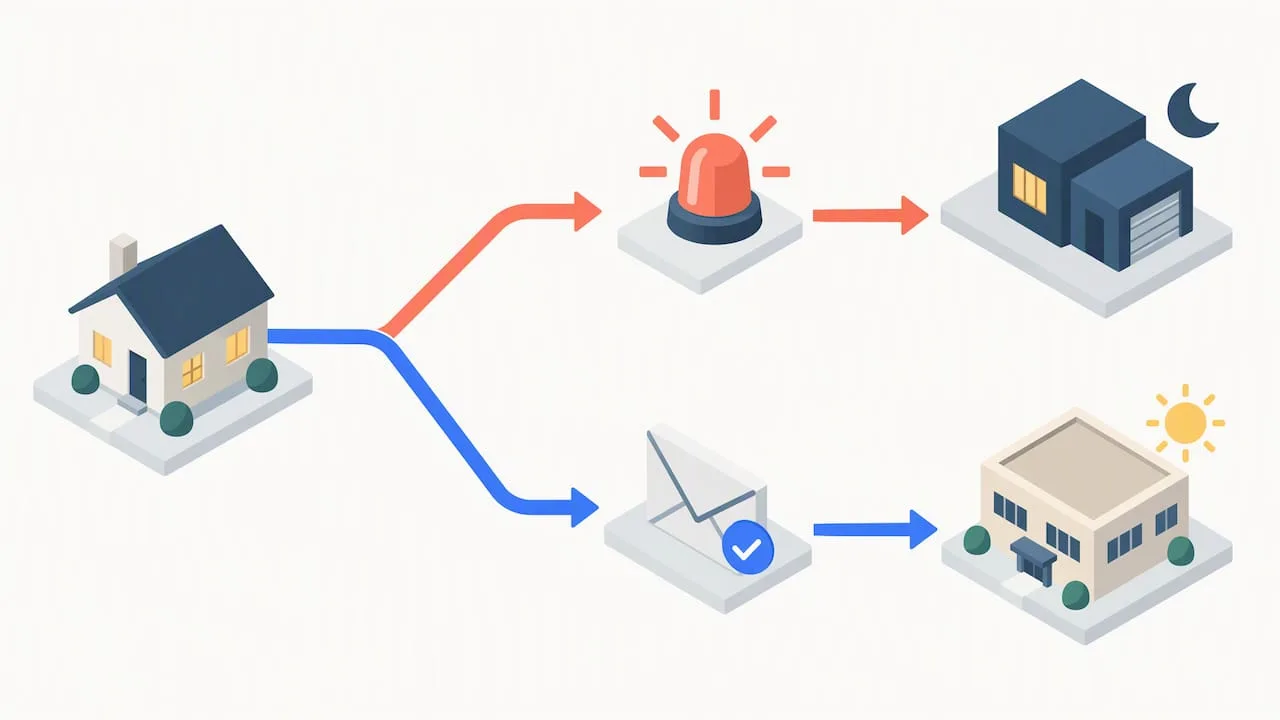
Decide in advance what happens when nobody is at a desk. Options include an on-call phone, a voice agent that gathers the problem, address and callback number, or an automatic text that confirms you received the request and states when someone will reply. For emergencies, the path should reach a human fast. For non-urgent requests, a prompt acknowledgment plus a first-thing-in-the-morning assignment is reasonable. The failure to avoid is silence.
2. A named intake owner
Incomplete records should go to a named intake person, not sit unassigned, which is also the recommendation in the operations guide cited earlier. For a small shop that is usually the office manager or the owner. Their job is to read what did not match, fix the data, and either assign the lead or reply directly.
3. A missed-call and unanswered-lead rule
If a call goes unanswered, the caller should get a text within moments. If an assigned lead is not touched within a set window, escalate it to a backup. Most routing leaks look like this: the rule did assign the lead, and the person never acted on it.
Common routing problems to check for
Run through this list whenever leads seem to be slipping.
| Problem | What it looks like | Fix |
|---|---|---|
| Overlapping rules | A lead matches two rules and goes to the wrong person | Put specific rules above general ones |
| Missing fallback | Some leads show no owner | Add a catch-all that routes to the intake owner |
| Stale team list | Leads go to someone who left or is on leave | Review the roster monthly |
| Service area gaps | A town you serve is not on the list | Compare the list to actual jobs booked |
| Messy form fields | Free-text service names that no rule recognizes | Use dropdowns for service and town |
| No acknowledgment | Lead assigned, nobody responds | Add a timeout and reassignment |
| Duplicate leads | The same homeowner appears three times through call, form and chat | Match on phone number and merge |
How to tell whether your routing works
A rule that looks correct on screen can still fail in the field. The checks that matter are simple.
- Test every path. Submit a form for each service, from an in-area and an out-of-area address, during business hours and after. Call the main number at night. Confirm each test lands where you intended.
- Read the routing log. Look at the last 20 leads. Who got each one, and how long before the first contact? Patterns appear fast: one person always last to respond, one source with no owner.
- Track time to first contact. Measure from the moment the lead arrives to the first call or text. Pick a target you can hold, and review the slowest 10 percent each month.
- Compare assignments to outcomes. Look at booking rates by person, source and service. If one estimator closes far fewer jobs from the same lead type, the issue may be follow-up, not routing, and you will want to know which.
- Re-audit after any change. New hire, new town, new service line or new ad campaign all justify a fresh test.
Our perspective: routing is only half of the job
We work only with contractors in Rhode Island and Massachusetts, and the pattern we see is consistent. Owners rarely lack leads. They lack a dependable way to catch every one of them. The phone rings while a tech is under a sink, the form sits unread over a weekend, and the homeowner books whoever answered.
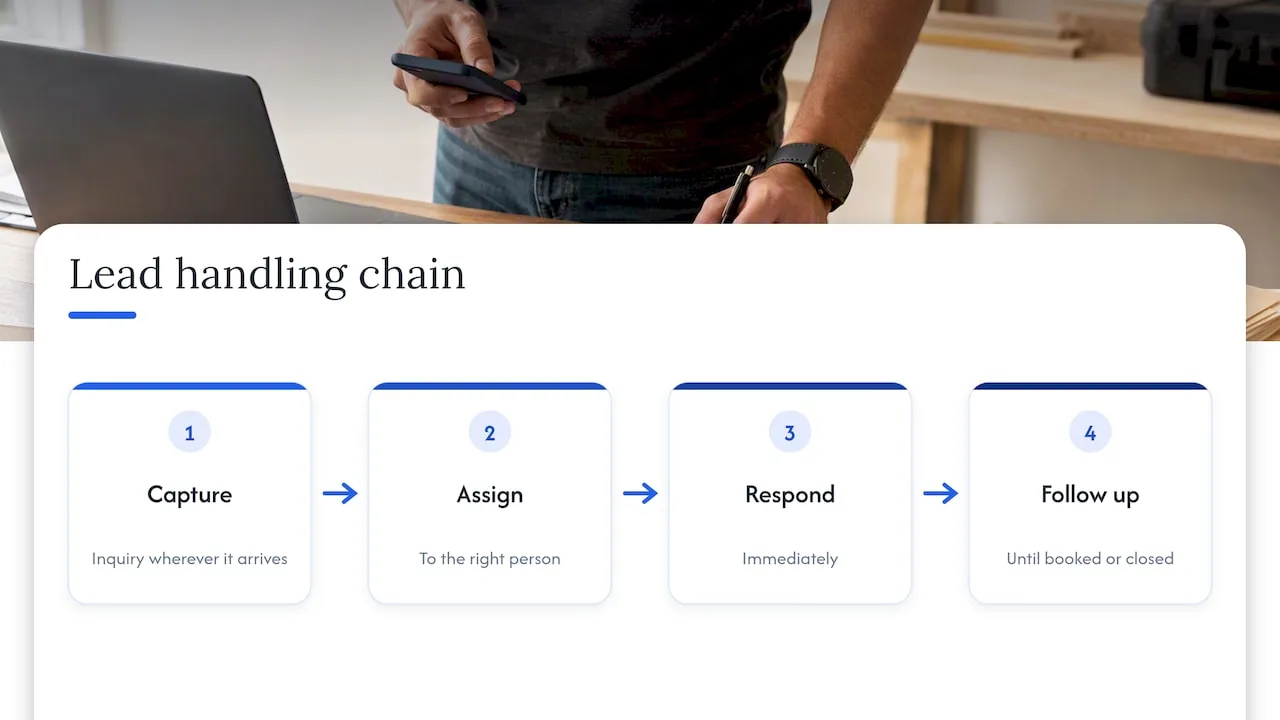
So we treat routing as one link in a chain: capture the inquiry wherever it arrives, assign it to the right person, respond immediately, then follow up until the job is booked or closed. Fancy rules do not help if the first step drops the lead. That is why we pair routing logic with missed-call text-back, an AI voice agent for inbound calls, website chat and automated follow-up. The system acknowledges the homeowner right away, even while your people are on a job.
Our advice for a team with fewer than ten people is to keep the rules boring. Five or six criteria, one fallback owner, and a monthly review beat a clever setup nobody maintains. Know your towns, write down who covers them, and make sure a person is always the backstop when automation runs out of answers.
— Tyson
Putting this in place with Coastal Connect
If you would rather not build this yourself, we set up the capture and follow-up side for trades businesses. The missed-call text-back and CRM service handles instant replies and lead tracking, and our AI voice agent answers inbound calls around the clock. Our websites that book jobs use short forms that collect exactly the fields your rules need.
Our published plans start with Foundation at $597 per month, Growth at $1,297 per month and Scale at $2,497 per month. An AI employee on the Growth plan is $199 per month. See the pricing page for what each plan covers.
A simple starting setup you can use this week
You do not need software to begin. Start on paper, then translate it into whatever tool you use.
- List every way a lead reaches you: phone, form, chat, text, Google Business Profile messages, referrals.
- List your services in the exact words customers use, and your towns by name.
- For each service and town combination, write down who is eligible.
- Mark which jobs are emergencies and who is on call.
- Decide the distribution method inside each pool: named owner, round robin or least busy.
- Name your intake owner for anything unmatched.
- Set a response target and a backup person for when it is missed.
- Test every path before you rely on it.
Two pages of notes is a perfectly good first version. The point is that every lead has a destination before it arrives.
FAQ
What is the difference between lead routing and lead follow-up?
Routing assigns an inquiry to a responsible person or team. Follow-up is everything that person or system does afterward: calling, texting, sending an estimate, reminding the homeowner. You need both, and routing should come first because follow-up cannot start until someone owns the lead.
Is round robin a good choice for a small contractor?
It works when two or more people can handle the same kind of job in the same area. It works poorly when only one person is licensed or nearby, or when lead values differ a lot. Filter by service, town and availability first, then rotate among whoever is left.
How many routing rules do I need?
Most small trades businesses do well with five to eight: emergency, existing customer, service type, town, availability, a distribution method and a fallback. More rules create overlaps and make mistakes harder to find. Add a rule only when it changes who should get the lead.
What happens to leads that arrive after hours?
They need a defined path, not a hope. Emergencies should reach an on-call person quickly, while routine requests can receive an automatic acknowledgment and be assigned first thing the next business day. Either way, the caller should hear back from you the moment they reach out.
How often should I review my routing rules?
Check them monthly and after any change to staff, service area or services offered. Read recent leads, confirm each had an owner, and look at how long the first response took.