The single most useful set of lead qualification questions covers four dimensions: need, budget, authority, and timeline. Ask open-ended, business-case questions first, covering the problem and its cost, before you ask about money. Use BANT for speed on simple deals, and MEDDIC or CHAMP when the buying group and deal size get complicated. Qualify continuously, not once.
TL;DR:
- Short deals with a single decision maker and clear budget candidates often only need BANT qualification, while complex enterprise deals benefit from MEDDIC’s detailed criteria.
- Asking about the problem and consequences first helps reveal genuine need and success metrics before discussing budget or authority, increasing qualification accuracy.
- Qualification should be an ongoing process, with requalification needed after stakeholder changes or scope adjustments, rather than a one-time gate.
- Automated tools targeting need, timeline, and fit signals can capture leads early, but higher-level questions like budget and authority should be deferred to calls or follow-up.
- Avoid rigid scripting; instead, ask open-ended questions tailored to the deal’s complexity and listen actively to better identify true qualification.
Table of Contents
- 1. Questions grouped by qualification dimension
- 2. How to structure a discovery call: order and timing
- 3. Adapt questions by deal complexity and ICP
- 4. Turning qualifying questions into forms, scoring, and automation
- 5. Example scripts and phrasing for phone, email, and chat
- 6. Research-backed best practices behind these frameworks
- 7. What most teams get wrong about qualification
- 8. Coastal Connect: turning qualification into automated capture and follow-up
- Sources
- FAQ
1. Questions grouped by qualification dimension
Every strong qualification question does one job: it makes the prospect reveal something they would not volunteer on their own. The trick is grouping questions so you cover every dimension without turning discovery into an interrogation.
Need. Start broad, then narrow toward measurable pain. “What problem are you trying to solve right now?” opens the conversation without leading the witness. Follow with “What happens if this doesn’t get fixed in the next six months?” to surface consequences, and “How would you know if this was solved, what would change?” to pin down a success metric. These three questions do more work than a dozen closed ones because they force the prospect to articulate value in their own words.
Budget. Budget questions fail when they sound like a price check. Instead of “What’s your budget?” try “What have you set aside to solve this, or is this still in the exploration phase?” That phrasing gives an honest prospect room to say “nothing yet” without feeling caught out, and it tells you whether you’re talking to someone early in the process or someone ready to allocate spend. A second useful version: “What would this problem need to cost you before spending money to fix it made sense?”
Authority. Few buyers admit they lack authority, so ask around the issue instead of at it. “Who else weighs in before a decision like this gets made?” works better than “Are you the decision maker?” because it assumes a process exists and invites the prospect to map it for you. Add “Walk me through how a similar purchase got approved in the past” to expose the real approval chain, and “Who would be most affected if this rolled out?” to find a champion who isn’t the final signer but can carry your case internally.
Timeline. Timeline questions should hunt for a driving event, not a wish date. “Is there something forcing a decision by a certain point, a contract renewal, a compliance deadline, a busy season?” gets a sharper answer than “When do you want to start?” If there’s no driving event, that’s information too: it usually means the deal will slip.
Fit, obstacles, and champion questions round out the picture. Ask “Have you tried to solve this before, and what happened?” to learn what’s already failed and why. Ask “What would stop this from moving forward even if everything else looks good?” to surface objections while there’s still time to address them. For complex, multi-stakeholder deals, layer in MEDDIC-style questions on metrics and decision criteria: “What numbers will you show your leadership to justify this?” and “What criteria will you use to compare options?” These questions matter most when more than two or three people touch the final decision, since that’s when unstated criteria quietly kill deals late in the cycle.
A short reference list for the questions worth memorizing:
- Need: “What problem are you trying to solve, and what happens if it doesn’t get fixed?”
- Budget: “What have you set aside to solve this, or is this still exploratory?”
- Authority: “Who else weighs in before a decision like this gets made?”
- Timeline: “Is there something forcing a decision by a specific date?”
- Fit: “Have you tried to solve this before, and what happened?”
- Metrics (MEDDIC): “What numbers would you show leadership to justify this purchase?”
2. How to structure a discovery call: order and timing
The order you ask questions in matters as much as the questions themselves. Salesforce recommends moving from context to commitment, which earns you the right to ask about money instead of demanding it upfront.
- Context and fit. Confirm you’re talking to someone in the right role and industry before anything else.
- Current problem and consequences. Get the prospect talking about pain in their own words.
- Desired outcome and success measure. Establish what “solved” looks like in numbers or outcomes.
- Urgency and timeline. Find out if a driving event exists.
- Stakeholders and decision process. Map who else needs to say yes.
- Investment and approval. Ask about budget only after the case has been made.
- Obstacles. Surface objections before they become surprises later.
- Agreed next step. Leave with a specific, mutually confirmed action, not a vague “I’ll follow up.”
This order works because budget questions land differently once a prospect has already admitted a problem is costing them something. Asking about money first invites a guarded, defensive answer. Asking about money after urgency and stakeholders have surfaced turns it into a natural next step in a conversation the prospect is already invested in.
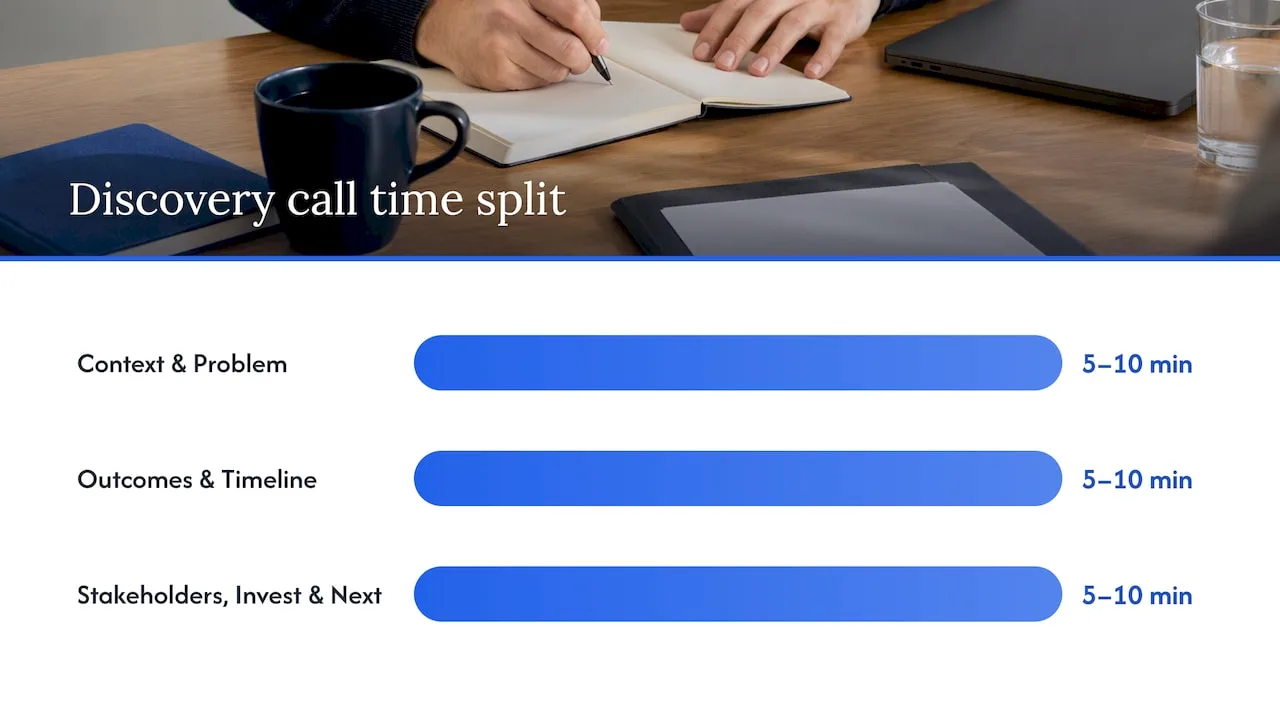
For a typical 15 to 30 minute call, spend the first third on context and problem, the middle third on outcomes and timeline, and reserve the last five to ten minutes for stakeholders, investment, and the next step. Watch for red flags that should trigger escalation or disqualification: a prospect who can’t describe a consequence of inaction, one who dodges every stakeholder question, or one who has no driving event and no urgency at all. Any of these usually means more nurturing, not more selling.
Pro Tip: When a prospect dodges budget questions, ask about the cost of the problem instead, since most people find it easier to estimate what something is costing them than to commit to what they’d spend to fix it.
3. Adapt questions by deal complexity and ICP
Not every lead deserves the same depth of questioning. Matching the framework to the deal saves time on simple sales and prevents costly misreads on complex ones.
BANT works well for shorter sales cycles with a single decision maker and a clear budget line, the kind of deal common in SMB and transactional inbound sales. MEDDIC earns its extra steps, Metrics, Economic Buyer, Decision Criteria, Decision Process, Identify Pain, and Champion, when the deal involves multiple stakeholders, technical evaluation, or enterprise procurement. CHAMP, which leads with Challenges before Authority, Money, and Prioritization, suits teams that want to open with pain discovery before anything else.
A few rules of thumb:
- Inbound leads that arrived through a demo request or pricing page visit usually need less qualification friction since intent is already signaled.
- Outbound leads need more upfront context questions because the prospect hasn’t self-selected into your funnel.
- SMB deals rarely justify a full MEDDIC pass, BANT plus one or two fit questions is usually enough.
- Enterprise deals with multiple stakeholders benefit from MEDDIC’s decision-criteria and champion questions, since those are exactly where big deals stall.
For operational thresholds, advance a lead when it clears need, timeline, and at least a plausible path to authority, even if budget is still fuzzy. Disqualify when there’s no real problem, no timeline, and no one willing to advocate internally, since no amount of follow-up fixes the absence of all three at once.
4. Turning qualifying questions into forms, scoring, and automation
Not every qualifying question belongs on a web form. Asking for budget or authority details before someone has downloaded anything tends to kill conversions, so the best approach splits questions between low-friction form fields and higher-context call questions.
Forms should capture company size, role, and the specific problem or service needed, questions with low emotional cost that also feed segmentation. Save budget, stakeholder mapping, and obstacle questions for the call or a follow-up email, where a human can read tone and adjust.
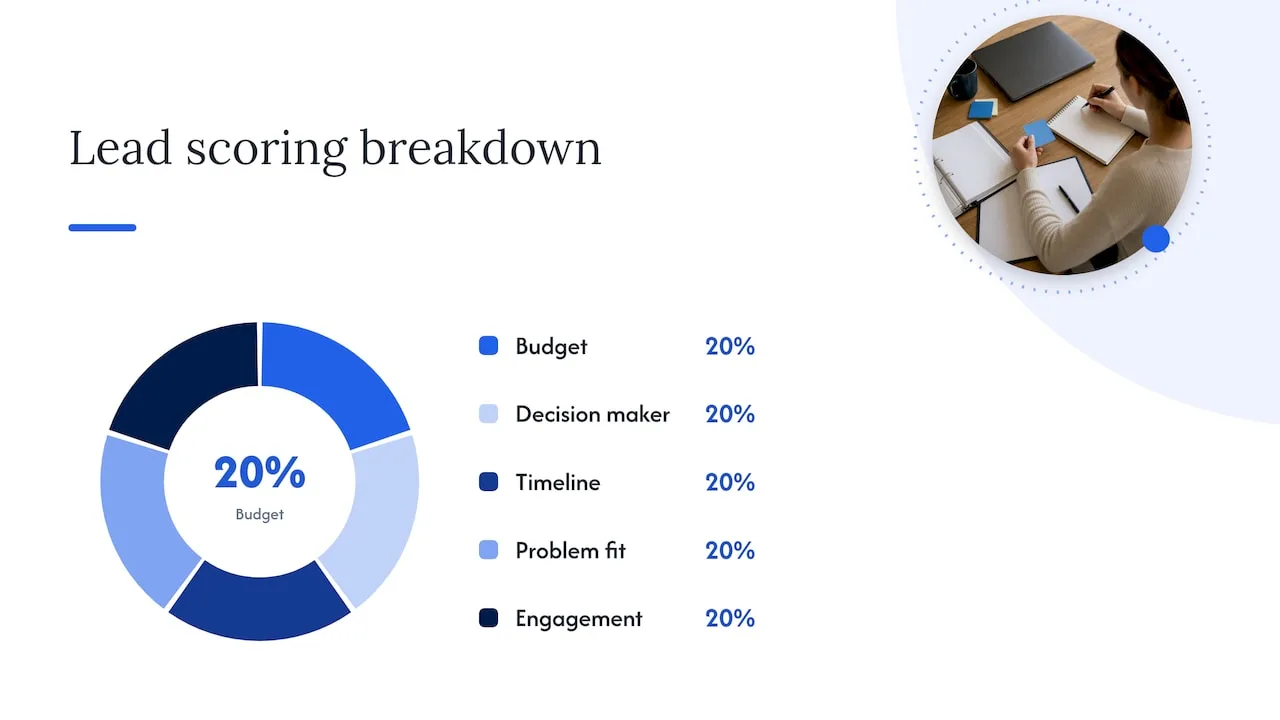
A simple scoring rubric might assign points like this: 20 points for a confirmed budget range, 20 for a named decision maker or clear path to one, 20 for a stated timeline within the current quarter, 20 for a described problem matching your ICP, and 20 for engagement signals like repeat site visits or content downloads. A lead crossing roughly 60 points moves from marketing-qualified to sales-qualified and gets routed to a rep; below that, it stays in nurture.
A few practical notes for building this out:
- Use progressive profiling to collect deeper information across multiple touches instead of one long form.
- Keep the first form under five fields to protect conversion rates.
- Route leads automatically based on score and territory so no qualified lead sits unassigned overnight, leveraging proven examples from Managed IT Services Indianapolis & Pacific Northwest | NEXTmsp.
- Revisit scoring thresholds quarterly, since what counts as “qualified” shifts as your pipeline and ICP mature.
Forrester’s research on buyer insights emphasizes publishing internal MQL and SQL definitions with clear service-level expectations, since ambiguity about ownership after a lead qualifies is one of the most common reasons good leads stall.
5. Example scripts and phrasing for phone, email, and chat
Open-ended phrasing sounds natural once you’ve practiced it a few times, but the first attempts often come out stiff. These snippets are built for reuse across channels.
- Phone opener: “Before we get into details, can you walk me through what’s prompting this now?”
- Phone, budget: “What have you set aside for this, or are you still figuring out what it’s worth solving?”
- Phone, authority: “Who else will want a say before this moves forward?”
- Email, cold outreach: “Curious what’s driving the timing on this, is something changing on your end?”
- Email, follow-up: “What would need to be true for this to become a priority this quarter?”
- Chat, first message: “What are you hoping to fix or improve, so I can point you in the right direction?”
- Chat, qualifying: “Is this something you’re evaluating for yourself or bringing back to a team?”
- Gatekeeper handling: “No problem, who typically handles decisions like this so I can share the right information with them directly?”
- Budget evasiveness: “Totally fair if it’s not locked in yet. Roughly, is this a five-figure problem or a bigger one?”
- Escalating to the economic buyer: “It sounds like this affects more than your team, would it make sense to loop in whoever owns that budget?”
Each of these avoids a yes-or-no trap. A gatekeeper or hesitant prospect will usually give you more than you expect when the question assumes cooperation instead of demanding a commitment.
6. Research-backed best practices behind these frameworks
Salesforce’s comparison of BANT and MEDDIC confirms the core logic here: BANT’s four conditions, budget, authority, need, and timeline, cover the basics fast, while MEDDIC adds the metrics, decision-criteria, and champion depth that complex B2B deals require. The recommended discovery sequence, context through to an agreed next step, comes from Salesforce’s BANT guidance, which also stresses treating MQLs and SQLs as operationally distinct stages, each with its own owner and next action.
Buyer behavior is shifting the qualification job itself. Forrester’s research on how buyers use AI finds that buyers increasingly self-research and turn to AI tools before ever talking to a rep, which means the qualifying questions a prospect can answer on a call are often ones they’ve already half-answered themselves. Forrester recommends mapping recurring buyer questions to content so answers are discoverable before the call even starts, which shortens discovery and raises the quality of the leads that do reach a rep.
7. What most teams get wrong about qualification
Most teams treat qualification frameworks like scripts instead of guides, working through BANT or MEDDIC in a fixed order regardless of what the prospect is actually telling them. That rigidity is the biggest mistake I see. A framework should shape your thinking, not replace your listening.
The second mistake is treating qualification as a one-time gate instead of a continuous check. Deals change: a champion leaves, a budget freeze hits, a competitor gets evaluated. A lead qualified three weeks ago deserves a quick requalification before a proposal goes out, not an assumption that nothing’s moved.
A few rules worth adopting as a team standard: never advance a lead without a stated problem and at least a plausible timeline, and always requalify after any major change in stakeholders or scope.
— Tyson
8. Coastal Connect: turning qualification into automated capture and follow-up
Contractors rarely have a team dedicated to scoring leads or chasing down budget answers between service calls. That’s the gap Coastal Connect fills for plumbing, HVAC, electrical, and roofing businesses in Rhode Island and Massachusetts.
Coastal Connect builds websites that book jobs, designed to capture the same need, timeline, and fit signals covered above directly on the page, before a call ever happens. The missed-call text-back & CRM system routes and scores those leads automatically, so a homeowner asking about an emergency repair gets flagged differently than one requesting a routine quote. An AI voice agent and AI website chat handle initial discovery questions around the clock, catching leads that would otherwise go to voicemail after hours.
This is an automation-first approach built to complement a skilled crew, not replace the judgment a good technician brings to a quote. The qualifying questions still matter: Coastal Connect just makes sure they get asked and logged every time, even at 9 PM on a Sunday. Contractors ready to see how this fits their trade can check pricing plans starting with Foundation.
Sources
FAQ
What are the five requirements for a qualified prospect?
Definitions vary by organization, but a common version covers need, budget, authority, timeline, and fit with your ideal customer profile. A prospect who clears need, timeline, and a plausible path to authority is often worth advancing even when budget details are still fuzzy.
How do you determine if a lead is qualified?
A lead is qualified when it has a confirmed problem matching your product, a stated or implied budget range, access to or influence on the decision maker, and a timeline tied to a real event. Teams that publish internal MQL and SQL definitions reduce disagreement about when a lead is genuinely ready for a sales conversation.
What questions come up in a lead qualification conversation?
Expect questions about the problem you’re trying to solve, what’s changed to make this a priority now, who else is involved in deciding, and what budget or resources have been set aside. Salesforce’s BANT framework recommends asking these as open-ended questions rather than yes-or-no checks, since open answers reveal more context.
When should a sales team use MEDDIC instead of BANT?
MEDDIC fits complex, high-value deals with multiple stakeholders and a formal evaluation process, while BANT works better for shorter, simpler sales cycles. Many teams start with BANT and escalate to MEDDIC’s metrics and decision-criteria questions once a deal shows signs of scale or technical complexity.
How is a marketing-qualified lead different from a sales-qualified lead?
A marketing-qualified lead (MQL) has shown enough interest, through downloads, page visits, or form fills, to suggest fit, while a sales-qualified lead (SQL) has been vetted by a rep against criteria like need, budget, and timeline. Forrester recommends publishing clear internal definitions for each stage so ownership of the next action never gets ambiguous.