Send the proposal, confirm it arrived the same day, make your first real follow-up within two to five days, and then keep to a fixed schedule of three or four touches over about a month. Each touch should add something: an answer, an option or a date. Then close the loop politely. That routine wins more jobs than a longer proposal or a lower price.
Below you will find the schedule for residential estimates, how commercial bids differ, word-for-word scripts for email, phone and text, and what to do when a customer goes quiet.
TL;DR
- Confirm every estimate the day it goes out, then make your first real follow-up two to five days later.
- Plan three or four touches in total. After that, send one closing message and stop.
- Make each message useful: answer a likely question, offer two scheduling options, or mention a crew date that is genuinely open.
- On commercial bids, work to the owner’s or GC’s decision date, not your own calendar.
- Write the schedule down and automate the reminders, so follow-up doesn’t depend on a busy week.
Table of Contents
- Why the follow-up decides the job
- The follow-up schedule for residential estimates
- Commercial bids: follow the owner’s clock
- What to say in a follow-up email
- Phone and text scripts
- When the customer goes silent or picks someone else
- Our perspective
- Put your follow-up on autopilot
- A simple setup you can start this week
- FAQ
- Sources
Why the follow-up decides the job
Most contractors put hours into the estimate and almost no structure into what happens next. The customer is comparing two or three proposals, juggling a kitchen full of other decisions, and nobody is chasing them except the contractor who has a system.
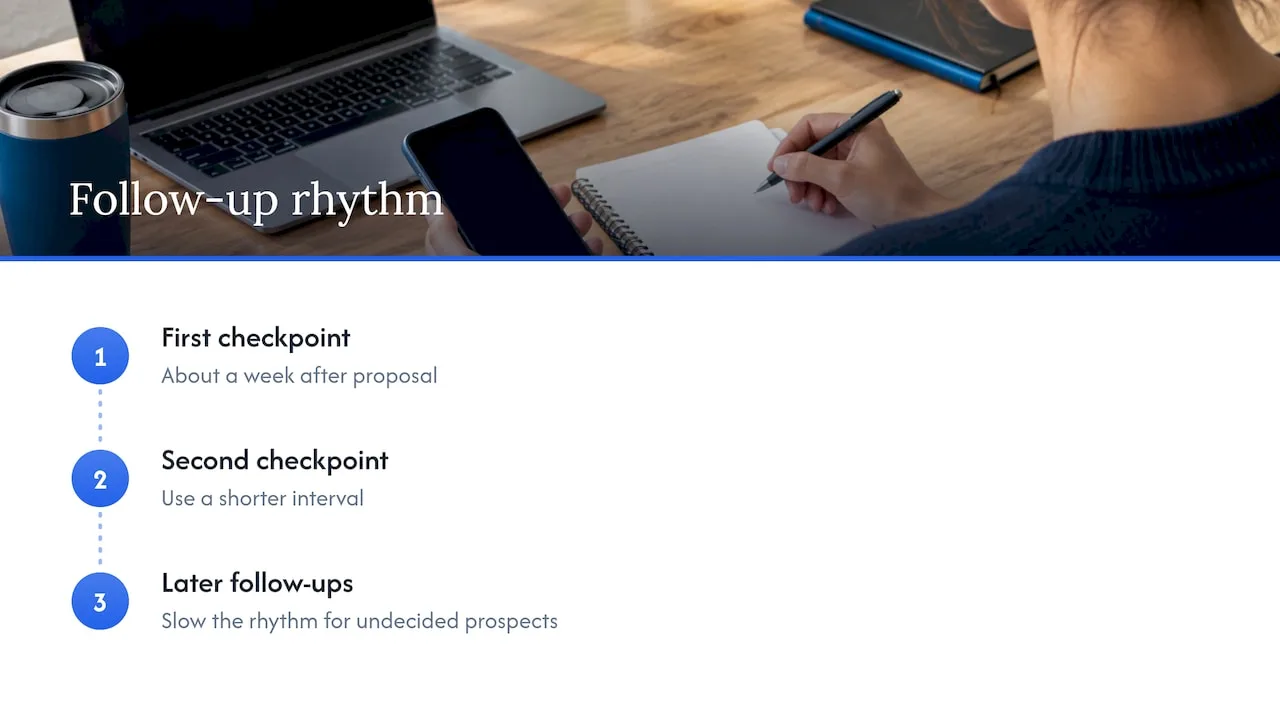
Silence after a proposal rarely means no. More often it means the customer has questions they haven’t asked, hasn’t opened the file, or is waiting for the other quotes to land. A follow-up is how you find out which. It is also a sales conversation, not an administrative reminder. The National Association of Landscape Professionals describes follow-up as a structured sales process with a first checkpoint about a week after the proposal, a shorter second interval, and then a slower rhythm for prospects who remain undecided.
The same applies whether you run a plumbing shop in Warwick, an HVAC company in Worcester or a roofing crew on the South Shore. The job goes to the contractor who is easy to answer, easy to schedule and still in the conversation when the customer is ready.
The follow-up schedule for residential estimates
For homeowner work, a schedule of five touches over about 30 days covers nearly every situation. The table below is a working template. It blends the timing from the sources linked in this article, so adjust the days to your sales cycle.
| Day | Touch | Purpose |
|---|---|---|
| 0 | Send estimate, with a text or email confirming it was sent | Make sure the right file reached the right person |
| 1 to 2 | Short confirmation: did it arrive, any questions? | Catch spam folders and wrong addresses |
| 3 to 5 | Phone call or personal email about scope or options | Answer questions, not push for a yes |
| 7 to 10 | Email or text with something useful, plus a scheduling choice | Move toward a start date |
| 14 | Call, then text if unanswered | Find out the real status |
| 30 | Short close-the-loop email | Give an easy exit and leave the door open |
Timing guidance varies a little between sources, which is useful in itself. One home services software guide says the best first follow-up falls two to three days after the quote, since sooner can feel pushy and waiting too long risks losing the customer. The landscape association piece describes a contractor who follows up about a week after the proposal, again three or four days later if there is no reply, then every couple of weeks while the prospect is undecided. Both are reasonable. Pick one rhythm and apply it to every estimate.
Confirm the same day
The cheapest follow-up is the one that happens within hours. An HVAC-focused sequence from Built on Tenth recommends a call within two hours of sending an estimate to confirm it arrived and ask whether the technician’s findings make sense, with a voicemail no longer than 15 seconds if nobody picks up. You may not always manage two hours, but same day is a sound standard. It tells the customer you are organized before they have paid you a dollar.
Use a calendar, not memory
The contractors who lose track of estimates are not careless. They are on a roof, under a sink or in a crawlspace. Put the next touch into your CRM or calendar the moment the estimate leaves, and let a reminder, or better an automated message, handle the first confirmation. If you want to see how a sequence of nudges can be structured, these proposal follow-up email templates lay out a short run of touches that each have a clear job.
Commercial bids: follow the owner’s clock
Commercial and public work runs on a different rhythm. There is a bid due date, a review period and an award date, and a decision may involve a committee or a board vote. Copper’s guidance on this is blunt: there is no universal schedule, so anchor your follow-ups to the due date and the award date. A two-week tenant-improvement decision and a school project that needs a board vote are not the same animal.
A workable commercial rhythm looks like this:
- Before the deadline: confirm the owner or GC received your bid.
- After bid opening or when review begins: call to offer scope clarification, and answer any questions in writing.
- About a week later: a substantive email, not a nudge. Reference the project and your submission date, and ask whether anything in the scope or exclusions needs clarifying.
- One or two days before the stated decision date: a short check-in asking whether the date still holds.
- After the decision date passes in silence: one final nudge, then close the file.
FollowUpCRM suggests three to four spaced messages per bid as a reasonable ceiling, which matches the pace above.
Property managers and HOAs
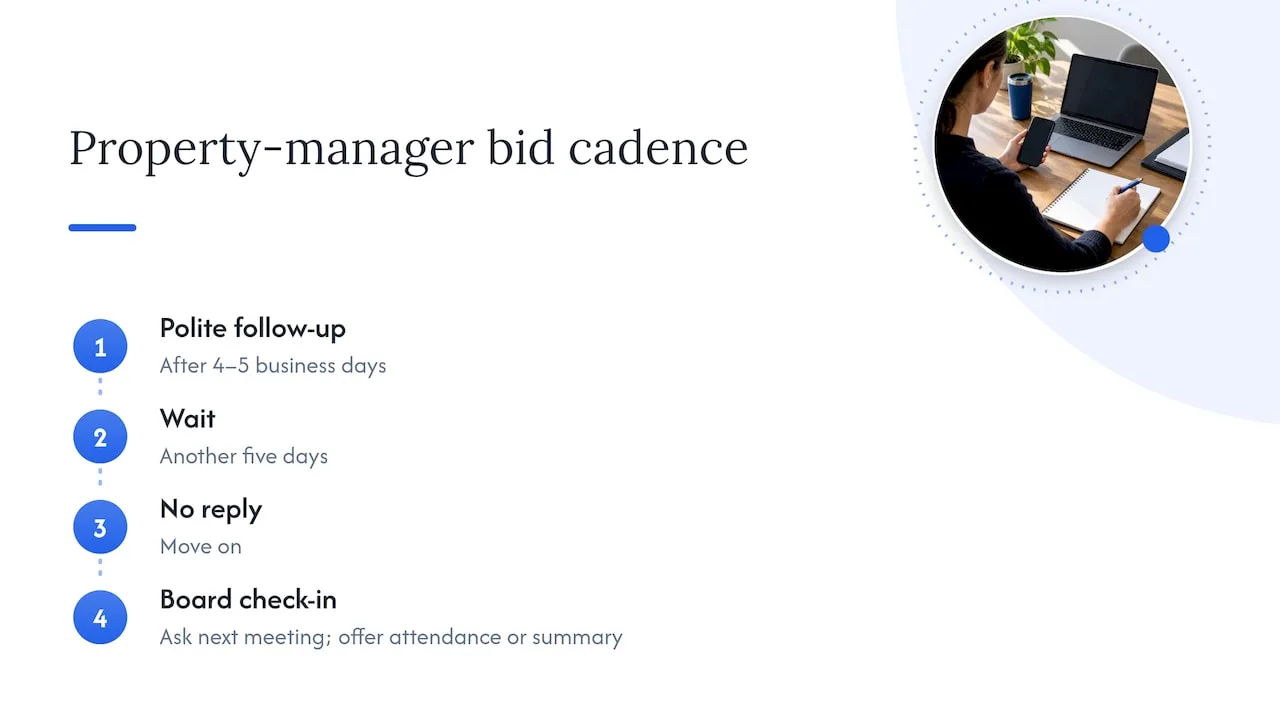
When the buyer is a property manager or condo board, you are often dealing with someone who has to get approval from others. BidMyCommunity’s contractor FAQ recommends one polite follow-up after four or five business days when a manager goes silent on a bid, and, if there is still nothing after another five days, moving on. For board-driven buyers, ask when the board next meets and whether they would like you to attend or send a summary page.
What to say in a follow-up email
The most common mistake is a message that says nothing. “Just checking in” gives the customer nothing to answer and nothing to gain. Waco3’s guidance on unanswered proposals says the first message should be short, specific to the project and ask one clear question, without apology or guilt. The second should add something relevant rather than repeat the status request.
The rule that holds the whole sequence together: every message adds an answer, an option or a date.
Touch 1: the confirmation
Hi Maria, this is Dan from Harbor Mechanical. I sent the estimate for the boiler replacement this morning. Can you confirm it came through? If anything in the scope or the equipment options is unclear, call or text me at this number.
Short, specific and easy to answer. Include the job name, so it can’t be mistaken for a mass email.
Touch 2: the useful follow-up
Hi Maria, a quick follow-up on the boiler estimate. Most customers ask whether the higher-efficiency unit is worth the difference, so I put a one-page comparison together and attached it. I also have an install slot open the week of the 20th. Would a call Thursday at 4 or Friday at 9 work to go through it?
Notice what it does. It offers help, gives two concrete times and mentions a crew date. Tree Service Resources advises mentioning an available crew date only when it is real and as scheduling information rather than pressure, and not discounting right away. A fake deadline damages trust faster than silence does.
Touch 3: the decision question
Built on Tenth’s script moves from answering questions toward a choice between concrete openings, instead of a broad yes-or-no about proceeding. That is good practice for any trade. “Do you want to move forward?” invites a “let me think about it.” “Would you rather start the 14th or the 21st?” invites a decision about timing.
Touch 4: the close-the-loop email
Hi Maria, I haven’t heard back on the boiler estimate, so I’m guessing the timing may not be right or you went another direction. Either is completely fine. If you’d let me know, I’ll close out the file. If plans change, the estimate is here and I’m happy to update it.
Waco3 recommends this kind of ending: give the customer an easy out, say timing may not be right, and leave the door open. People often reply to this message when they ignored the previous three, because replying no longer feels like a confrontation.
Keep messages short and send one at a time
A few habits to avoid, all of which appear in contractor follow-up guidance: guilt or shame language, invented deadlines, instant discounting, long emails, several messages on the same day, and sales jargon. If you would like to tighten your timing around specific dates, simple email deadline reminders can make sure a promised follow-up doesn’t slip.
Phone and text scripts
For homeowner work, a call often beats an email, because you can hear hesitation and respond to it. Keep it short and structured.
The status call
Tree Service Resources lays out the logic: identify yourself and your company, name the job and the estimate, confirm the customer received it, and ask whether they have questions about scope or pricing. If they are still deciding, ask what needs clarifying.
A version you can use:
“Hi Maria, it’s Dan with Harbor Mechanical. I’m calling about the boiler estimate I sent Tuesday. Did it come through okay? Is there anything about the scope or the numbers I can walk you through?”
If she says she is still comparing, don’t push. Ask: “What would help you feel sure about the decision?” Then listen. Price objections often turn out to be scope or timing questions in disguise.
The voicemail
Keep it to about 15 seconds: your name, your company, the job, one reason to call back, your number. Then send a text, so the customer can reply in ten seconds from a job site or a school pickup line.
The text
Hi Maria, Dan from Harbor Mechanical. Did the boiler estimate come through? Happy to answer any questions.
Built on Tenth suggests a day-7 text asking whether the customer’s problem was solved, and explicitly giving them permission to say they went another direction. That small line, “it’s fine if you went another way,” is one of the most effective in the sequence.
When the customer goes silent or picks someone else
Some proposals won’t close, and the goal is to find that out without burning the relationship. Use a limit. Estimates vary, but the research converges on a ceiling of about three or four contacts, or two to three for smaller jobs. Daylite’s example sequence sends a second email three days after the first and a closing note a week after the final follow-up that acknowledges the service may not be a current priority.
When you reach the end of your sequence:
- Send the closing message and mark the estimate as closed in your system.
- Ask what happened, if they replied: “Would you mind telling me what tipped it? It helps me improve.” A few will tell you, and that is valuable feedback on your pricing and your proposals.
- Keep them on a light nurture track. A seasonal reminder or a maintenance offer six months later can bring a lost job back.
- Ask for a review on jobs you do win. Reviews help the next prospect decide faster.
The landscape association recommends asking whether the prospect is still considering partners for the project, and encouraging them to tell you if they chose another contractor. That is a direct, respectful question, and it gets answers.
A note on being too quick to discount
When a customer goes quiet, the instinct is to cut the price. Resist it. A discount offered unprompted tells the customer your first number was soft. Offer options instead: a phased scope, a different equipment tier, or a better start date.
Our perspective
Most of the contractors we talk to in Rhode Island and Massachusetts don’t have a closing problem. They have a speed and consistency problem. The customer who fills out a form at 7 p.m. gets a reply the next afternoon, if the owner remembers, and by then another company has already called back.
We build for that gap. A website should capture the lead, the missed-call text-back should answer it within moments, and the follow-up sequence should keep running while you are on the job. Our approach is designed to make sure no estimate is left waiting on someone’s memory, and that reviews are requested after every finished job without anyone having to ask.
We focus only on contractors in this region, in trades such as plumbing, HVAC, roofing, electrical and landscaping. We know the towns and how people here look for a tradesperson. A follow-up system that fits how you actually sell is worth more than a template that sits in a folder.
Tyson
Put your follow-up on autopilot
A schedule only helps if it runs every time. That is the part we build at Coastal Connect: missed-call text-back and CRM automation that responds to new inquiries and keeps estimate follow-up moving, plus reviews that keep coming after completed jobs.
Our plans are published on the pricing page: Foundation is $597 per month, Growth is $1,297 per month and Scale is $2,497 per month. If you want an AI employee on Growth, it is $199 per month. You can see how the pieces fit together on our main site, then decide which plan matches the number of calls and estimates you handle.
A simple setup you can start this week
You don’t need software to begin. You need a rule and a place to record it.
- Write your sequence down. Use the table above as a base. Decide on days and channels for residential work, and a separate version for commercial bids.
- Create saved messages. Store the four email scripts and the text in your phone and email, so a follow-up takes under a minute.
- Log every estimate with a next-touch date. A spreadsheet works. A CRM works better, because it can send the reminder to you.
- Review weekly. Every Friday, scan open estimates and see which are due. Update the status and the next date.
- Track results. Count how many estimates you sent, how many got a reply, and how many closed. After a month you will see which touch performs best.
One caution on automation: let it handle the confirmations and reminders, but have a person handle the substantive call. Customers can tell the difference, and the call is where jobs are won.
FAQ
How long should I wait before following up on a contractor estimate?
Confirm receipt the same day or the next, then make your first real follow-up two to five days after sending. Sources vary: some suggest two to three days, others about a week. For commercial bids, tie the timing to the bid due date and the decision date.
How many times should I follow up?
Three to four spaced messages per bid is a sensible ceiling for most jobs. The last one should be a polite close-the-loop message that gives the customer an easy way to say “not now.” After that, stop chasing and move the contact to a light nurture list.
What should I say if I haven’t heard back?
Reference the specific job, ask one clear question, and add something useful, such as an answer to a common question or a real open date on your schedule. Avoid “just checking in,” guilt, or fake deadlines. Offering two specific times for a call works better than asking whether they have decided.
Should I call, text or email?
Use all three, in order. Email carries the written estimate and the details, a call handles questions and objections, and a short text gets a fast reply. Don’t send more than one message in a day.
What if the customer chose another contractor?
Thank them, ask politely whether they would share what influenced the decision, and ask to stay in touch for future work. Close the file professionally. Customers who had a good experience with your follow-up often return when the first contractor falls through or when their next project comes up.
Sources
- Business Smarts: Sales Process Strategies to Keep the Ball Rolling (National Association of Landscape Professionals)
- How to Follow Up on a Quote to Win More Business
- Construction bid follow-up emails: 10 templates that work
- Construction Bid Follow-Up Templates for Email
- Estimate Follow-Up Sequence for Contractors (Built on Tenth)
- FAQs for contractors (BidMyCommunity)
- What to Do When a Client Ghosts You
- Quote Follow-Up Call Method (Tree Service Resources)
- Sample Follow-up Email to Client After Sending a Proposal (Daylite)
- 3–4 Touches to Get Replies: Proposal Follow Up Email Templates
- Email Deadline Reminders for Busy Pros