
A heat wave does not create HVAC leads you have to hunt for. It creates a flood of urgent callers who book with the first company that picks up, answers a text or shows a clear way to schedule. The contractors who win are the ones who prepared the phone, the website and the follow-up before the temperature spiked. This guide covers where heat-wave leads come from, what they cost, and how to answer them fast enough to turn them into jobs.
TL;DR
- Heat-wave demand can multiply call volume several times over, so the bottleneck is usually answering and booking, not finding leads.
- Your Google Business Profile, a mobile-first website and Local Services Ads are the channels that catch people searching “AC repair near me” in a panic.
- Speed decides who gets the job: reply in minutes by call, text or chat, even after hours.
- Free lead sources exist (reviews, your profile, past customers, referrals), but they need to be set up before the heat arrives.
- Set up your systems in spring so the first hot week fills your calendar instead of your voicemail.
Table of Contents
- What a heat wave does to HVAC call volume
- What a heat-wave lead actually is
- Which channels bring qualified leads during a heat wave
- How HVAC companies get leads for free during peak demand
- How much HVAC companies pay for leads, and what moves the price
- Speed decides who books the job
- A heat-wave readiness checklist
- How to build trust when customers need AC right now
- Perspective: why heat waves reward the prepared
- Put the system in place before the next heat wave
- FAQ
- Sources
What a heat wave does to HVAC call volume
The numbers from recent heat waves are striking, and they come from companies in our own region and beyond.
During a dangerous heat wave in early July 2026, Akian Plumbing, Heating, Cooling & Electric in Massachusetts reported that a normal summer day brings 90 to 100 service calls, while the heat wave pushed that into the hundreds, with more than 600 calls over four to five days.
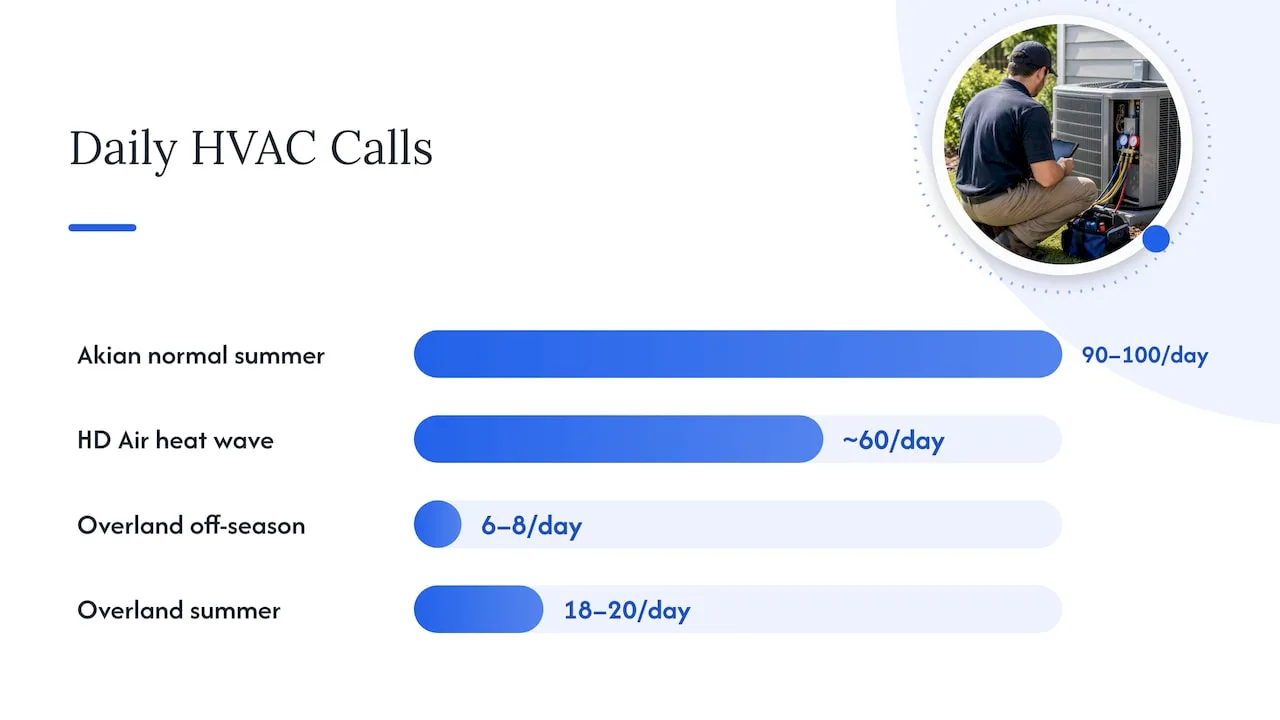
In the Pioneer Valley, HD Air was handling about 60 calls a day during a week-long heat wave, with 75 employees and 50 trucks working to keep up.
The pattern is not only a Northeast story. An Overland Park, Kansas owner told KSHB that AC repair demand more than doubles in heat waves, going from 6 to 8 calls a day in the off season to 18 to 20 in summer.
What this means for a smaller shop: if you run two to ten trucks, you will not be able to answer every call live while technicians are on roofs and in attics. Whoever solves that gap captures the surplus demand. Everyone else watches it go to the next name on the search results page.
What a heat-wave lead actually is
A heat-wave lead is rarely a shopper comparing five quotes. It is usually one of three people:
- The emergency caller. The system died, the house is 88 degrees, there may be an elderly relative or a baby inside. They want a human or an instant reply and a time slot today.
- The failing-system caller. The AC still runs but barely cools. They want service within 24 to 48 hours and will compare two or three companies by reviews and availability.
- The replacement shopper. The heat wave exposed a 15-year-old unit. This is the highest-value lead, and they will want a quote and financing details, usually over several days.
Each needs a different response. The emergency caller needs speed. The failing-system caller needs proof you are trustworthy and available. The replacement shopper needs a website and a quote process that makes you look like the safe choice. Your lead capture should treat all three on purpose.
Which channels bring qualified leads during a heat wave
People in a heat wave search on their phone, usually with a version of “AC repair near me” or “emergency HVAC [town].” That narrows the useful channels.
Google Business Profile and the map pack
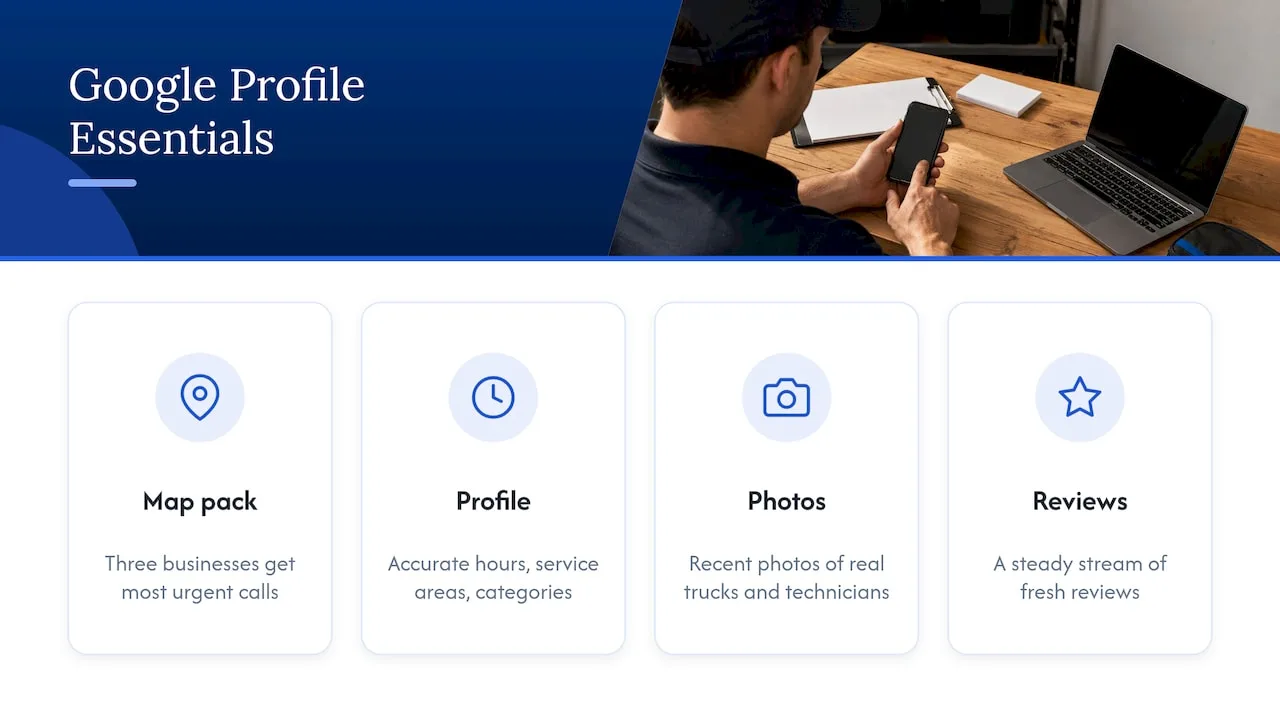
The three businesses in the map results get most of the urgent calls, because the call button sits right there. A strong profile has accurate hours, service areas by town, the right categories, recent photos of real trucks and technicians, and a steady stream of fresh reviews. Update your hours and add a short post about same-day or emergency availability before the first forecast of 90-degree days. Our local SEO and Google Business Profile work is built around exactly this: showing up for the town-by-town searches that spike in summer.
Local Services Ads
Local Services Ads sit above standard search results and charge per lead rather than per click. For heat-wave searches they put your name, rating and a call button at the very top. They need verification and a budget that can absorb a surge, so set them up and test them well before July. Paid ad management is available on our pricing page alongside our plans.
Your website
Most heat-wave visitors land on a website from their phone, in a hurry. The page needs a tap-to-call button that stays visible, a short booking form, a plain statement of your service area and hours, and a clear promise about response time. A site built as a lead engine, not a brochure, is the difference between a call and a bounce. See how our websites that book jobs are structured.
Paid search
Non-branded search ads can work during a heat wave, but the click costs rise when every competitor bids at once. Paid search pays off most when the landing page converts, the phone is answered, and the ad schedule covers evenings and weekends, when people notice the house is too hot.
Text, chat and voice
The fastest lead channel is the one that answers the person where they already are. A text-back to a missed call, a chat window on the website, and an AI voice agent that answers after hours all catch leads that voicemail loses. More on this in the response section below.
How HVAC companies get leads for free during peak demand
Paid sources are not the only option, and several free ones work especially well in a heat wave. None of them is truly instant, which is why the work happens before summer.
- Reviews. Customers in an emergency scan ratings first. A profile with a few hundred recent reviews beats one with twenty old ones. Ask every satisfied customer right after the job, by text, while the cool air is still a relief. Automated review requests make that happen without anyone remembering to do it.
- Past customers. Everyone who had a tune-up, install or repair in the last few years is a warm lead. A short text or email before the first hot stretch, offering priority scheduling or a pre-season check, fills the calendar and builds a base of maintenance customers.
- Your Google Business Profile. Posts, photos, questions and answers, and service listings cost nothing and feed the map pack.
- Referrals. Property managers, realtors, plumbers and electricians who do not do HVAC all meet people with cooling problems. A simple relationship with a few of them produces steady jobs.
- Local community channels. Neighborhood groups and town Facebook pages fill with “who can fix my AC today?” threads during a heat wave. A helpful, non-spammy reply from the company page, or from your team, gets noticed. Customers who recommend you there do it for free.
The common thread: free leads come from reputation and visibility, and both are slow to build and fast to pay off.
How much HVAC companies pay for leads, and what moves the price
There is no single price. What a contractor pays depends on a handful of factors, and these matter more than any quoted average:
- Source. Shared leads sold to several companies cost less per lead but convert worse than exclusive leads. Pay-per-call and Local Services Ads sit in between. Organic leads from search and reviews cost time and monthly marketing fees instead of a per-lead charge.
- Exclusivity. If the same inquiry goes to three companies, you are racing two other contractors for the same job.
- Job type. A replacement system lead is worth far more than a maintenance lead, and the price per lead rises with it.
- Season and competition. When heat hits, more contractors bid for the same clicks, and ad costs rise.
- Your answer rate. A lead you never answer costs you its full price and returns nothing. This is the cost most owners overlook.
The better yardstick is cost per booked job, not cost per lead. A cheaper lead you answer in two minutes often beats an expensive one you call back tomorrow. If you buy leads from any vendor, track how many turn into scheduled appointments and revenue, and judge the source on that number alone.
One more thing on cost: lead-buying marketplaces rent you demand, month by month. A website, a profile and a review base are assets you keep. That is why we treat paid lead sources as a supplement, not a foundation.
Speed decides who books the job
The research on online leads is consistent: the longer a company waits to respond, the less likely it is to reach the customer and qualify them. The Harvard Business Review study “The Short Life of Online Sales Leads” looked at exactly this problem, response time to web-generated inquiries. A heat wave sharpens it, because the caller has a deadline measured in hours and a list of other companies to try.
Here is a response routine that works for a trades business of almost any size.
Step 1: Never let a call go to a dead voicemail
When all your techs and your office staff are busy, an automatic text should go out within seconds: “Sorry we missed you. This is [Company]. Are you looking for AC repair? Reply with your address and we will get you on the schedule.” A missed-call text-back and CRM setup turns a lost call into an open conversation.
Step 2: Answer after hours
Many people discover their AC died at 9 p.m. An AI voice agent can pick up around the clock, collect the address, the problem and the urgency, and put the job on the calendar or flag it for your on-call tech. A website chat does the same for visitors who would rather type. Our AI website chat handles those questions at any hour.
Step 3: Triage by urgency
Decide, before the heat arrives, what counts as an emergency (no cooling with vulnerable people at home, for example) and what can wait for the next day. Write it down. Whoever answers, human or automated, should follow the same script.
Step 4: Quote fast and professionally
For repairs and replacements, a clean written quote sent the same day makes you look organized and trustworthy. A simple HVAC quote template gives you a printable starting point for itemized estimates. The faster the quote reaches a replacement shopper, the less time they have to call someone else.
Step 5: Follow up on every open lead
Some inquiries will not book on the first contact. Set automatic follow-ups at 1 hour, next morning and day three. Many of the people who cooled off after a heat wave will come back when the next one hits, so keep them in your CRM and message them in spring.
Step 6: Ask for the review
After each completed job, send a review request by text. The review you collect during the busiest week of the year is the one that carries you through the next summer.
A heat-wave readiness checklist
Use this list in April or May, not the week the forecast turns.
| Area | What to have ready | Why it matters in a heat wave |
|---|---|---|
| Google Business Profile | Correct hours, service towns, photos, recent posts | Wins the map-pack call |
| Website | Tap-to-call button, short booking form, emergency messaging | Converts mobile visitors in a hurry |
| Phone coverage | Missed-call text-back, after-hours answering | Catches calls while techs are on jobs |
| Reviews | Automatic request after every job | Builds trust for urgent shoppers |
| Ads | Local Services Ads verified, budget for surge | Top-of-page placement |
| CRM | Lead stages, automatic follow-ups | Nothing falls through the cracks |
| Past customers | Pre-season message list | Warm leads, no ad cost |
| Dispatch rules | Written emergency vs. next-day triage | Same answer from every team member |
How to build trust when customers need AC right now
Urgent buyers decide on trust signals in seconds. They are not reading your “about us” page. They are checking for:
- A strong star rating with recent reviews. Recent matters more than a high count from years ago.
- Real photos. Your own trucks and technicians beat stock images of smiling families.
- A local name and area. A page that names the towns you serve, in Rhode Island or Massachusetts, feels like a neighbor, not a national call center.
- Clear availability. “Same-day service available” or “We answer 24/7” removes the biggest worry.
- Licensing and insurance information. If you hold the licenses your state requires, show them plainly. Only state what is true for your company.
These signals work together. A profile with great reviews that sends people to a slow, confusing website loses the sale. A beautiful website attached to a profile with six reviews does too.
Perspective: why heat waves reward the prepared
We work only with contractors in Rhode Island and Massachusetts, and we see the same story every summer. The shop that answers its phone, texts back in seconds and shows up well on Google gets the work. The shop with a better technician but a voicemail box does not.
That is why we build these pieces as one system rather than separate services: a website designed to turn visitors into booked appointments, local SEO and Google Business Profile work that puts you in front of people in your actual towns, automated follow-up and review requests, and 24/7 call handling that makes sure a lead is never left waiting.
Heat-wave demand is the easiest test of whether that system works. Owners who put it in place before June stop thinking of a spike in calls as a crisis and start treating it as the best week of the year. Our team knows the towns and the trades, and our goal is simple: no missed lead, no missed job.
Tyson
Put the system in place before the next heat wave
If you want the website, local SEO, text-back, voice agent and review engine set up and running for you, that is what we do for plumbing, HVAC, electrical, roofing and landscaping companies across Rhode Island and Massachusetts. Our plans are published on our pricing page: Foundation is $597 per month, Growth is $1,297 per month and Scale is $2,497 per month. An AI employee add-on on Growth is $199 per month, and extra locations start from $299 per month.
If you are not sure which fits a company your size, start with our services overview and tell us how many calls you miss in a normal week. That number usually points to the right starting point.
FAQ
How can HVAC companies get leads for free during a heat wave?
The best free sources are your Google Business Profile, customer reviews, past-customer texts and emails, and referrals from related trades. All of them work best when set up before the heat. Updating your hours and posting same-day availability costs nothing and shows up fast on the map.
How much do HVAC companies pay for leads?
It depends on the source, whether the lead is exclusive or shared, the job type and how competitive the season is. Replacement leads cost more than maintenance leads, and prices climb when every contractor bids at once. Track cost per booked job rather than cost per lead, because an unanswered lead is money wasted at any price.
What is the fastest way to turn heat-wave inquiries into booked jobs?
Reply within minutes, by text, chat or call, and offer a specific time slot. A missed-call text-back and an after-hours voice agent let you do this even when your team is on jobs. Follow up automatically with anyone who does not book the first time.
Do Google reviews matter during a heat wave?
Yes. Urgent customers check ratings in seconds, and recent reviews tell them you are active and reliable. Ask for a review by text right after each completed job, while the customer is happy with the cooler house.
When should an HVAC business set up its heat-wave lead system?
Spring is the right window, before the first hot week. Profiles, websites, ads and automations take time to settle in and gather reviews. Starting in April or May means the first heat wave of the season finds you ready.
Sources
- NBC Boston: AC repair calls spike in extreme heat
- Western Mass News: Local A/C company sees major uptick in business with excessive heat
- KSHB: Demand for local AC repair more than doubles in record-breaking heat
- Harvard Business Review: The Short Life of Online Sales Leads