A financing page does one job: it lets a homeowner see that a $12,000 project can become a monthly payment before they ever call you. The page that works is short, plain and specific. It explains how payment options work, shows the next step, uses advertising wording that follows federal rules, and sits on a site that answers every inquiry fast. A financing page that gets a click but no fast reply loses the job to the next contractor who picks up the phone.
This guide is for plumbers, HVAC specialists, roofers, electricians and landscapers who already offer financing through a lender, or are about to. It covers what to put on the page, what to avoid saying, and how to connect the page to your lead capture.
TL;DR
- Financing is now expected in the trades: 68% of HVAC contractors in the 2025 Contractor of the Future Study offer it, so homeowners compare you against contractors who do.
- A good financing page explains the process in four steps, names the kinds of payment options, shows a sample monthly payment and has one clear button to apply or request an estimate.
- Any ad that states a payment amount or term triggers federal disclosure rules under Regulation Z, even if you are not the lender. Use the lender’s approved wording.
- Never promise approval, a rate or a decision time on the page. Say “payment options” and let the lender’s written terms carry the numbers.
- The page only pays off if inquiries get an instant reply. Missed calls and slow follow-up cancel the benefit of offering financing at all.
Table of Contents
- Why a financing page earns its place
- How contractor financing works, in plain terms
- What belongs on the page
- Wording that keeps the page compliant
- Fees, models and your own business financing
- From click to booked job: the follow-up gap
- A short launch checklist
- What we offer for contractors who want this built
- Perspective
- FAQ
- Sources
Why a financing page earns its place
Homeowners rarely budget for a new furnace, a re-roof or a panel upgrade. The cost lands as a surprise, and the first question is how to pay for it. If your site never mentions payment options, the visitor has to call and ask, and many will not.
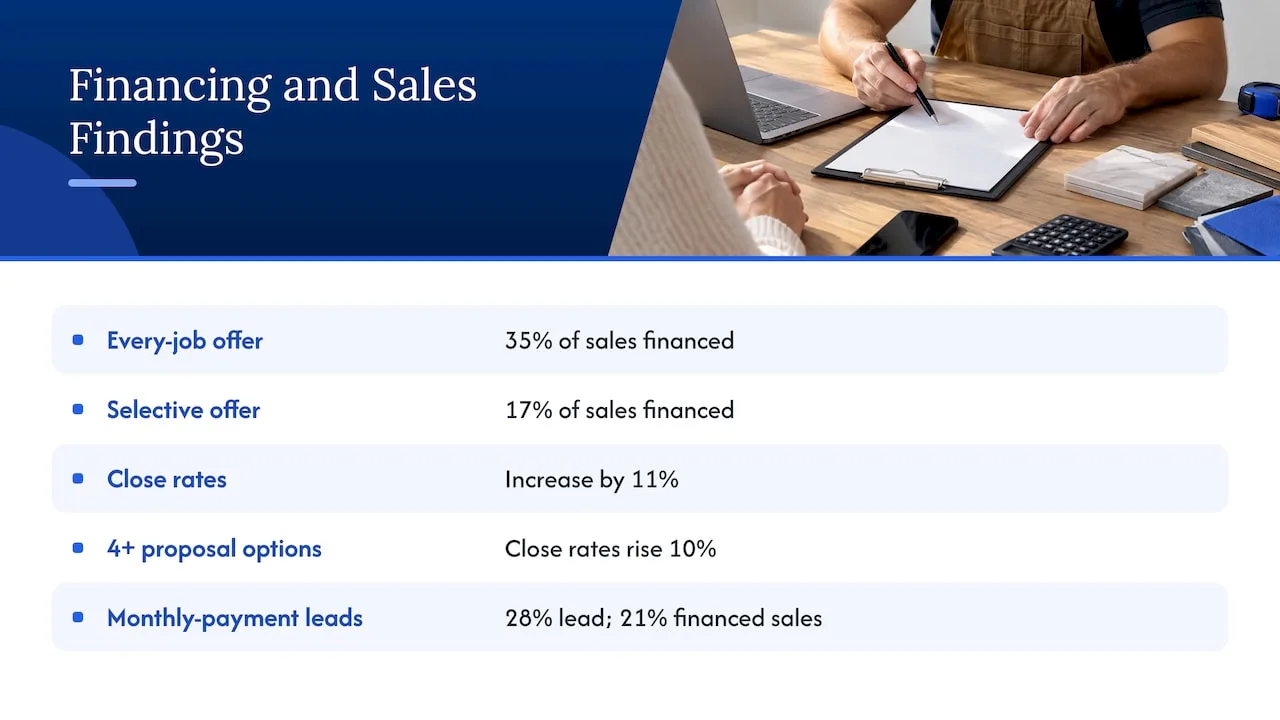
The trade data points the same direction. The ACCA study of more than 1,000 HVACR contractors found that contractors who offer financing on every job finance 35% of sales, compared with 17% for those who offer it selectively, and that close rates increase by 11%. The same study’s author-side commentary called a related finding, that presenting four or more proposal options lifts close rates by 10%, “low-hanging fruit”.
How you present the payment matters too. Reporting on the same research notes that only 28% of contractors lead with a monthly payment in their proposals, but those who did saw a higher share (21%) of financed sales. A financing page is the website version of that habit: it puts the monthly figure in front of the homeowner at the moment they are deciding whether to call.
There is a second benefit that gets less attention. Customers who have a monthly payment to compare are more likely to choose the better system or the full scope instead of trimming the job. A page that frames the project as a payment gives you that conversation before the estimate visit.
How contractor financing works, in plain terms
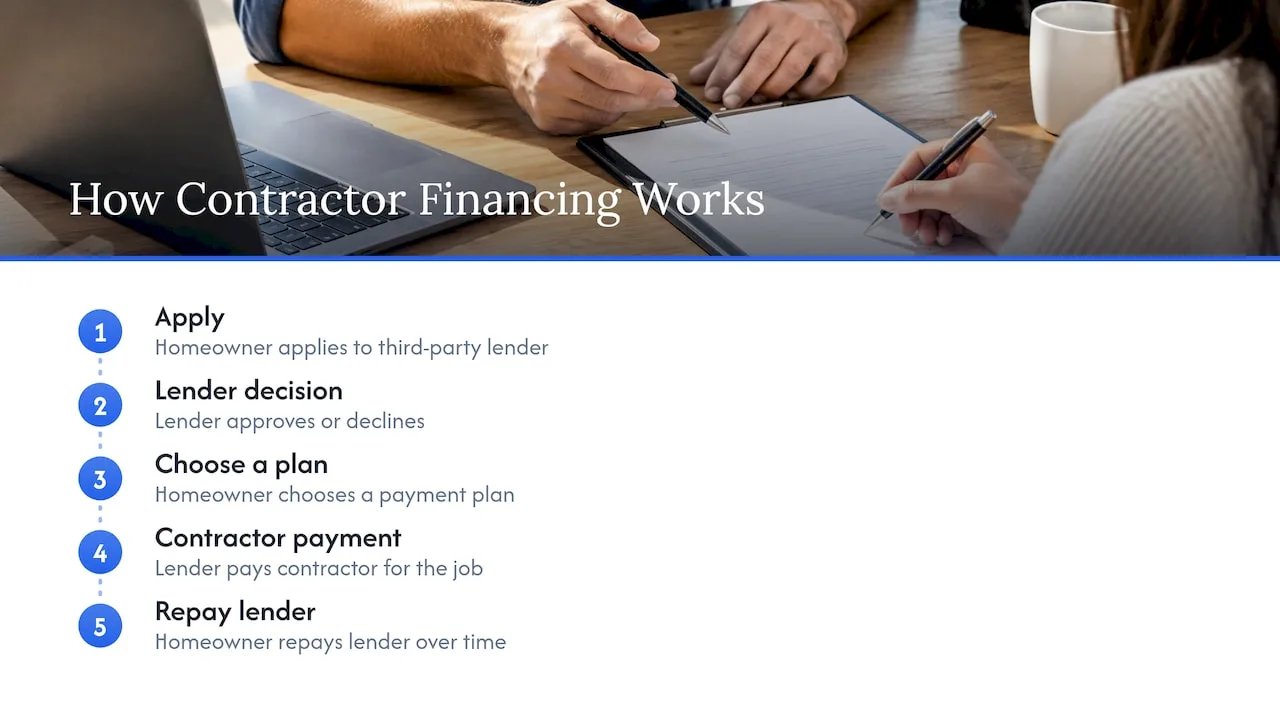
Your page has to explain this in a few lines, so be clear on it yourself first. In the common setup, the homeowner applies to a third-party lender, not to you. The lender approves or declines, the homeowner chooses a payment plan, and you are paid for the job by the lender. The homeowner repays the lender over time. Because the lender carries the repayment risk, you are not collecting installments.
The alternative is in-house financing, where you carry the payments yourself. That ties up your cash and makes you a creditor, with all the compliance that implies. Most small and mid-size trade businesses stay with the lender model.
What homeowners expect you to explain is wider than your lender’s program. Common ways people pay for big home projects include home equity loans, HELOCs, cash-out refinancing, savings, personal loans and government-backed FHA Title 1 loans, which are capped at $25,000. For roofs specifically, deferred-interest or same-as-cash offers carry a 0% introductory APR period that runs from three months up to a year. You do not need to teach all of these on your page. You do need your page to make it obvious that you accept the lender option and will walk them through it.
What belongs on the page
Keep it to one screen of scrolling for most visitors. Work from top to bottom in this order.
1. A headline that talks about payments, not credit
Trades people often hesitate over the word itself. One contractor-supply guide quotes an industry trainer who says financing is often seen as a dirty word in the trades and suggests saying “payment options” or “monthly payments” instead. A headline like “Monthly payment options for your new heating system” does the same job without the baggage. Name the trade and the project: furnace replacement, roof replacement, panel upgrade, patio build.
2. Four steps, in plain words
Show how it works in four short lines:
- Request an estimate from us.
- Choose the work and the payment option on your estimate.
- Apply with the lender online. It takes a few minutes.
- We schedule the work.
Only write what your lender’s program actually does. If the application takes ten minutes in your lender’s portal, say that. If you are unsure about a detail, leave it out rather than guess.
3. A sample payment, clearly labeled
A number gives the visitor something to react to. Here is an illustration of the format: on a $12,000 project repaid in 60 equal payments at 0% APR, the payment would be $200 a month. That is arithmetic, not an offer, and a real program will have its own rates and terms. If you publish an example like this, use the exact terms from your lender’s current rate sheet and show every term with it (see the compliance section below).
4. What the financing can cover
List the work: equipment, labor, permits, add-ons. Homeowners often assume financing covers only equipment. If your program covers the entire job, say so, because it keeps people from trimming scope to fit a cash budget.
5. One button
Offer one primary action: “Request an estimate” or “Apply for payment options”, depending on how your lender’s flow works. Put it at the top and again after the steps. Repeat the phone number beside it. People who are ready to apply on a Sunday night should not have to hunt for a way to start.
6. Short answers to the questions people actually have
Four or five lines is enough: Does applying affect my credit? Can I pay it off early? What happens if I am declined? Answer only from the lender’s written terms. If the lender does a soft credit check for pre-qualification, say that, but only in the lender’s own words. Where terms vary by customer, say they vary and point to the lender’s disclosure.
7. Proof that you are local and real
A photo of your crew, your town names, your license number and a few recent reviews do more for conversion than any financing graphic. Homeowners applying for a loan want to know the company is established. For Rhode Island and Massachusetts trades, list the towns you serve and show the license details that apply to your trade.
For layout ideas that turn visitors into calls, our contractor contact page examples show how to place the form, phone number and trust signals. If you are a roofer, our guide to the five roofing pages that should come first shows where a financing page sits in the site.
Wording that keeps the page compliant
This is the part that gets contractors into trouble, and it is easy to avoid. The rules are in the federal Truth in Lending regulation, Regulation Z, and they apply to you even when the lender is someone else. The regulation’s text says that people who are not themselves creditors, including merchants and builders, must still follow its advertising provisions when they advertise consumer credit.
The practical rules for a financing page:
- Stating a payment or term triggers more disclosure. For installment (closed-end) credit, if your ad states a triggering term, it must also state the down payment, the repayment terms over the full loan term, and the APR. If the APR can rise after the loan is made, the ad must say so.
- Use the words “annual percentage rate”. When a rate of finance charge is stated, it has to be expressed as an annual percentage rate using that term.
- Store-card style credit has its own rule. For open-end credit, if an ad states a periodic payment amount, it must also state the total of payments and the time period to repay, with equal prominence.
In practice, this means a line like “as low as $99 a month” with no terms next to it is a problem. Either leave the number off the page and discuss payments at the estimate, or publish the number with every required term beside it, copied from the lender’s approved language. Ask your lender for the compliance-approved advertising copy, and have an attorney review the final page if you write your own. That is not a formality: it is the one place on this page where a mistake carries legal cost.
Words to keep off the page
Keep price and credit cost separate, and do not promise anything the lender controls. Avoid:
- “Guaranteed approval” or “everyone qualifies”.
- A decision time or funding time you do not control.
- Claims about credit-score effects.
- “No interest” when the offer is deferred interest with conditions.
A standard script for presenting the option also works for web copy. One training provider suggests telling customers that most customers either pay in full or choose a financing option, and that you will review both. That frames financing as a normal choice, not a rescue plan, and it carries no promise.
Fees, models and your own business financing
The lender usually charges the contractor a fee for each financed job, and it varies by program and by the rate the customer gets. Ask for your lender’s rate sheet and dealer-fee schedule in writing, then decide whether to fold the cost into your pricing. Do not publish fee percentages from a blog as if they were yours: your numbers come from your agreement.
One more point for owners: a financing page for customers is different from financing for your own company. If you also need working capital, a truck or equipment, a primer on equipment financing requirements and what lenders check will help you prepare your paperwork before you apply.
From click to booked job: the follow-up gap
A financing page raises the number of people who contact you. What happens in the next five minutes decides whether those contacts become jobs.
Think about the sequence. A homeowner whose furnace failed at 9 p.m. reads your financing page, decides they can afford the replacement, and calls. If it rings out, they call the next company. The same goes for a form submission that sits until morning. Payment options reduce price hesitation, but they cannot fix a missed call.
This is why we build the page as part of the lead capture system rather than as a standalone graphic. Our websites that book jobs are designed as lead generation engines for contractors, and they pair with:
- Missed-call text-back and CRM, so a call you cannot answer still gets a reply.
- An AI voice agent for 24/7 inbound call handling, so a late-night financing question gets an answer.
- AI website chat on the financing page itself, where visitors tend to have questions. Our chatbot scripts for contractors show the flows we use.
If you want the follow-up side in detail, read our guide to contractor lead nurturing automation and the six steps for keeping night leads with after hours answering.
Getting people to the page
A financing page nobody finds does nothing. Link it from your main navigation, from each service page (heating, roofing, electrical) and from every estimate you send. Mention it inside your Google Business Profile description in plain words, such as “payment options available”, without rates. Searchers in Providence or Worcester who compare three roofers see the profile before the website, so the first hint of payment options often belongs there. If you run Google’s Local Services Ads, make sure the person who answers those calls knows the financing script. Our local services ads guide covers how to convert those leads quickly.
A short launch checklist
- Get written terms, approved advertising language and the application link from your lender.
- Draft the page: headline, four steps, covered work, one button, short answers, local proof.
- Compare every payment or rate statement against the Regulation Z requirements above, and have an attorney review it.
- Add the page to your navigation, service pages and estimate templates.
- Connect the button and phone number to instant follow-up: text-back, chat and after-hours answering.
- Train whoever quotes jobs to offer payment options on every estimate, not only when a customer hesitates. The ACCA figures above come from contractors who do exactly that.
What we offer for contractors who want this built
We design and run lead capture for contractors in Rhode Island and Massachusetts: custom websites, local SEO, Google Business Profile optimization, automated follow-up, review requests and 24/7 call handling, built for plumbing, HVAC, electrical, roofing and landscaping. A financing page fits into that site as another page that turns a visitor into a call.
Our plans are published: Foundation at $597 per month, Growth at $1,297 per month and Scale at $2,497 per month. An AI employee on the Growth plan is $199 per month, and extra locations start from $299 per month.
See the full pricing and plan list to pick the level that fits your crew size.
Perspective
Most contractors we talk to think of a financing page as a design task. We think of it as a lead-handling task. The page is the easy part: a headline, four steps, a button.
What decides the result is what happens after someone taps that button or dials that number. A homeowner who has just worked out that they can afford the job is at their most ready, and they will not wait. Our view is that the website, the phone line, the text-back and the review requests should work as one system, so that the person who was ready to buy hears back in minutes, and the happy customer is asked for a review afterward.
That is why we build for contractors in Rhode Island and Massachusetts only, with a local team that knows the towns and trades. A payment option removes the price objection. A system that answers every inquiry makes sure you are the one who gets to remove it.
Tyson
FAQ
Do I need a separate financing page, or is a line on my estimate enough?
Use both. The estimate is where the homeowner decides, but the page is where they find out before they call. Build it as a standalone page, link it from your menu and service pages, and also print the option on every estimate and quote so no customer misses it.
Can I put “as low as” monthly payments on my website?
Only with care. Stating a payment amount or term triggers additional disclosures under Regulation Z, including the APR and repayment terms for installment credit. Use the lender’s approved advertising language, show every required term next to the figure, and have an attorney review it. If that is not practical, leave the number off and discuss payments at the estimate.
Should I use the word “financing” on the page?
You can, because homeowners search for it. Many contractors pair it with friendlier phrases like “payment options” and “monthly payments” in the headline and button text. Describe it as a normal way to pay, not as a rescue for people who cannot afford the job.
Will a financing page work if I miss calls?
It will bring more inquiries, but missed ones still go to your competitors. Text-back for missed calls, chat on the page and after-hours answering are what turn the extra interest into appointments.
Sources
- ACCA: Maximus partnership release (68% of HVAC contractors offer financing)
- ACCA HVAC Blog: Contractor of the Future Study key findings
- ACHR News: From Perk to Expectation, financing in HVACR sales
- Houzz: 10 Ways to Finance a Home Remodeling Project
- GAF: How Homeowners Pay for Roofing Projects
- Ferguson: How to Offer Financing as a Contractor
- Bankers Online: 12 CFR 1026.2 Definitions
- Federal Reserve: Regulation Z section 1026.24, Advertising
- Federal Reserve: Interagency Consumer Laws and Regulations, Truth in Lending
- eCFR: 12 CFR 1026.16 Advertising
- Eano: How to Offer Customer Financing for Contractors
- Formosity Funding: Used Equipment Financing Requirements