SMS compliance in the U.S. comes down to three things: get the right consent before you text, make it easy to stop, and keep proof of both. The main federal law is the Telephone Consumer Protection Act (TCPA), and carrier rules sit on top of it. For a plumber, HVAC shop, roofer or electrician who texts missed-call follow-ups, estimate reminders and review requests, this guide shows what to do, in what order, and where the risk really sits.
TL;DR
- Automated marketing texts to a cell phone need prior express written consent. Appointment reminders and replies to a customer who texted first are treated more lightly.
- Your opt-in must say the customer agrees to marketing messages and that consent is not a condition of buying anything.
- Honor “STOP” and any other reasonable opt-out request quickly, and no later than 10 business days.
- Keep consent records (wording, timestamp, phone number) for years. You are liable for what an agency or lead vendor sends on your behalf.
- Penalties start at $500 per message and reach $1,500 if the violation is willful, so a bad list can get expensive fast.
Table of Contents
- What SMS compliance means for a contractor
- Marketing text or informational text?
- Getting consent right
- Opt-outs: make stopping easy
- Timing: quiet hours and state rules
- Records that protect you
- What a violation can cost
- A practical checklist for your shop
- Perspective
- Where Coastal Connect fits
- FAQ
- Sources
What SMS compliance means for a contractor
SMS compliance is the set of rules that decide when a business may text a person, what the message must say, and how fast you must stop when asked. In plain terms it means getting consent and respecting people’s privacy. Consumer Action’s small-business guide to the TCPA describes it that way, and notes that the TCPA restricts marketing texts and requires prior express written consent for automated marketing texts to cell phones.
The FCC’s page on unlawful communications explains the legal base: the TCPA restricts unsolicited advertisements, autodialers and prerecorded or artificial voice messages, and those restrictions also cover text messages to cell phones. Spoofing the sender’s caller ID with intent to defraud or cause harm is separately prohibited, and that applies to texts too.
There are really three layers, and contractors tend to know only the first:
- Federal law. The TCPA and the FCC rules that implement it.
- State law. Some states add stricter definitions, calling hours or registration.
- Carrier and industry rules. Mobile carriers and the industry body CTIA set expectations for how messaging programs are described and run.
The stated goal of the industry side is simple: people should receive messages they want from businesses they chose to hear from. If you build every text flow around that idea, most of the individual rules become easy to remember.
Marketing text or informational text?
The first question for any automated text is what kind it is, because the consent bar changes.
| Type of text | Examples for a contractor | Consent needed |
|---|---|---|
| Marketing | Seasonal tune-up promo, “10% off roof inspections,” referral offers, financing pitches | Prior express written consent |
| Informational | Appointment confirmation, “your technician is on the way,” reminder about tomorrow’s visit | Express consent, such as the customer giving you their number to be contacted about the job |
| Reply to the customer | Answering a question the customer texted you first | No additional permission for that conversation |
This split follows the Dialpad compliance principles: marketing texts include sales promotions or calls to action and should have express written consent, while informational texts such as appointment reminders should have express consent, and responding inside a conversation the consumer started needs no extra permission.
The trap is the mixed message. A reminder that ends with “Book your furnace tune-up now and save 15%” is no longer purely informational. If a text contains a promotion, treat the whole text as marketing. Roofing contractors who run lead follow-up should read this breakdown of SMS follow-up for roofing, which walks through timing and how the informational-versus-promotional line applies to estimate sequences.
Getting consent right
What “prior express written consent” requires
For automated marketing texts to cell phones, the customer must agree in writing before you send. Electronic agreement counts: a checked box or a form submission on your website can work if it is set up properly. According to Consumer Action, the opt-in must clearly state that the consumer authorizes marketing messages and that consent is not a condition of purchase.
In practice, your web form or text-to-join keyword needs these elements near the button, not buried in a footer:
- Your business name, so the customer knows who is texting.
- A plain statement that they agree to receive marketing text messages at the number they entered.
- A statement that agreeing is not required to buy anything.
- Message frequency and a note that message and data rates may apply.
- How to opt out (reply STOP) and where to find your terms and privacy policy.
The CTIA’s Messaging Principles and Best Practices push the same direction: a clear call to action that discloses the program description, where messages come from, who is sending them and how to opt out.
One seller at a time
Lead-gen forms that say “you agree to hear from our partners” are a major source of lawsuits. The FCC’s rule requires prior express written consent to apply to one seller at a time, with messages logically and topically related to the website where the consumer gave consent, as set out in the Federal Register notice. For a contractor, that means a homeowner who filled out a roof-repair form on your site can be texted about roof repair by you. They cannot be passed along to a list of other businesses, and you should not buy a list and assume the consent travels with it.
Consent in the real world of home services
A few common situations:
- A homeowner calls and you collect their number. That supports texting about the job at hand, such as confirming the appointment. It does not by itself support a marketing campaign. Ask for marketing consent separately and say so.
- A homeowner texts you first. You can answer within that conversation. Do not use it as a doorway to put them on a promo list without asking.
- A missed call triggers an automatic text. The text is a response to someone who just tried to reach you, so keep it about that: “Sorry we missed you. How can we help?” Leave the coupon out.
- Past customers. A job done in 2021 is not written consent for texting in 2026. Re-permission them with a proper opt-in before sending promotions.
Opt-outs: make stopping easy
An opt-out is not a courtesy, it is a legal obligation. Per Consumer Action, customers may revoke consent in any reasonable manner, such as replying “STOP,” and you must honor the request as soon as possible and no later than 10 business days. Do not make people use a magic word, call a number or fill in a form. If someone replies “please stop texting me” or “remove me,” treat it as an opt-out.
There is also a rule that has been moving. The FCC adopted a requirement that an opt-out from one type of message apply to future unrelated robocalls and robotexts from the same caller, and delayed it until April 11, 2026. Check the FCC’s current status before you finalize your setup. The safe design is to treat “STOP” as a stop to everything automated from your business, except one confirmation text that the opt-out was received.
Build these habits into your system:
- Process STOP, STOPALL, UNSUBSCRIBE, CANCEL, END and QUIT automatically.
- Send a single confirmation and nothing more.
- Sync the opt-out across every tool that can text: your CRM, your review-request tool, your voice or chat assistant.
- Never re-add someone because they appear on a new lead form unless they give fresh consent.
Timing: quiet hours and state rules
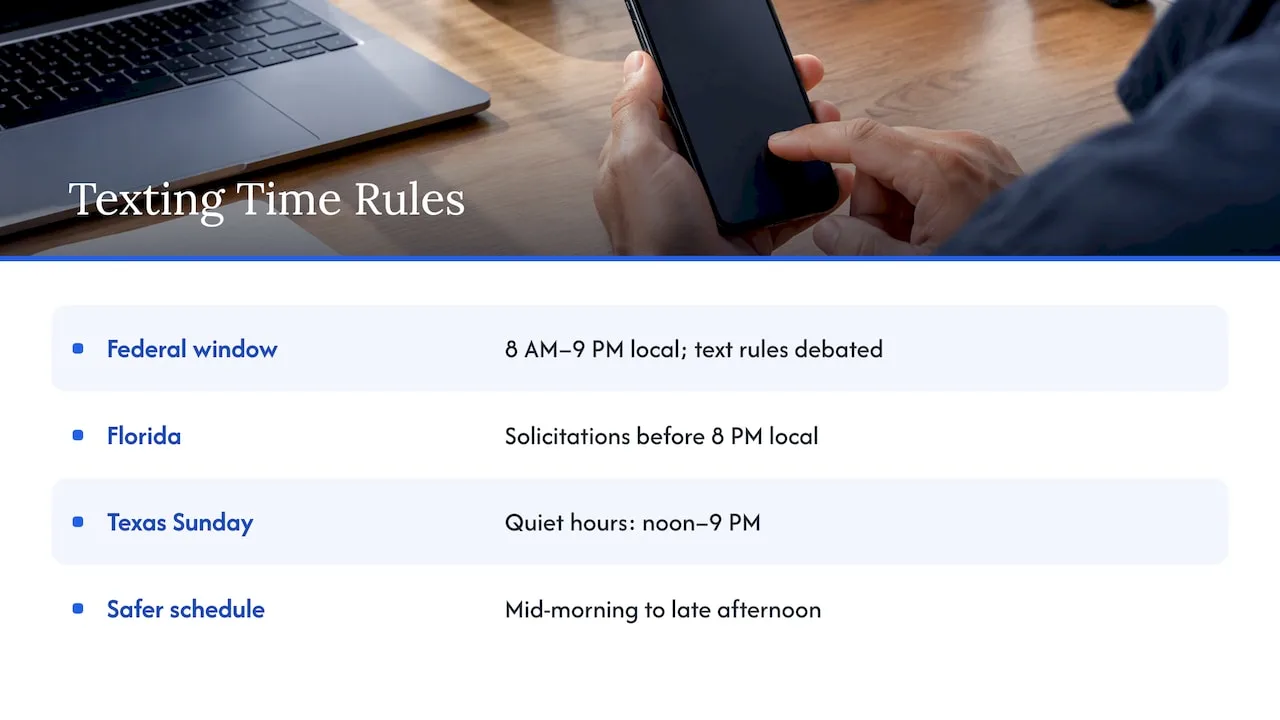
Federal call-time rules prohibit telephone solicitations to residential subscribers before 8:00 AM or after 9:00 PM at the called party’s location. Whether those hours apply strictly to texts has been argued, but plaintiffs have filed suits over texts sent just outside the window, and Blank Rome’s analysis of TCPA quiet hours recommends that businesses stay inside 8:00 AM to 9:00 PM to reduce exposure. That is a cheap rule to follow: schedule marketing texts for mid-morning to late afternoon in the recipient’s time zone, not yours.
Some states go further. Florida and Oklahoma define autodialers more broadly than the federal TCPA, and Florida limits solicitation to before 8:00 PM in the recipient’s local time, according to the National Law Review. Texas requires many businesses sending promotional texts to register with the Secretary of State and has Sunday quiet hours from noon to 9:00 PM, according to one state-by-state summary. Treat that last summary as a pointer and confirm details with the state or an attorney.
If you work in Rhode Island or Massachusetts, the federal rules and carrier requirements are your baseline, and your lawyer should confirm anything state-specific for your situation. If you ever text customers across state lines, such as a landscaping or roofing firm near a border, apply the strictest rule that touches the recipient.
Records that protect you
If a customer says they never agreed, the burden falls on you to show they did. Keep, for each contact:
- The exact consent language shown at the time, and which form or keyword they used.
- Timestamp, phone number and, where relevant, the page URL or IP address.
- Any opt-out request and the date you honored it.
According to TCPA.com’s compliance guide, businesses should retain key telemarketing records, including consent records and call details, for five years, and record do-not-call requests and honor them for five years. The same guide says good records are a defense in litigation. Its authors are a commentator with an interest in the field, so treat the retention period as a conservative practice and ask your attorney what fits your business.
One more point that surprises owners: you remain liable for violations by third parties acting for you, such as lead-generation companies or marketing agencies, according to Consumer Action. Hiring someone to run your texting does not move the risk off your books. Ask any vendor, in writing, how consent is collected, where the records live and how opt-outs sync.
What a violation can cost
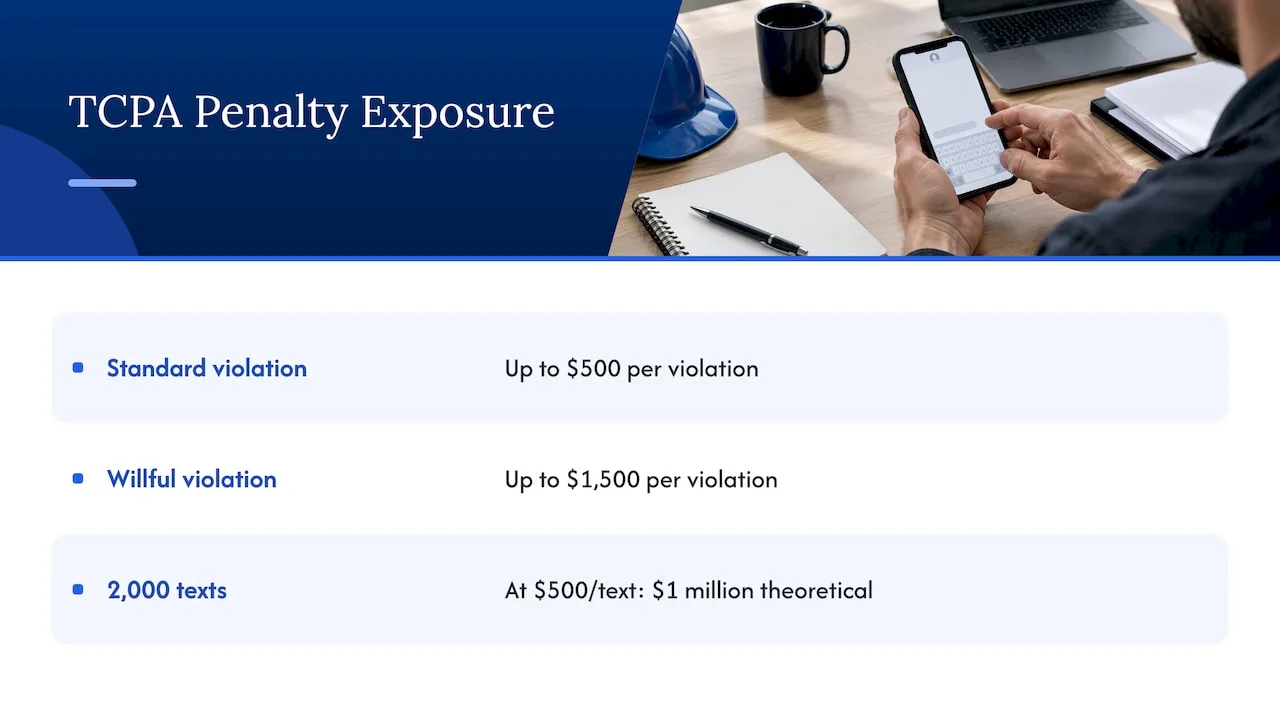
Consumers may seek up to $500 per TCPA violation, or up to $1,500 if the violation is willful, and the FCC and state attorneys general can also levy penalties, per Consumer Action. The math is what makes this serious. A list of 2,000 homeowners texted without valid consent, at $500 per text, is $1 million in theoretical exposure from a single blast. Most small contractors will never face that, but one aggrieved recipient with a lawyer is enough to cause a very bad month.
The cheapest protection is boring: clean consent, quick opt-outs, sane send times and records.
A practical checklist for your shop
Use this before you turn on any automated text flow.
- List every automated text you send. Missed-call text-back, appointment reminders, “on my way” alerts, estimate follow-ups, review requests, seasonal promos.
- Label each one informational or marketing. Anything with an offer is marketing.
- Check the consent source for each audience. Where did the number come from, and what did the person agree to?
- Fix your forms. Add the consent language beside the submit button, unchecked by default, with the “not a condition of purchase” statement.
- Identify yourself in the first message of any thread and include opt-out instructions in marketing texts.
- Set sending hours to 8:00 AM to 9:00 PM in the recipient’s local time, and shorter for any state with tighter rules.
- Connect opt-outs across every tool.
- Store records in one place you can export on request.
- Audit vendors. Get their consent practices in writing.
- Schedule a yearly review, because the FCC and carriers keep changing details.
Review requests: a special case
Contractors ask this one constantly. A text asking for a review after a job is a gray area: it is a request that serves your marketing, even though it is tied to a transaction. The conservative approach is to disclose in your job paperwork or booking form that customers may receive texts about their service, including a request for feedback, and to honor STOP immediately. Do not bundle a discount or promo into the review request unless you have marketing consent. Ask your attorney whether your wording is enough.
Perspective
Contractors do not lose jobs because they text too little. They lose them because a homeowner called at 7 PM, got voicemail, and dialed the next listing. Fast text-back and follow-up win those jobs, and we build them for plumbers, HVAC techs, electricians and roofers across Rhode Island and Massachusetts.
The same speed is why compliance has to be designed in from day one. When a system texts automatically, every mistake repeats automatically. That is why we think the right setup is one where the consent language sits on the website form, the opt-out reaches every tool in the CRM, and the follow-up sequences are separated into informational messages and marketing messages from the start.
We would rather see a shop send three well-timed, well-permissioned texts than thirty that put the business at risk. A website built to capture leads with clear consent, plus an automated follow-up flow that respects STOP, protects your phone number, your reputation and your margin together.
Tyson
Where Coastal Connect fits
If you are a contractor in Rhode Island or Massachusetts and your texting is a patchwork of a phone, a spreadsheet and a few apps, we can help you tidy it up. Our missed-call text-back and CRM service is built to answer the customers you cannot reach, and our websites that book jobs give you a place to put compliant consent language right where leads come in. Plans start with Foundation at $597 per month, Growth at $1,297 per month and Scale at $2,497 per month, and an AI employee on Growth is $199 per month. The full list is on our pricing page.
We design our tools to support compliant practices, but your consent wording and your legal obligations remain your business’s responsibility, so have your attorney review the final language.
FAQ
Does the TCPA apply to texts, or only to calls?
It applies to texts. The FCC states that the TCPA’s restrictions on autodialers and prerecorded messages also apply to text messages sent to cell phones. If you use software to send texts at scale, assume the rules cover you.
Can I text a customer who gave me their number on the phone?
You can text about the job they called about, such as confirming the visit or sending a technician’s arrival time. Marketing texts need separate written consent. Ask for it clearly and keep a record of the answer.
How fast must I honor a STOP request?
As soon as possible, and no later than 10 business days, according to Consumer Action’s TCPA guide. Automated systems should process STOP in seconds. Treat any reasonable wording as an opt-out, not just the word STOP.
Are my marketing agency or lead vendor responsible for compliance?
They share the work, but you remain liable for violations committed on your behalf. Ask for their consent process and record retention in writing before they send a single text for you.
What are the penalties for texting without consent?
A consumer can seek up to $500 per violation, or up to $1,500 if the violation is willful. The FCC and state attorneys general can also impose penalties. If you have a concern about past campaigns, speak with a telecommunications or consumer-protection attorney.
Sources
- Consumer Action: A Small Business’s Guide to the TCPA
- FCC: Unlawful Communications
- Dialpad: SMS messaging compliance principles
- Federal Register: FCC consent rule notice
- CTIA Messaging Principles and Best Practices
- FCC order delaying opt-out rule
- Blank Rome: TCPA quiet hours
- National Law Review: TCPA rules for marketing texts
- State-by-state SMS marketing laws summary
- TCPA.com: TCPA compliance guide