The best plumbing blog topics are the ones a homeowner types into Google while water is already on the floor or a water heater is already cold. Write for that moment: a specific problem, an honest answer on what can be fixed at home, and a clear point where you tell the reader to call a pro. This guide gives you the topic categories, example titles, and the structure that turns a post into a phone call.
TL;DR
- Start with urgent, problem-based topics (leaks, clogs, no hot water, running toilets). Readers searching these are close to booking.
- Every DIY post should say plainly when to stop and call a licensed plumber. That honesty is what converts.
- Add local posts on Rhode Island and Massachusetts licensing, codes and town-specific issues. Generic national posts are the ones everyone else already wrote.
- Cover high-value upgrades (heat pump water heaters, leak sensors, fixture retrofits) with real numbers and real limits.
- A post only earns money if the page has a call button, a form and a fast response behind it.
Table of Contents
- What the ranking plumbing blogs have in common
- Emergency and problem-based topics
- Myth-busting and DIY topics that earn trust
- Water heater and upgrade topics
- Smart leak detection and water monitoring
- Local topics only a Rhode Island or Massachusetts plumber can write
- Turning topics into a content calendar
- The anatomy of a post that books jobs
- Our perspective: content is only the first half
- Make the traffic pay: the system behind the blog
- FAQ
- Sources
What the ranking plumbing blogs have in common
Look at what shows up for this topic and a pattern appears. Manufacturer blogs publish product news. Seasonal posts list a dozen tips for summer. Local shops publish room-by-room checklists, “plumber vs. handyman” explainers and sewer repair technology pages. Directories collect lists of other plumbers’ blogs.
Most of it is broad and safe. Very little of it answers one exact question for one town. That is your opening. A short, specific post such as “Why your Providence basement drain gurgles when the washer runs” has far fewer competitors than “10 plumbing tips.”
The other gap is honesty. Many tip posts promise a fix and never say when the fix will not work. Readers notice, and so do the ones who end up with a bigger repair bill.
Emergency and problem-based topics
These are your bread and butter. The reader has a problem, a phone in hand and low patience. Titles that name the symptom work best.
- What to do when a main water line bursts (shutoff first, then the call)
- How to find a hidden water leak in your home
- Why your toilet keeps running
- Low water pressure in the whole house: causes and what to check
- Why a water heater makes popping or rumbling noises
- Slow drains in every sink: a branch clog or a main line problem?
- What to do when your pipes freeze, and how to keep them from bursting
The structure for each is the same. Lead with the immediate action, explain the likely causes, list what a homeowner can safely try, then state the exact signs that mean a professional is needed.
The numbers help. According to the EPA’s WaterSense statistics, a stuck toilet fill valve can waste about 4,300 gallons per day, costing up to $1,400 in a month. A running toilet post that opens with that figure explains why a $10 problem should not be ignored, and why a diagnosis visit is worth booking.
Write the “when to call” box in every post
Professionals who publish plumbing FAQs make the same point: the content that builds trust is the content that says where a home fix ends. If a snake does not clear the drain, or water is coming up in a floor drain, or a line has burst, the reader should hear that clearly from you. One plumbing company’s FAQ page shows how this tone works: practical answers, with the limits spelled out.
Put a short boxed section near the end of every DIY post with three to five specific triggers. Then add your phone number and a booking button directly under it.
Myth-busting and DIY topics that earn trust
Searchers ask about home remedies constantly, including the baking soda and vinegar question. A strong post on it does not say “never” or “works great.” It says what is true: the mixture can help with very mild soap film, but it does little against grease, mineral buildup or a real clog. Used repeatedly without a thorough hot water rinse, it can also dull some metal finishes, as plumbers explain on that same FAQ page.
Other myth and DIY topics that work:
- Chemical drain cleaners: why plumbers avoid them, and what to try first
- Plumber or handyman: which jobs need a license
- Flushable wipes: what actually happens in the line
- Garbage disposal dos and don’ts
- How to shut off the water to your whole house, with where the valve usually sits
These posts attract the DIY searcher. You will not convert every one of them, and that is fine. The reader who tries your tip, fails, and remembers your name is the one who calls.
Water heater and upgrade topics
Upgrade content brings in bigger tickets, and readers researching them are comparing options, not panicking. That gives you room for depth.
Heat pump water heaters
This is one of the most useful topics right now, and one where nuance sets you apart. A 120-volt heat pump water heater can avoid an electrical panel upgrade. According to a Department of Energy peer review presentation, that can save a household between $800 and $15,000 compared with a 240-volt model. The same material points to practical realities for installers: airflow, condensate drainage, and installs that often run six hours or more, longer than a typical gas swap.
A field study of plug-in units lists higher upfront and installation costs and the complexity of space, ventilation and condensation among the lessons learned. Write the post the way a good installer would explain it at the kitchen table: where the unit can go, what it needs, what it costs, and what could make it a poor fit for a tight New England basement closet.
Post ideas:
- Tank vs. tankless vs. heat pump: real costs over ten years
- Can a heat pump water heater work in a small basement?
- Signs your water heater is near the end of its life
- What happens during a water heater replacement, hour by hour
Fixture retrofits and water savings
The EPA says that retrofitting with WaterSense-labeled fixtures saves the average family more than $380 a year, and that replacing old toilets alone can save about 13,000 gallons and $130 annually. Those figures give a homeowner a payback argument for a bathroom update, and they give you a reason to quote the job.
Smart leak detection and water monitoring
This category is still thin in most plumbers’ blogs, which makes it a good place to stand out. Household leaks can spike utility bills and sometimes damage homes, and the EPA publishes a fact sheet on leak detection and flow monitoring devices that explains the device types.
Utilities are also moving toward smart metering. An EPA WaterSense webinar on advanced metering infrastructure shows how meter data is being used to spot customer-side issues and boost customer enrollment. For a plumber, that opens topics like:
- How continuous flow alerts catch a leak before the ceiling does
- Do you need a whole-home leak sensor, or is a $20 puddle alarm enough?
- What to do when your water utility says you have a leak
- Installing a smart shutoff valve: what a plumber checks first
These posts position you as the person who manages the home’s water system, not just the person who shows up after it fails.
Local topics only a Rhode Island or Massachusetts plumber can write
National sites cannot touch this section, so spend real effort here.
Licensing and code explainers
Homeowners want to know if the person in their basement is licensed. In Massachusetts, plumbing and gas fitting work falls under 248 CMR, administered by the Board of State Examiners of Plumbers and Gas Fitters. 248 CMR 3.00 covers the administrative requirements for installation, removal, alteration, repair and inspection of plumbing and gas fitting work.
In Rhode Island, the Department of Labor and Training’s application instructions set out the requirements: master plumber applicants need at least five years of experience, and the application fee listed is $75.00. Always check that page for the current version before you quote any requirement in a post, because rules and fees change.
Post ideas from this material:
- How to check whether a plumber is licensed in Rhode Island or Massachusetts
- Why permits and inspections matter on a water heater swap
- What a licensed plumber can do that a handyman cannot
What the “135 rule” means
One of the questions people ask is about the “135 rule.” According to plumbers’ explanations, it is shorthand for the pitch of horizontal drain pipe: typically a quarter-inch drop per foot for 2.5 to 3 inch pipe, and an eighth-inch per foot for pipe 4 inches or larger (source). Confirm the slope your local code requires before publishing a number, then write a post on why bad pitch causes slow drains and failed inspections.
Town and season posts
Use what you know about your service area:
- Frozen pipe prevention for older New England homes, by neighborhood type
- Sump pump and basement flooding after a nor’easter
- Well water vs. municipal water issues in rural Massachusetts towns
- Sewer line problems in older Providence, Cranston or Warwick streets
- Spring startup checklist for outdoor spigots and irrigation
If you do not have the specific detail, do not fake it. A post with one true local detail beats five pages of filler.
Turning topics into a content calendar
A simple calendar beats an ambitious one you abandon. Here is a rhythm that fits a small shop.
| Month type | Post focus | Goal |
|---|---|---|
| Cold months | Frozen pipes, water heater failure, burst line | Emergency calls |
| Spring | Sump pumps, outdoor spigots, irrigation startup | Maintenance bookings |
| Summer | Fixture retrofits, water savings, bathroom remodels | Upgrade quotes |
| Fall | Winterizing, water heater checkups, leak sensors | Planned work |
Aim for one strong post a month before you aim for four weak ones. Update older posts each season with fresh photos, prices and links.
The anatomy of a post that books jobs
Topic choice is half the work. The other half is what is on the page.
- Answer in the first two sentences. Name the cause and the immediate step.
- Show a real job. A photo from a local call, with the town named and the homeowner’s permission, beats stock images.
- Give the limit. State exactly when to stop and call.
- Put a number to it. Gallons wasted, a licensing fee, hours on the job. Link the source.
- Add one clear action. A call button, a text option and a short form, visible without scrolling.
- Link to your service page. A water heater post should lead to your water heater page.
Then check what happens after the click. A reader who calls after hours and gets voicemail goes to the next result. This is where most contractor blogs quietly fail: the content works and the follow-up does not.
Our perspective: content is only the first half
We build websites and automation for contractors in Rhode Island and Massachusetts, including plumbers, and the same pattern shows up over and over. A shop writes a good post, it ranks, the phone rings during a job, nobody answers, and the lead is gone.
So we treat blog topics as one part of a lead capture system. The post brings the reader in. The page converts them. A missed-call text-back replies within moments when you cannot pick up. Reviews after each job build the proof that the next reader looks for.
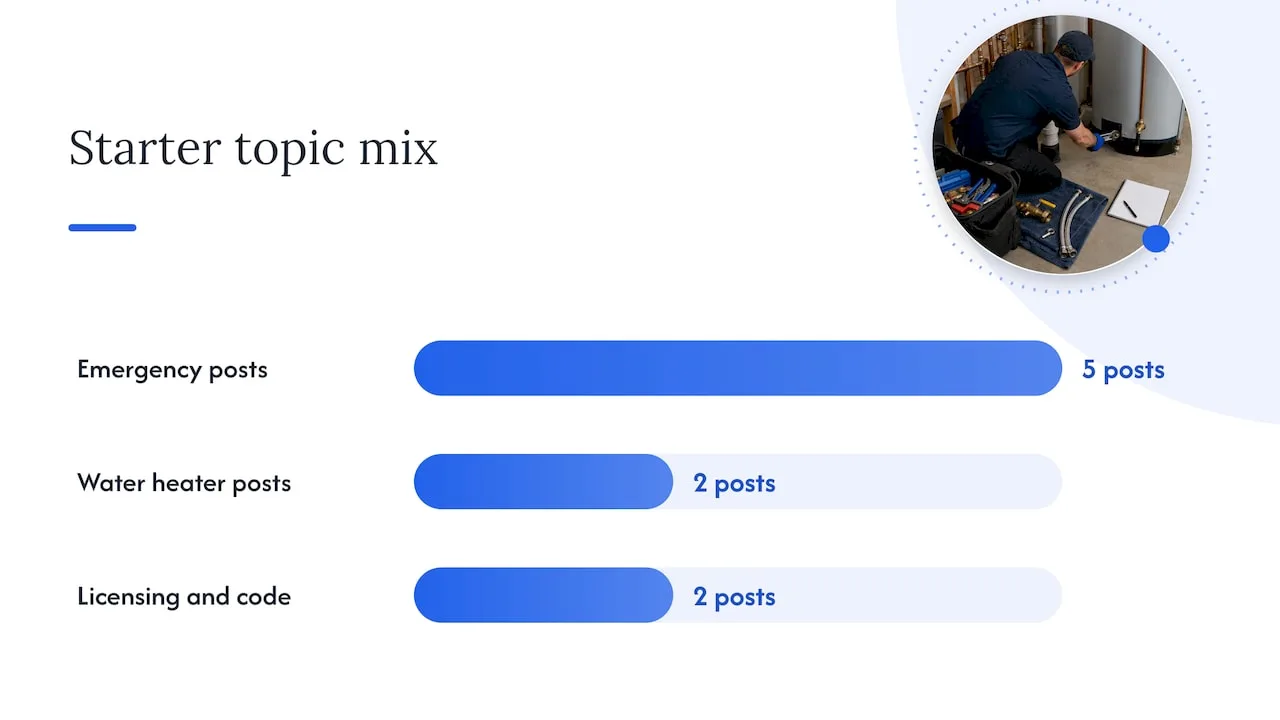
If we had to pick topics for a plumber starting from zero, we would choose five emergency posts, two water heater posts and two local licensing and code posts. Then we would make sure every one of them leads somewhere: a clear call button, a form that reaches a human, and a response that arrives fast. Fancy content on a slow, hard-to-use site wastes the work.
And we would not write anything we could not stand behind. Plumbing advice that goes wrong costs a homeowner real money. Honest limits make a post better and make your shop look like the careful pro it is.
— Tyson
Make the traffic pay: the system behind the blog
If you want the posts above to turn into appointments, the pieces we would put in place are a website built to book jobs, local SEO and Google Business Profile work so the right towns find you, and missed-call text-back with a CRM so no lead goes cold. Our Foundation plan is $597 per month, Growth is $1,297 per month and Scale is $2,497 per month, and the pricing page shows what each includes along with add-ons such as an AI employee on Growth at $199 per month.
FAQ
How many plumbing blog posts do I need before it helps?
There is no magic number. A handful of well-built posts on your most profitable services and your service area will do more than dozens of thin ones. Start with the emergency and water heater topics, then add one post a month.
Should I write about DIY fixes if I want customers to hire me?
Yes, if you are honest about limits. A homeowner who sees you explain a fix and also say exactly when to call a pro is more likely to call you when the fix fails. Skip anything that could cause damage or injury if done wrong, such as gas line work.
What is the 135 rule in plumbing?
Plumbers use it as shorthand for the slope of horizontal drain pipe: about a quarter-inch drop per foot for 2.5 to 3 inch pipe and an eighth-inch per foot for 4 inch or larger. Check your local plumbing code for the requirement that applies to your jobs.
Do baking soda and vinegar unclog drains?
They can help with very mild soap film, but they are largely ineffective against grease, mineral deposits or a significant clog. If a drain stays slow after a hot water flush, a plumber should look at it.
Can I mention licensing rules in my posts?
Yes, and for Rhode Island and Massachusetts it builds trust. Link the official state pages and check them for current requirements before publishing, since fees and rules can change.
Sources
- EPA WaterSense: Statistics and Facts
- EPA: Know Your Flow, Leak Detection and Flow Monitoring Devices
- EPA WaterSense webinar on Advanced Metering Infrastructure, January 28, 2026
- DOE: Identifying and Removing Barriers for 120-volt Heat Pump Water Heaters
- Plug-In Heat Pump Water Heater Field Study Findings
- Massachusetts 248 CMR 3.00
- Rhode Island DLT plumbers and irrigators application instructions
- Plumbing FAQs from a plumbing company