
For a contractor, local SEO usually shows its first measurable movement at about 11 weeks. First-page map visibility on your main keyword follows around week 19 for the typical business, and real traffic growth around week 26. Service-area trades like plumbing and electrical tend to land a little faster than most industries. Those are medians from one data set, not promises, and your own timeline depends on your starting point, your town and how consistently the work gets done.
This guide walks through the timeline phase by phase, explains the stall that makes many owners quit, and shows what you can control. It is written for plumbers, HVAC specialists, electricians, roofers and landscapers in Rhode Island and Massachusetts who are deciding whether to invest, or whether to keep going.
TL;DR
- Expect the first measurable ranking movement around week 11, a first-page map-pack spot on your main keyword around week 19, and a clear traffic lift around week 26 (median figures from a 200-business study).
- Service-area trades such as plumbers and electricians reach first map-pack visibility at a median of 14 weeks, against 28 weeks for lawyers and accountants.
- Progress often stalls between weeks 8 and 14. Owners who keep working through it are far more likely to resume climbing than those who cut back.
- Google says you cannot pay for a better local ranking. Reviews, accurate information and a strong web presence are the legitimate levers.
- A verified Google Business Profile is the starting line. Delays there push every other milestone back.
Table of Contents
- Why there is no single answer
- How Google decides who shows up
- The timeline, phase by phase
- Why trades often move faster than other industries
- What speeds the timeline up, and what slows it down
- Speed to lead: where a timeline turns into revenue
- Our perspective
- How Coastal Connect fits into the timeline
- A realistic first-year plan for a contractor
- How to measure progress without guessing
- FAQ
- Sources
Why there is no single answer
Ask three agencies how long local SEO takes and you will hear “three to four months,” “six months” and “about a year.” They are all describing different finish lines. One means the first ranking shift. Another means a steady flow of calls. The third means dominating a competitive keyword.
The first step is to pick the finish line that matters to your business. For a contractor, that is almost never “rank number one.” It is more booked jobs from people who search things like “emergency plumber near me” or “roof repair Warwick.” So when you read a timeline, ask what exactly is being measured.
The study we lean on here, a review of 200 small businesses, defined measurable movement as a shift of at least three places on a keyword, or a first-time appearance in the map pack. That is a useful, honest definition because it can be checked. It is also a reminder that a median is a midpoint: half of businesses moved slower, half faster.
How Google decides who shows up
Before the timeline makes sense, you need the rules. Google states that local results rely on three things: relevance (how well your profile matches the search), distance (how far you are from the person searching) and prominence (how well known you are).
Two of those are partly out of your hands. You cannot move your shop closer to a homeowner in Cranston. What you can build is relevance and prominence, and that takes calendar time because it depends on signals that accumulate: reviews, citations, links, content and engagement.
Google is also blunt on one point: there is no way to pay for a better local ranking, and the algorithm details are kept confidential to keep results fair. Anyone promising a guaranteed position in 30 days is selling something Google says does not exist. The factors Google does name include review count, review score and your presence in regular web results, which is why local SEO is a mix of profile work and website work.
The timeline, phase by phase
The figures below come from the same 200-business data set. The tasks in each phase are our own working view of what typically has to happen for those milestones to arrive.
| Phase | Typical window | Milestone from the data | What drives it |
|---|---|---|---|
| Foundation | Weeks 0 to 4 | None yet | Profile verified, categories and service areas set, site fixed, tracking installed |
| Early signals | Weeks 4 to 11 | First measurable movement at median week 11 | Reviews start, citations cleaned up, service pages published |
| Plateau | Weeks 8 to 14 | Gains flatten | Consistent publishing, review requests, citation upkeep |
| Map-pack entry | Around week 19 | First-page map-pack visibility on a primary keyword (median) | Review volume, relevance of pages, local links |
| Traffic lift | Around week 26 | Organic traffic up more than 20% over baseline (median) | Compounding of all of the above |
| Momentum | Months 9 to 12 and beyond | Multiple keywords and towns | Expansion to more services and service areas |
Weeks 0 to 4: foundation
Nothing moves in the rankings yet, and that is normal. This is the stage where most contractors lose ground without knowing it. Your Google Business Profile has to be claimed and verified, your primary and secondary categories chosen, your service areas defined and your phone number and hours matched across the web.
Verification deserves its own warning for trades. Contractors who travel to the customer generally need to set up as a service-area business and hide the street address. In one Google Business Profile community thread about a plumbing company stuck in repeated rejections, the pattern was clear: rejections usually came down to missing proof that the business operates in the area it claims. Branded vehicle photos, local licenses and utility bills were the kinds of evidence people pointed to. These are community answers, not official policy, so use them as a checklist of what to have ready and check Google’s current verification instructions when you apply.
If verification takes three weeks instead of three days, assume your whole timeline shifts by the same amount.
Weeks 4 to 11: the first signals
This is where the work starts to show up as data, even if the phone is not ringing yet. You might see impressions rising in Search Console, your profile appearing for branded searches, or a new review landing every week.
The median time to first measurable movement in the study was 11 weeks. A faster start is possible if your site is already sound and you have an established review base. A slower one is common if you are starting from a thin website, inconsistent business listings or a suspended profile.
In this phase, track leading indicators rather than leads: profile views, direction requests, calls from the profile and the number of pages indexed. If you only watch booked jobs, you will think nothing is happening.
Weeks 8 to 14: the plateau most people quit in
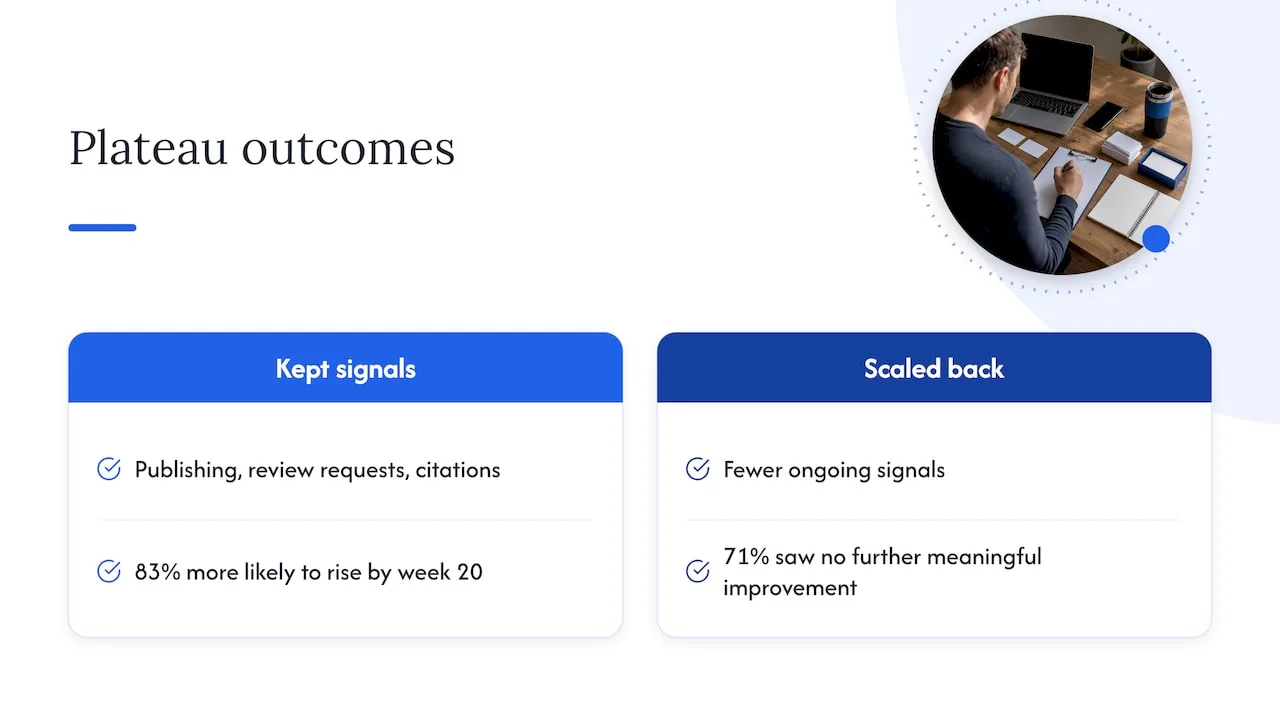
The study’s background data flags a quiet phase between weeks 8 and 14 where early gains flatten. Among businesses that kept up publishing, review requests and citation management through it, 83% were more likely to resume upward movement by week 20. Among those who scaled back, 71% saw no further meaningful improvement.
That is a vendor-published data set, so read it as a strong signal rather than a law of nature. It still matches what many owners report: the early bump comes from cleaning up obvious problems, and the next climb requires fresh, sustained signals.
This also explains the common six-month quote. The data suggests agencies often say six months because that is when traffic starts to look meaningful, even though ranking movement begins much earlier. If you cancel at month three because the lead count is flat, you may be leaving right before the payoff. Tools that automate keyword research and publishing, such as SEO automation platforms, can help keep the content cadence steady through the plateau, which is the real goal of this phase: no gaps.
Weeks 14 to 26: map pack, then traffic
The median first-page map-pack appearance on a primary keyword came at week 19, and a measurable organic traffic increase (more than 20% over baseline) at week 26. For a contractor, week 19 is when “furnace repair” searchers in your core town start seeing you in the three-pack. Week 26 is when your website, not just the profile, starts pulling its weight.
This is also when conversion matters most. Visibility without a fast response is wasted: a homeowner with no heat will call the next company in the list if you do not answer. We come back to that below.
Months 7 to 12: momentum and expansion
After the first map-pack win, the work becomes widening the footprint: more services, more towns, more review volume. Competitive categories (roofing in Boston, for example) take longer than a niche service in a smaller town. Once your core town is stable, adding neighboring towns usually goes faster because your profile and site already carry authority.
Why trades often move faster than other industries
The same study found clear differences by industry. Service-area businesses like plumbers and electricians reached first map-pack visibility at a median of 14 weeks. Lawyers and accountants needed a median of 28 weeks, which the data attributes to higher competition and lower query frequency.
For contractors, that is good news. People search for trades constantly and urgently, so there are more searches, more engagement and more reviews flowing in a given month. The flip side is that your neighbors compete for those same searches. Speed in the data is a median, not a guarantee that your specific town and trade will match it.
What speeds the timeline up, and what slows it down
Things that speed it up
- A verified, complete profile on day one. Correct categories, service areas, hours, photos and services.
- A steady stream of reviews. Count and score are named by Google as ranking factors. Asking after every finished job beats a one-time push.
- Dedicated service pages. One page per core service and town you want to win, not a single “services” page.
- Consistent business details. The same name, address (or service area) and phone number everywhere.
- Accurate structured data. Google’s LocalBusiness documentation describes markup that helps Google understand hours, services and reviews. It is not a ranking factor on its own, and the markup must be accurate and visible to users, or you risk a manual action.
Things that slow it down
- Failed or delayed verification, often from weak proof of operations.
- Pausing during the plateau. The data shows this is the costliest mistake.
- Keyword stuffing the business name, or running multiple profiles for one business.
- A slow, hard-to-use website. Rankings may arrive, but calls will not.
- Changing agencies every three months. Each restart resets the foundation work.
Speed to lead: where a timeline turns into revenue
Ranking is only half of the equation. Once you appear in the map pack, the question becomes how many of those calls you actually book. A plumber on a job site cannot answer every call, and every missed call goes to the next company.
That is why we treat SEO and lead capture as one system. A website built to book jobs, a missed-call text-back, and a way to catch calls after hours all make the ranking gains pay off sooner. Even a modest lift in visibility becomes visible revenue much earlier when fewer calls are lost.
Our perspective
We work only with contractors in Rhode Island and Massachusetts, and the same mistake shows up again and again: owners judge local SEO on month two. They look at the phone, see no change and conclude it does not work. The reality is that month two is paperwork, cleanup and early signals. Month five is when it starts to feel different.
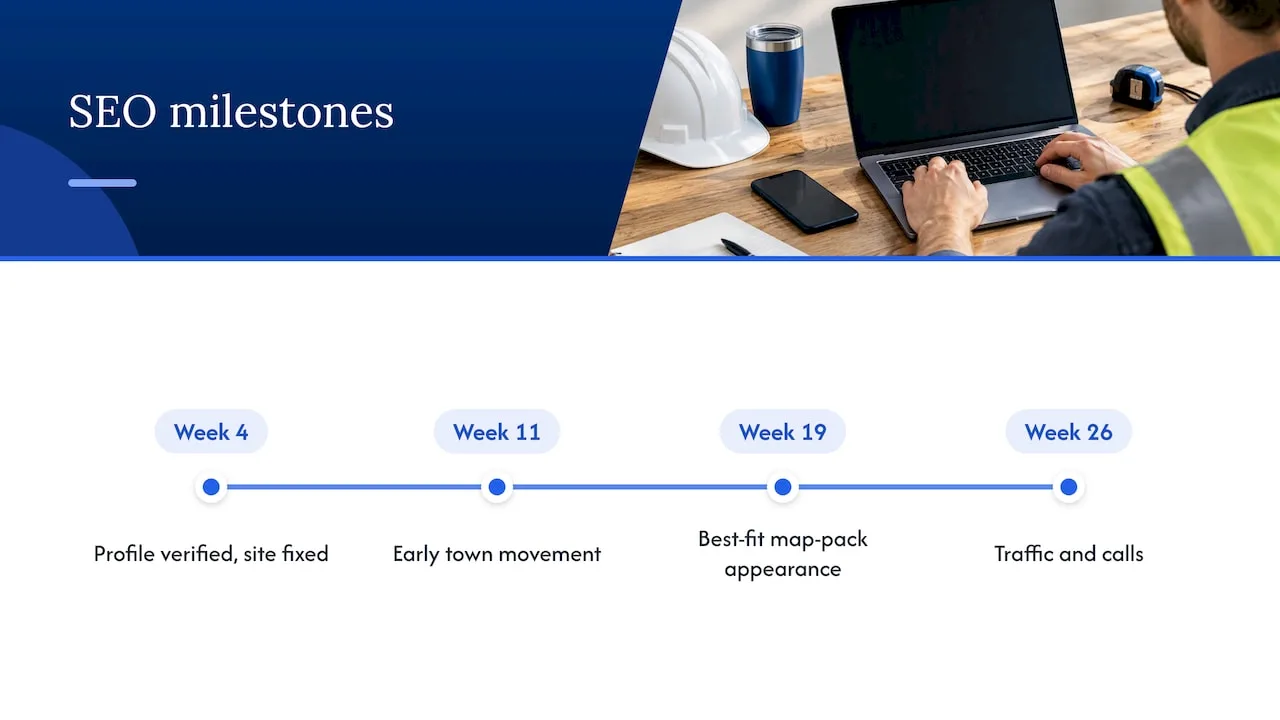
Our advice is to agree on milestones before you start, not on promises. Week four: profile verified and the site fixed. Week eleven or so: early movement in your main towns. Week nineteen or so: a map-pack appearance for your best-fit service. Week twenty-six: traffic and calls that you can compare with a baseline we record on day one. If an agency cannot tell you what to expect at each checkpoint, or guarantees a number one spot, walk away. Google itself says rankings cannot be bought.
The second thing we push is local knowledge. A roofer in Plymouth and an electrician in Somerville face different competition, different seasons and different homeowners. A team that knows the towns builds service pages that sound like they were written by someone who has driven the streets, and that helps relevance as much as any technical fix.
Finally, protect the plateau. If your budget is tight, we would rather you run a leaner, consistent plan than a big plan that stops at week ten.
— Tyson
How Coastal Connect fits into the timeline
If you want the foundation, the profile work and the lead capture handled together, our Local SEO and Google Business Profile service covers verification, categories, service areas and ongoing optimization for contractors in Rhode Island and Massachusetts.
Our plans start with Foundation at $597 per month, with Growth at $1,297 per month and Scale at $2,497 per month. Extra locations start from $299 per month. You can compare what each includes on the pricing page.
Pair it with a missed-call text-back and CRM setup and a review system that keeps requests going, and the milestones above turn into booked work sooner.
A realistic first-year plan for a contractor
Here is how we would lay out the first twelve months for a single-location HVAC or plumbing business. It is a template, not a quote, and the timing is based on the medians above.
- Month 1: Verify the profile, set categories and service areas, audit the website, fix speed and mobile issues, set up call and form tracking, and record a baseline for impressions, calls and traffic.
- Month 2: Publish or rewrite the main service pages, clean up listings and start a review request routine after every completed job.
- Month 3: Check for early movement. Continue publishing and review requests even if lead numbers have not changed. This is the start of the plateau window.
- Months 4 and 5: Add town pages for the next-closest service areas, build a few local links (suppliers, chambers of commerce, local sponsorships) and keep adding photos and posts to the profile.
- Month 6: Compare against the baseline. Look for a map-pack position on your primary keyword and for a traffic increase of 20% or more. Decide which services and towns to expand to.
- Months 7 to 12: Expand to secondary services and towns, grow the review count, and test conversion improvements such as call tracking, chat and faster response.
How to measure progress without guessing
A timeline only helps if you can tell where you are on it. Keep a simple monthly record:
- Profile calls, direction requests and website clicks from your Google Business Profile insights.
- Impressions and clicks for your service pages in Google Search Console.
- Map position for three to five target keywords, checked from a few points around your service area, since results change with the searcher’s location.
- Review count and average score, plus how many came in that month.
- Booked jobs by source, asked at intake: “How did you find us?”
Rankings checked from your own office can mislead you, because Google weighs distance. What looks like page one in your shop may be page three in the next town over.
FAQ
How long does local SEO take for a contractor?
In the 200-business data set, first measurable movement came at a median of 11 weeks. Service-area businesses like plumbers and electricians reached first map-pack visibility at a median of 14 weeks. Expect meaningful call volume closer to six months, and longer in crowded markets such as Boston.
Can I pay Google to rank higher in the map pack?
No. Google says you cannot pay for or request a better local ranking. Paid ads are separate and appear in their own placements. Organic map visibility comes from relevance, distance and prominence, including reviews and your web presence.
Why did my rankings stop improving after a good start?
A flat stretch between weeks 8 and 14 is common, according to the same study. The early gains often come from fixing basics, and the next step needs ongoing reviews, content and citation upkeep. Businesses that kept working through it were more likely to start climbing again by week 20.
Why was my Google Business Profile verification rejected?
The usual cause is not enough proof that the business really operates where it says it does. Contractors who travel to customers generally need to set up as a service-area business and hide the address. Have branded vehicle photos, licenses and a utility bill ready, and follow Google’s current guidance when you reapply.
Should I stop SEO if I see no leads after three months?
Not on lead count alone. Check leading indicators first: impressions, profile views, review growth and indexed pages. If those are flat as well, ask your provider what went wrong. If they are moving, you are probably still before the point where calls typically show up.
Sources
- How Long Local SEO Actually Takes: Data from 200 Small Businesses
- Tips to improve your local ranking on Google, Google Business Profile Help
- How to improve your local ranking on Google
- Business verification repeatedly failing for legitimate 50-year plumbing company, Google Business Profile Community
- Local Business structured data, Google Search Central