The best landscaping SEO keywords are a service plus a place: “lawn mowing Warwick RI” or “landscape design Newton MA”, not “landscaping” on its own. A homeowner who types those words has a yard, a budget and a decision to make this week. This guide shows how to build that list, sort it by what each term is worth, and put each phrase on the right page so your phone rings. The same method works for lawn care, hardscaping, tree work and seasonal cleanups.
TL;DR
- Pair every service you sell with the towns you actually serve. Those phrases beat broad terms because the searcher is ready to hire.
- Sort keywords into three groups: service, local and informational. Give each core service its own page and each key town its own page.
- Check the search results before you commit to a term. If Google shows a map pack and local companies, the intent is local and worth targeting.
- Write for the homeowner, not the algorithm. Repeating a phrase over and over is against Google’s spam policies and does not help you rank.
- Lawn care and landscaping are different searches. Treat “lawn care keywords” as their own set with their own pages.
Table of Contents
- What landscaping SEO keywords actually are
- Three kinds of keywords, three jobs
- Service keywords: one page per core job
- Local keywords: where the calls come from
- Lawn care keywords are their own list
- A five-step method to choose and prioritize
- Where to place keywords on the page
- Mistakes that keep you from local customers
- Our perspective: keywords are the easy half
- Turning keyword pages into booked jobs
- A simple first-month plan
- FAQ
- Sources
What landscaping SEO keywords actually are
A keyword is simply a word or phrase a person might type to find a page about your work. Google’s own SEO starter guide puts it that way, and it adds a point contractors often miss: a beginner and an expert may use completely different words for the same thing. A homeowner with a patchy yard may search “fix bare spots in grass”, while a property manager searches “turf renovation”. You do not need to cover every variation. You need to cover the ones your real customers use.
That is why a keyword list built from guesses usually disappoints. The list should come from three places: the jobs you already want more of, the words customers use on the phone, and what the search results show when you type the term yourself.
Three kinds of keywords, three jobs
It helps to sort every term by what the searcher wants. Most landscaping terms fall into one of three groups.
| Type | Example | What the searcher wants | Where it belongs |
|---|---|---|---|
| Service | lawn mowing service, landscape design, mulching | A company that does this work | Dedicated service page |
| Local | lawn mowing Warwick RI, landscaper near Cranston | A company that does this work in their town | Town page, Google Business Profile, page titles |
| Informational | how to overseed a lawn, when to aerate | An answer, not yet a contractor | Blog post or guide |
Service and local terms bring people who are ready to book. Informational terms bring people who are learning, and some of them become customers later. Start with the first two, then add informational content once the money pages are in place.
Service keywords: one page per core job
Start with your service list, not a keyword tool. Write down every job you want more of. For a typical New England landscaping company that might be:
- Lawn mowing and weekly maintenance
- Spring and fall cleanups
- Mulching and bed edging
- Landscape design and installation
- Patios, walkways and retaining walls
- Aeration and overseeding
- Tree and shrub trimming
Housecall Pro’s landscaping SEO guide suggests building dedicated pages for each core service such as lawn mowing, landscape design, mulching and seasonal cleanups. The reasoning is simple. A single page called “Our Services” cannot be the best answer to five different searches. Five pages, each about one job, can.
Trim the list to jobs you want to book. If you do not install patios, do not build a patio page just because the term has volume. Google’s people-first content guidance warns against producing content mainly to attract search traffic or covering many topics you have no real expertise in. A page about work you do not do will not convert anyway.
Local keywords: where the calls come from
Landscaping is a local purchase. Nobody in Providence wants a crew from Worcester, so the most valuable searches carry a place name. The research points to a simple pattern: combine a service with a city or neighborhood, and put the city and state in the page title, the meta description and the H1.
A few examples of the shape, written for this region:
- lawn mowing service in Cranston, RI
- landscaping company near Federal Hill, Providence
- spring cleanup Barrington RI
- landscape design Newton MA
- retaining wall contractor Quincy MA
These are patterns to adapt, not a ranked list with proven volumes. Your own towns, your own services.
How to treat “near me”
You cannot reliably win “near me” by writing it on your page. Google decides who is near the searcher from their location, so those results come mostly from your Google Business Profile and how close it is to the person searching. What you can control is the information behind it. Google explains that local results rest mainly on relevance, distance and prominence, and that complete, accurate business information helps match you to the right searches. Reviews and links from other sites feed prominence. So the work behind “near me” is a finished profile, service areas set to the cities and ZIP codes you really serve, and a steady flow of reviews.
Do not claim towns you do not serve
It is tempting to list forty towns. Resist it. Set your service areas to places where you actively work, and build a real page only for towns where you have jobs, photos and something specific to say. A page for “Warwick” that mentions a finished job on a Warwick street and the kinds of lots you see there is worth more than a page that swaps one town name into the same paragraph.
Lawn care keywords are their own list
People who search for lawn care are often after a recurring service: weekly mowing, fertilizing, weed control, aeration. People who search for landscaping are more often after a project: a design, a new bed, a patio. The first is a subscription-style sale and the second is a quote. They deserve different pages, different calls to action and different proof.
Ahrefs’ guide for landscapers suggests starting research from three seed words, “landscaper”, “landscaping” and “lawn”, and letting a keyword tool expand them into service searches such as mowing and aeration, and into problem-based questions such as how to aerate a lawn. That is a good way to see the vocabulary. Then filter hard. You are looking for the terms that match a service you sell in a town you serve.
For a lawn care page, useful details to cover include:
- The services included in a visit and how often you come
- The towns you serve and any route-based scheduling
- How to start service and how quotes work
- Seasonal work, like spring cleanup and fall leaf removal, offered alongside regular mowing
- Proof: reviews, before and after photos, crew photos
A five-step method to choose and prioritize
Ahrefs’ local keyword research walkthrough lays out a process that fits a contractor well. Here it is, adapted for landscaping.
Step 1: List the services you want to sell
Use the list above. Mark the three or four that make you the most money per job, not just the ones that are easy to describe.
Step 2: Check for local intent
Search each phrase yourself, with a town name. If the results show a map pack and local companies, Google treats it as a local search and a service page can compete. If the results are all national articles and tool vendors, the term is not for you.
Step 3: Check search volume, with realistic expectations
Local terms often show tiny numbers. Some tools report only a handful of searches a month for a term like “landscape design Barrington RI”. Small numbers are normal for a town-level phrase, and one booked design job can be worth thousands of dollars. Do not throw out a term just because the number is low. Throw it out when it does not match something you sell.
Step 4: Group and map keywords to pages
Put closely related phrases on one page and give each page one main job. “Lawn mowing Warwick” and “lawn mowing service Warwick RI” are the same search and belong together. “Lawn mowing” and “landscape design” are not and do not.
A simple map looks like this:
| Page | Main keyword | Supporting terms |
|---|---|---|
| /lawn-care | lawn care services RI | weekly mowing, fertilizing, weed control |
| /landscape-design | landscape design Rhode Island | garden design, planting plans |
| /spring-cleanup | spring cleanup Providence | yard cleanup, bed cleanup, debris removal |
| /towns/cranston | landscaping Cranston RI | lawn mowing Cranston, mulching Cranston |
Step 5: Add what customers expect to see
For each page, look at what the top local results cover and fill the gaps: pricing guidance, what is included, how scheduling works, how soon you can start. Ahrefs’ local SEO tips make the same point: useful service pages cover things like pricing, service types, locations and availability, rather than repeating an exact phrase unnaturally.
Where to place keywords on the page
The terms you picked work only if they sit in the right spots, written the way a person would write them.
- Title. Google recommends unique, clear and concise title links that describe the page accurately. Example: “Lawn Mowing in Warwick, RI | Your Company Name”.
- H1. One per page, saying what the page is about in plain words.
- Opening paragraph. Name the service and the towns once, naturally, then get to the point.
- Subheadings. Use them for real questions: what is included, how often, how to book.
- Image names and alt text. Describe the photo honestly: “fresh mulch around hydrangeas in a Cranston front yard”.
- Google Business Profile. Choose accurate categories and services, set service areas, and keep the description consistent with your site.
Writing helpful pages around the search terms people use is a skill worth practicing, and it pays off most when each page answers one need in full. If you want a model for helpful pages around search terms, look at how a site explains what it offers to each audience in its own words before it asks for anything.
Mistakes that keep you from local customers
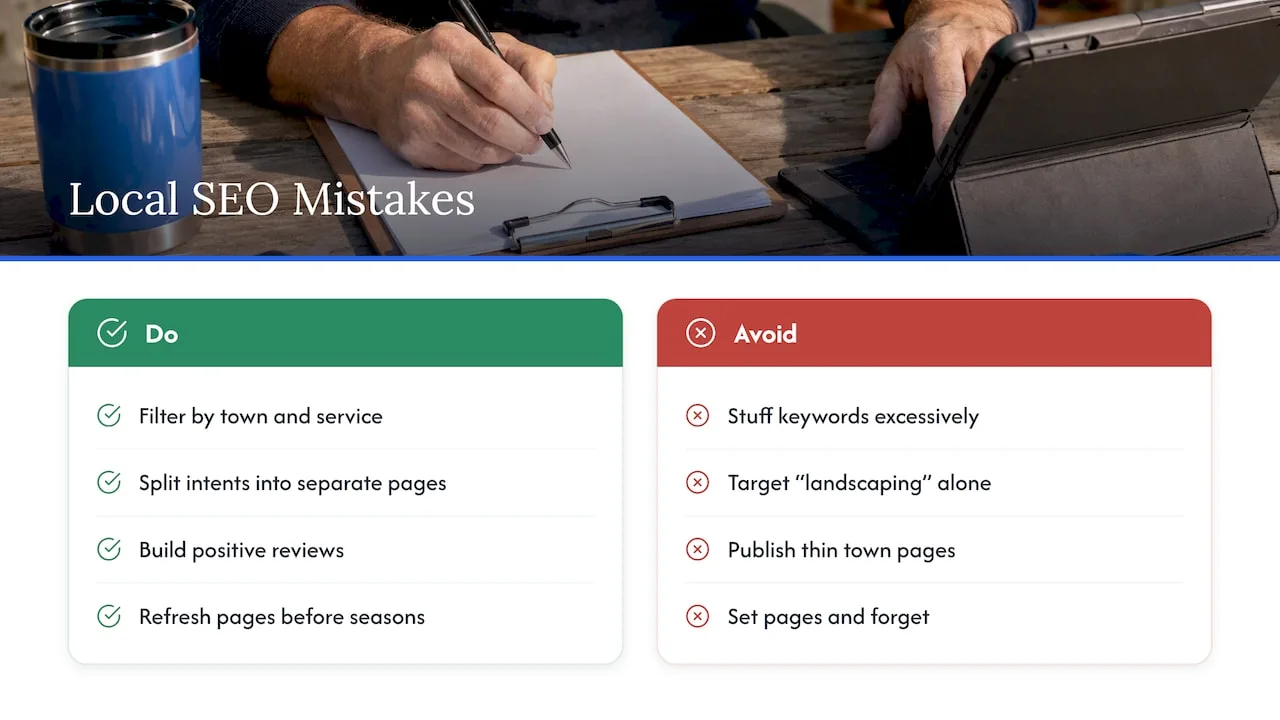
Stuffing keywords. Google’s starter guide says excessive repetition is tiring for readers and counts against its spam policies. If you read the page aloud and it sounds like a robot wrote it, rewrite it.
Targeting the wrong breadth. “Landscaping” alone pulls in tutorials, stock photos and searches from across the country. A town and a service filter all that out.
Mixing intents on one page. A page that tries to sell weekly mowing, patio installs and tree removal ranks for none of them. Split it.
Ignoring reviews. Google says prominence draws on factors including how many reviews a business has, and that more positive reviews can help local ranking, as the local ranking tips explain. Keywords get you into the running. Reviews help decide who wins.
Publishing for volume. Dozens of thin town pages with swapped names are the kind of content Google’s helpful-content guidance warns against. Fewer, better pages beat more, weaker ones.
Setting and forgetting. Seasonal services change what people search for. Spring cleanup, aeration, fall leaf removal and winter work each have their moment. Refresh the page ahead of the season, not during it.
Our perspective: keywords are the easy half
We work only with contractors in Rhode Island and Massachusetts, and we see the same pattern again and again. A landscaper picks decent keywords, publishes a page, and then loses the lead anyway. The homeowner searches at 8 p.m., finds the page, calls, and reaches voicemail. Or they fill in a form and hear back two days later, after another company has already booked the job.
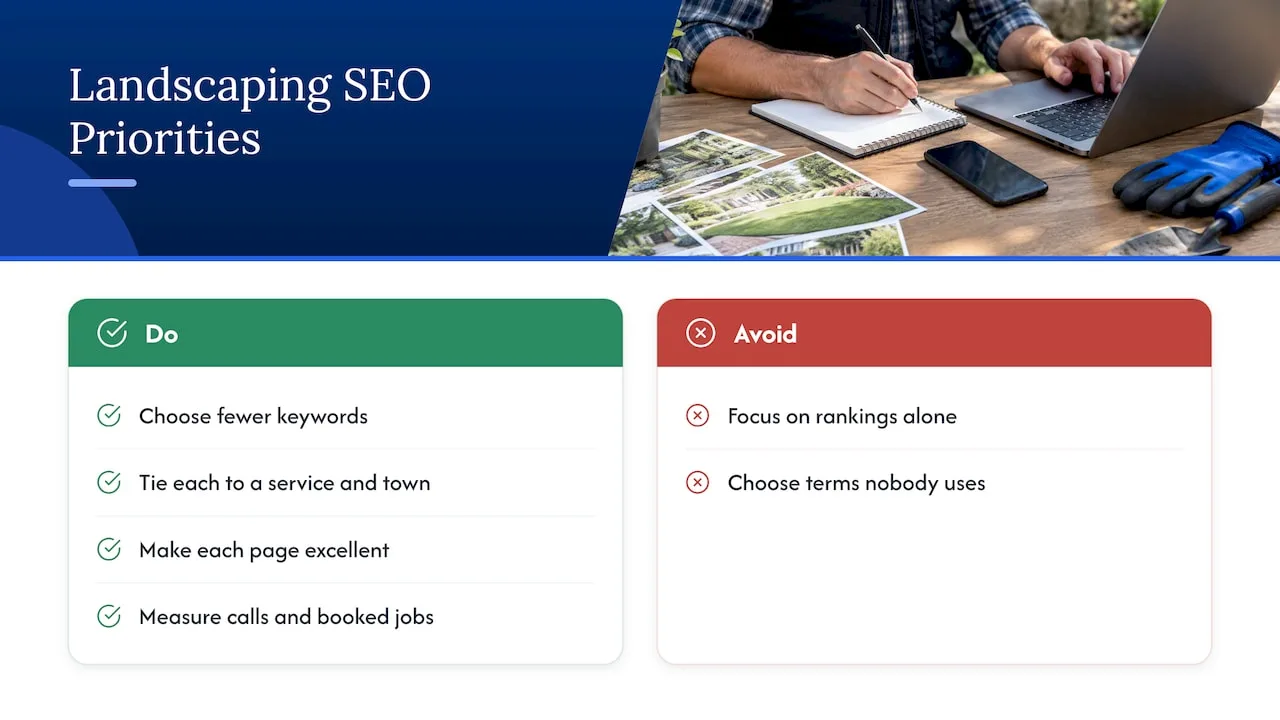
So we treat keywords as the first half of the work. The second half is what happens after the click: a site that makes it obvious how to request a quote, a fast reply by text when a call is missed, and a steady stream of reviews that back up the claims on the page. Local search rewards businesses that are complete, active and trusted, and customers reward the ones that answer quickly.
Our advice for a landscaper starting out is to choose fewer keywords than you think you need, tie each to a service you want more of and a town you serve, and make each page excellent. Then measure calls and booked jobs, not rankings. A page ranking third for a term nobody uses is worth less than a page ranking sixth for the one that fills your schedule.
— Tyson
Turning keyword pages into booked jobs
If you would rather not build all of this yourself, we do it for contractors across Rhode Island and Massachusetts. Our local SEO and Google Business Profile service covers the profile, service areas and local pages, and our websites that book jobs are built to turn a visit into a call or request. Add missed-call text-back and CRM and review requests that keep coming, and the lead you earn does not slip away.
Our monthly plans are published on the pricing page: Foundation is $597 per month, Growth is $1,297 per month and Scale is $2,497 per month. Extra locations start from $299 per month. Look there for what each plan includes, then get in touch.
A simple first-month plan
- Week 1. List your services, rank them by profit, and pick the towns you truly serve. Search each pair and note which show a map pack.
- Week 2. Map keywords to pages. Rewrite titles and H1s for your top services using the service plus town pattern.
- Week 3. Finish your Google Business Profile: categories, service areas, services, photos, hours. Start asking every happy customer for a review.
- Week 4. Build or upgrade one town page with real jobs and photos. Make sure every page has a click-to-call button and a short quote form.
Then watch calls and booked jobs for a couple of months before you add more pages. SEO builds over time, and the pages you improve first will tell you what to repeat.
FAQ
How many keywords should a landscaping website target?
Target one main phrase per page, plus a few close variations that mean the same thing. A small company usually needs a handful of service pages and a few town pages, not hundreds of keywords. Add more pages only when you have real work and proof to show for them.
Should I use “near me” in my page text?
It is not necessary and does not work as a lever. Google works out proximity from where the searcher is, so the stronger moves are a complete Google Business Profile, accurate service areas and good reviews. Write your city and state into titles, headings and copy instead.
Are lawn care keywords different from landscaping keywords?
Yes. Lawn care searches usually point to recurring services like mowing, fertilizing and aeration, while landscaping searches often point to one-time projects like design, planting and hardscaping. Give each its own page so the content and call to action match what the visitor wants.
How do I know if a keyword is worth targeting?
Search it with your town name. If the results show a map pack and local businesses, it has local intent. Then ask whether you sell that service in that place. If both answers are yes, it is worth a page, even if the monthly search number is small.
Can I repeat my keyword a lot to rank faster?
No. Google says excessive repetition frustrates readers and runs against its spam policies. Say it where it fits naturally, and spend the rest of the page on details like what is included, pricing guidance and how to book.
Sources
- SEO Starter Guide: The Basics, Google Search Central
- Creating Helpful, Reliable, People-First Content, Google Search Central
- Tips to improve your local ranking on Google, Google Business Profile Help
- How to Do Local Keyword Research, Ahrefs
- SEO for Landscapers, Ahrefs
- Local SEO Solutions: 8 Tips to Boost Local Rankings, Ahrefs
- Lawn Care & Landscaping SEO: 13 Steps to Rank Higher, Housecall Pro