
The best HVAC leads in Boston come from three things working together: a Google Business Profile and website that show up for the neighborhoods you serve, Google Local Services Ads for urgent calls, and a response system that answers every call and form within minutes. Buying shared leads from a broker is the weakest of the options. If you run an HVAC company out of Rhode Island and want Boston work, or you already work both sides of the state line, this guide shows where the leads come from and how to turn them into booked jobs.
TL;DR
- Own your visibility: an accurate Google Business Profile, service pages for each area, and steady reviews bring leads that keep coming after ad spend stops.
- Use Google Local Services Ads for emergency demand, and check your account notices because Google is moving advertisers to a new campaign format in phases.
- Most leads are lost after they arrive. Answer live, text back missed calls, and follow up on forms the same day.
- Track leads by source through to revenue, so you know which channel pays for itself.
- The same system works for plumbing in Providence and roofing in Worcester, with small changes for each trade.
Table of Contents
- What a Boston HVAC lead actually is
- Where Boston HVAC leads come from
- Turning calls and forms into booked jobs
- Reviews: the quiet lead engine
- Measuring what works
- The same system for roofing in Worcester and plumbing in Providence
- Where Rhode Island contractors fit in
- Perspective
- Get a lead system built for your trade
- FAQ
- Sources
What a Boston HVAC lead actually is
A lead is not a phone number. A qualified lead is a contact that fits your business: it is in your service area, wants a service you sell, can be scheduled in a timeframe you can meet, and has a clear next step. A qualified lead is different from a merely valid contact, which is why it pays to record those fit details on every inquiry.
In practice, sort every inquiry into three buckets:
- Emergency repair. No heat in January, no cooling in July. The caller will hire whoever picks up first.
- Planned replacement or install. A furnace at the end of its life, a heat pump conversion, a mini-split for an addition. The buyer compares, reads reviews and looks at photos for weeks.
- Maintenance and service plans. Lower urgency, and the most predictable revenue.
Each bucket comes from a different place and needs a different response, so one generic “get leads” campaign tends to waste money. Emergency jobs need immediate contact points such as ads and the map results. Planned projects need galleries, reviews and detailed service pages that carry a buyer through a longer decision.
Where Boston HVAC leads come from
Google Business Profile and the map results
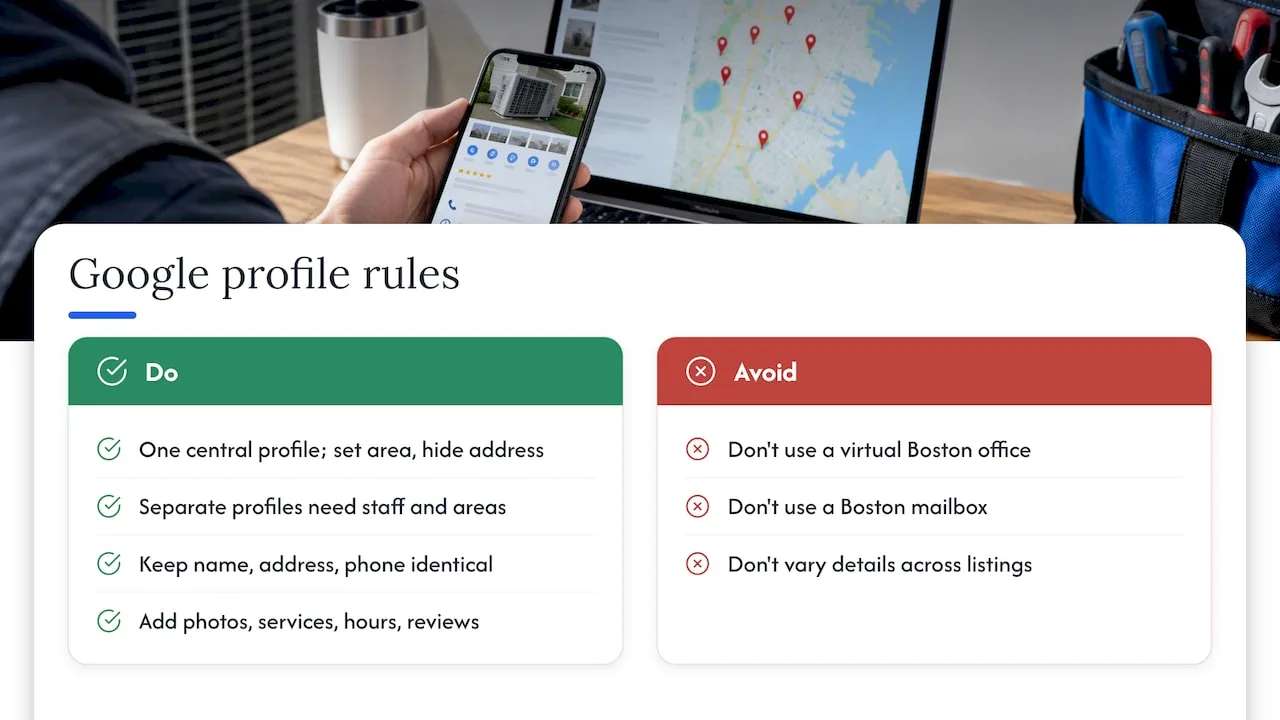
For a homeowner searching on a phone, the map block is often the first thing they see. Your profile has to be accurate and complete, and Google is strict about it. Its business profile guidelines call for an accurate real-world representation of your business, a precise address and/or service area, the fewest categories that fit, and only one profile per business.
That matters if you are based in Rhode Island and want Boston work. Do not create a profile with a virtual office or a mailbox in Boston. Google’s rules for a service-area business without a customer-facing storefront are to use one profile for your central office, set your service area, and hide the address. Separate profiles are allowed only when locations have separate service areas and staff. If you actually run a Massachusetts office with its own crew, that is a different conversation. If you don’t, treat Boston as part of your service area and build your visibility around it honestly.
Keep your name, address and phone number identical on your website, your profile and your other listings. Small differences confuse search engines and customers alike.
Then add the proof. Photos of real installs, a clear list of services, hours, and a steady stream of recent reviews all make a profile win the call. Our Local SEO and Google Business Profile work covers exactly this.
Neighborhood and service pages
Boston is not one market. A homeowner in Jamaica Plain with an old steam system, a condo owner in Back Bay and a family in a South Boston triple-decker need different things: boiler service, ductless installs, heat pump conversions. A page for each service and area, written around the real jobs you do there, gives you something to rank for and something a buyer can trust. Thin pages that swap the town name and repeat the same text do the opposite.
As a starting list, build pages for:
- each core service (furnace repair, boiler replacement, heat pump installation, mini-splits, AC installation, maintenance plans)
- each neighborhood or town where you want volume
- each seasonal emergency (no heat, no cooling, frozen coil)
A website built for this is not a brochure. It is a lead-generation tool, with a phone number front and center, proof close by and a simple path to book. That is how we build websites that book jobs.
Google Local Services Ads
Google lists HVAC among the categories in its Local Services Ads program for the United States, and it directs businesses to check whether they are eligible in their area. These ads show at the top of the results and send you phone calls or message requests. An ad profile highlights your services, service area, hours, reviews, phone number, photos and business bio, so the same reviews and photos that help your map ranking help your ad.
One change to watch: Google says it is moving Local Services Ads advertisers to Performance Max campaigns in phases. The first phase began in August 2026 for selected home and storefront service advertisers, including HVAC, with broader groups following in late 2026. Check your account for migration notices and save your historical reports before anything moves.
Rebates and financing as a lead source
In Massachusetts, incentives drive a lot of heat pump demand, and contractors who talk about them clearly win more of those jobs. Qualified homeowners may be eligible for a zero-interest HEAT Loan of up to $50,000 for heat pump electrification, subject to lender approval and program terms. Separately, the regional Accelerator program’s incentives run from February 2026 through December 2029, and contractors buy qualifying equipment through participating distributors and pass the incentive to customers as an invoice line-item discount.
Put this on a dedicated page, in plain language, and confirm current terms on the program pages before you publish, since they can change.
Why renting leads is a weak plan
Shared leads from a broker go to you and several competitors at once, and you pay whether or not anyone answers. Rankings and reviews are different. They take longer to build, but a page that ranks for “boiler replacement” in a specific town keeps sending buyers whether or not you are paying for clicks that month. We recommend using paid ads for the urgent, high-value moments and building your own search presence as the base.
Turning calls and forms into booked jobs
Most HVAC companies do not have a traffic problem first. They have a response problem. A homeowner with a dead furnace calls three companies and books the one that answers, so every missed call is a job handed to a competitor.
Make the phone the main call to action
For urgent trades, put your phone number first, in the header, tappable on mobile, and repeated down the page. Phone leads tend to book at a higher rate than form submissions. Keep a short backup form (name, phone, type of job, best time to call) for after-hours visitors, but never make the form the only way in.
The phone side matters as much as the page. If calls ring to one cell phone, you have a single point of failure. A hosted business phone setup with auto-attendants, call queues, ring groups and voicemail-to-email, like the business phone systems built for specific industries, lets a call roll to the next person when the first is on a roof or in a crawl space.
The call-handling checklist
Whether a person or an AI answers, every call should capture the same facts:
- Caller’s name and callback number
- Service address
- The problem, in the caller’s words
- How urgent it is
- Whether this is repair, maintenance or replacement
Then check real availability, explain what happens on the visit, ask for the appointment directly and confirm it right away by text. The step most teams skip is simply asking for the booking.
Respond fast, and escalate
A workable lead response process has four parts:
- the lead lands in the right queue immediately
- an instant text or email alert goes to whoever is on duty, based on urgency
- a missed call gets an automatic text within a minute or two
- if nobody acknowledges the lead, it escalates to a manager
For form leads, follow up the same day, and for emergency requests, within minutes. Our missed-call text-back and CRM setup handles the automatic part, and our AI voice agent answers inbound calls 24/7 for the hours your office is closed. An AI website chat catches visitors who would rather type than call.
Once the job is on the calendar, the estimate is the next place deals stall. If your crews quote from the field, tools that turn voice notes and photos into dual-language estimates in English and Spanish help you send a proposal while the homeowner is still thinking about you.
Reviews: the quiet lead engine
Reviews affect both your ranking and the decision a homeowner makes in the last minute before calling. Ask every customer, at the same point in the job, with a direct link and a text that takes ten seconds to answer. Do not cherry-pick only the happy ones, and do not offer rewards for positive ratings. Federal rules on consumer reviews restrict incentivized and suppressed reviews, so build a request process that treats every customer the same way. Reply to every review, the bad ones calmly and specifically.
Automating the request after each completed job keeps this from depending on someone remembering. That is what our review system does.
Measuring what works
By the end of each month, you should be able to answer a few questions per source (map results, Local Services Ads, organic search, referrals, repeat customers):
| Question | Why it matters |
|---|---|
| How many calls and forms came in? | Shows volume |
| How many were qualified? | Separates real demand from noise |
| How many became booked appointments? | Exposes response problems |
| How many jobs were completed and what did they bring in? | Shows true return |
| What did each booked job cost you? | Tells you where to spend next |
Connect the campaign, call, form, appointment, completion and revenue data so you can follow a lead all the way through. If you cannot see which source produced a furnace replacement, you cannot safely cut or grow any channel. Set your own targets by first measuring a baseline for a couple of months, because a healthy cost per booked job for a single-truck shop and for a five-truck company will not look alike, and emergency calls cost less to book than planned installs.
The same system for roofing in Worcester and plumbing in Providence
The search for HVAC leads in Boston is really a search for a repeatable system, and it carries over to other trades.
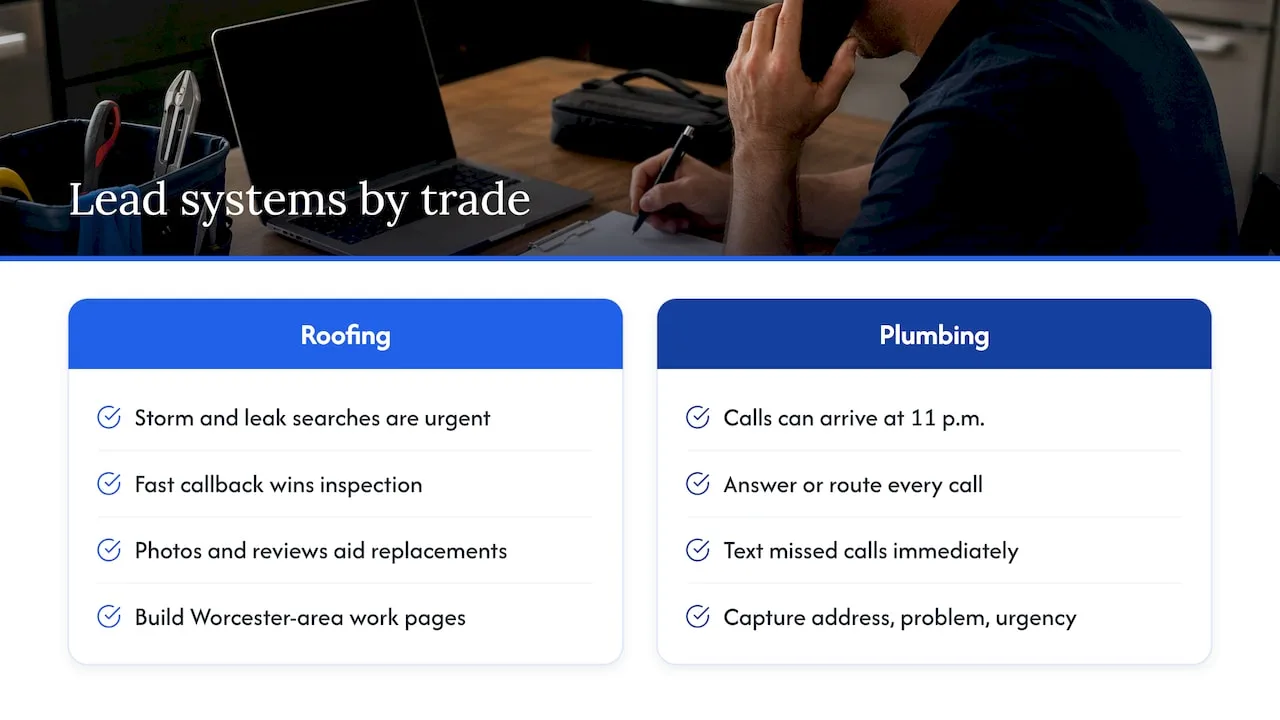
Roofing in Worcester. Storm and leak searches are high intent and urgent. Win them with a complete Google Business Profile, a presence in the map results and a fast speed-to-lead process: the first roofer to call back with a clear next step usually gets the inspection. Photo galleries and reviews do the heavy lifting for full replacements, which have a longer decision cycle. Build pages for Worcester and neighboring towns around the real work you do there.
Plumbing in Providence. Plumbing calls come at all hours: a burst pipe at 11 p.m. does not wait for your office to open. The fix is the same as in HVAC: a phone number that is always answered or routed, an instant text when a call is missed, and a short intake that captures address, problem and urgency. For a small shop where the owner is under a sink, 24/7 call handling is often the single change that recovers the most lost work.
Where Rhode Island contractors fit in
If you are based in Providence, Cranston, Warwick or Pawtucket, you already compete in a crowded home market. Expanding toward Boston is a real option, but it is a separate market with its own search results, competitors and neighborhoods. Start by strengthening your home territory, then add Massachusetts pages and ads one area at a time, and keep your profile honest about where you are based. Our team works across both states, and you can see the Massachusetts areas we serve.
Perspective
We work only with contractors in Rhode Island and Massachusetts, and the pattern we see is consistent: most companies do not need more clicks first. They need to stop losing the leads they already pay for.
A website that ranks but does not answer the phone is a leaky bucket. So we build the pieces to work together: a site designed to book jobs, local SEO and a clean Google Business Profile, an automatic text after every missed call, a 24/7 AI voice agent for after-hours calls, and review requests that go out without anyone remembering.
We would rather you own your search presence than rent leads from a broker. Our local team knows these towns and trades, which is why a Worcester roofing page reads differently from a Providence plumbing page.
Tyson
Get a lead system built for your trade
If you want this done for you, Coastal Connect builds and runs it for contractors in Rhode Island and Massachusetts. Plans are published: Foundation is $597 per month, Growth is $1,297 per month and Scale is $2,497 per month. An AI employee on Growth is $199 per month, and extra locations start from $299 per month.
See what each plan includes on our pricing page, or start at coastalconnect.ai to see how we work with HVAC, plumbing, electrical and roofing companies.
FAQ
How many HVAC leads should I expect from marketing in Boston?
It depends on your size, budget and how many neighborhoods you cover, so there is no honest universal number. Measure a baseline for two or three months, track qualified leads and booked jobs by source, and set targets from your own data. A single-truck company and a five-truck company will need very different volumes.
Are Google Local Services Ads worth it for HVAC?
They can be, especially for urgent calls, because they show at the top of results and send you calls or message requests. Google lists HVAC as an eligible category, so check eligibility for your area. Track cost per booked job, not just cost per lead, and watch for migration notices as Google moves advertisers to a new campaign format.
Can a Rhode Island HVAC company get leads in Boston?
Yes, if you serve the area for real. Use one profile for your actual office, set Boston and nearby towns as your service area, and build pages for those neighborhoods. Do not create a profile at a virtual office, since Google’s guidelines don’t allow it.
What is the fastest way to stop losing HVAC leads?
Fix the response first. Answer calls live or route them to a person or AI agent, text back every missed call within minutes, and follow up on every form the same day. This usually recovers more jobs than adding a new marketing channel.
Do I need a new website to get more leads?
Not always, but your site should put a phone number first, show your services and areas clearly, and carry proof such as reviews and project photos. If it reads like a brochure and has no booking path, it is costing you jobs.
Sources
- Getting started with Local Services Ads (United States)
- Local Services Ads transition to Performance Max campaigns
- Guidelines for representing your business on Google
- Mass Save HEAT Loan information
- Accelerator FAQ for contractors
- HVAC Lead Generation: A System for More Booked Jobs