
The best HVAC blog topics are the questions your customers already ask you: why the AC blows warm air, when to replace a furnace, how often to change a filter. Answer them plainly, tie them to the season and your service area, and each post becomes a page that can bring in calls. Below you will find topic ideas sorted by season, problem and town, plus the listing and citation basics that help those posts get found.
TL;DR
- Start every post from a real question heard on a call, at an estimate or during a maintenance visit.
- Plan around the calendar: cooling topics in spring, heating topics in fall, indoor air and efficiency posts year-round.
- Make each post local: your towns, your weather, your local codes. Do not clone one page across ten cities.
- Keep your business name, address or service area and phone number identical everywhere you are listed.
- End every post with one clear next step: call, text or book online.
Table of Contents
- How to choose HVAC blog topics that bring in jobs
- A year of seasonal HVAC blog ideas
- Troubleshooting posts that catch people mid-problem
- Energy efficiency and indoor air quality posts
- Turn your jobs and calls into local content
- Perspective
- Contractor business listings and local citations
- Where Coastal Connect fits
- Publishing and measuring your HVAC blog
- FAQ
- Sources
How to choose HVAC blog topics that bring in jobs
A blog post earns its keep when it matches what a homeowner types at the moment they need help. Nobody searches for “company news.” They search “furnace making banging noise” at 9 p.m. in January, or “how much does a new heat pump cost” after a quote lands in their inbox.
Three filters keep your list honest:
- Does a real customer ask this? Keep a running note on your phone or in your CRM. Every time a dispatcher, tech or estimator hears a question twice, it goes on the list. That is where the best ideas come from.
- Does it sit close to a job you sell? A post on thermostat settings is nice. A post on “what to check before you call for AC repair” leads straight to a service call.
- Can you say something specific? If your post could be copied onto any contractor’s site, it will not stand out. Add what you see in your own market: older homes with ductwork in tight attics, coastal humidity, basements that flood.
If you want a ratio to work with, aim for roughly half of your posts on problems and repair decisions (people ready to buy), a third on maintenance and efficiency (people planning), and the rest on local proof such as completed jobs and neighborhood notes.
A year of seasonal HVAC blog ideas
Seasonal timing does most of the planning for you. ENERGY STAR recommends checking air filters monthly and scheduling an annual professional checkup, with cooling system service in spring and heating system service in fall. That one guideline hands you a publishing calendar: post the tune-up content about four to six weeks before each season starts, when homeowners are thinking about it but your schedule still has room.
| Season | Topic ideas | Reader intent |
|---|---|---|
| Early spring | AC tune-up checklist: what we inspect and why; signs your AC will not survive another summer; how to prepare an outdoor unit after winter | Book maintenance |
| Late spring | Central air vs. ductless mini-splits for older homes; what to do before the first heat wave; why your AC freezes up | Compare and request quotes |
| Summer | AC blowing warm air: a quick checklist; why one room never cools; what a refrigerant leak really means | Emergency repair |
| Early fall | Furnace tune-up checklist; when to repair versus replace a furnace; carbon monoxide safety and detector placement | Book maintenance |
| Winter | Furnace not heating: what to check first; strange noises and what they mean; what to do when the heat goes out on the coldest night | Emergency repair |
| Year-round | Financing a new system; how to read an HVAC estimate; how to compare quotes fairly | Decision stage |
A good seasonal post also gives the reader something they can do today. If you publish a maintenance checklist, include the homeowner-safe steps (changing a filter, clearing debris around the outdoor unit, checking the thermostat batteries) and be explicit about what needs a licensed technician. That honesty builds more trust than any sales line.
Techs who are building their own content habits often swap ideas in trade communities. A forum for HVAC service techs is a quick way to see what field problems are coming up this week, which you can turn into homeowner-friendly seasonal posts.
Troubleshooting posts that catch people mid-problem
Troubleshooting posts bring the most urgent traffic. The reader is already uncomfortable and ready to call someone. Structure them the same way every time:
- Name the symptom in the reader’s words (“AC running but house is not cooling”).
- List two or three safe checks they can do in five minutes: thermostat mode, filter, tripped breaker, blocked vents.
- Explain the likely causes a technician would look at, without promising a diagnosis over the internet.
- Say when to stop and call, and give your phone number right there.
Topic ideas in this family:
- Why is my AC blowing warm air?
- Why does my furnace keep shutting off?
- Why is my heat pump running in the cold but the house feels cool?
- What does it mean when my thermostat says “waiting” or shows a blank screen?
- Why is there water around my furnace or air handler?
- Why do my energy bills spike in January?
- What is that burning smell when the heat first comes on in fall?
On safety, keep the caution at the point of action. Anything involving gas smells, carbon monoxide alarms, burning smells that persist, or electrical components should say plainly: leave the house if an alarm sounds, call 911 or your gas utility’s emergency line, and do not attempt repairs yourself. A post that says this clearly serves the reader first, and a reader who trusts you is the one who calls you later.
Energy efficiency and indoor air quality posts
These topics sell upgrades, and they rank well because homeowners research them slowly before spending.
Energy efficiency ideas
- How to lower heating and cooling costs without replacing equipment. One consumer guide from an HVAC service company notes that nearly half of the average home’s energy bills go to heating and cooling and points to equipment maintenance, thermostat management and duct sealing as practical steps. Each of those three is its own blog post.
- Smart thermostat versus programmable thermostat: what actually changes.
- Leaky ductwork: signs you have it and what sealing involves.
- What size system does my house need, and why bigger is not better.
- Heat pump versus furnace and AC for New England winters.
Indoor air quality ideas
- Which filter should I buy? Explain the difference between filter types in plain words.
- Why a better filter does nothing if the system is off. The EPA’s technical summary on residential air cleaners states that HVAC filters clean air only while the fan is running and must be maintained to stay effective. That is a useful point for a post on fan settings and filter changes.
- Humidity in basements and why it affects comfort and equipment.
- Whole-home air cleaners and humidifiers: what they are for.
- Allergy season and your HVAC system.
When a post touches a standard, say so. The ANSI/ACCA 4 QM standard sets minimum inspection requirements for residential HVAC maintenance, covering electrical, controls, mechanical, venting, air distribution and piping. If your maintenance visits follow a similar checklist, a post walking through “what happens during a tune-up” shows homeowners what they are paying for. Only claim your own process meets a standard if it truly does.
Turn your jobs and calls into local content
The posts competitors cannot copy come from your own work. A few reliable formats:
- Job write-ups. “Replacing a 20-year-old furnace in a Cranston cape”: what you found, what you recommended, what it solved. Get the homeowner’s permission before you use their name, address or photos.
- Before-and-after photos. One image set and 200 words of explanation beats a generic paragraph.
- Town and neighborhood notes. Older homes in one area may have tight attic space for ducts, while a newer subdivision nearby has different issues. Write what you actually see on jobs.
- Local weather posts. Nor’easters, ice storms, humid July weeks and salt air each create their own failure patterns.
- Permit and code explainers. Cover what a homeowner should expect when installing a new system, and link to the town or state page for the current rules instead of stating them from memory.
- Estimate walk-throughs. Show how you size a system and explain a quote, line by line.
One warning: do not publish the same page for fifteen towns with the town name swapped. Search engines treat that as thin content, and homeowners notice. A single strong page per service area, with real local detail, outperforms a pile of near-identical ones. Write a town page only when you can say something true about the place.
Each post should also end with a single action. If a reader finishes your furnace post at 10 p.m. with a cold house, they need a way to reach you at that hour. That is where missed-call text-back and automated follow-up pays off: the content brings the visit, and the system makes sure the call or form is never lost.
Perspective
We spend our days with Rhode Island and Massachusetts contractors, and the same pattern shows up again and again. The company with the best techs is not always the one that gets the call. The one that gets the call is usually the one whose website answered the homeowner’s question at the exact moment they were worried.
That is why we treat a blog as part of the lead system, not as a side project. Each post should have a reader, a question, a local angle and a next step. Then it has to connect to something that catches the lead: a site built to book jobs, a Google Business Profile that matches it, a text that goes out when a call is missed, a review request after the job.
Our approach is built around contractors in this region because the details matter: the towns you serve, the weather your customers live with, the trades you actually work in. A generic marketing template cannot supply that, and we designed our work to do it.
If you only have time for one habit, write down every real customer question your team hears this week. That list is your blog for the next three months.
Tyson
Contractor business listings and local citations
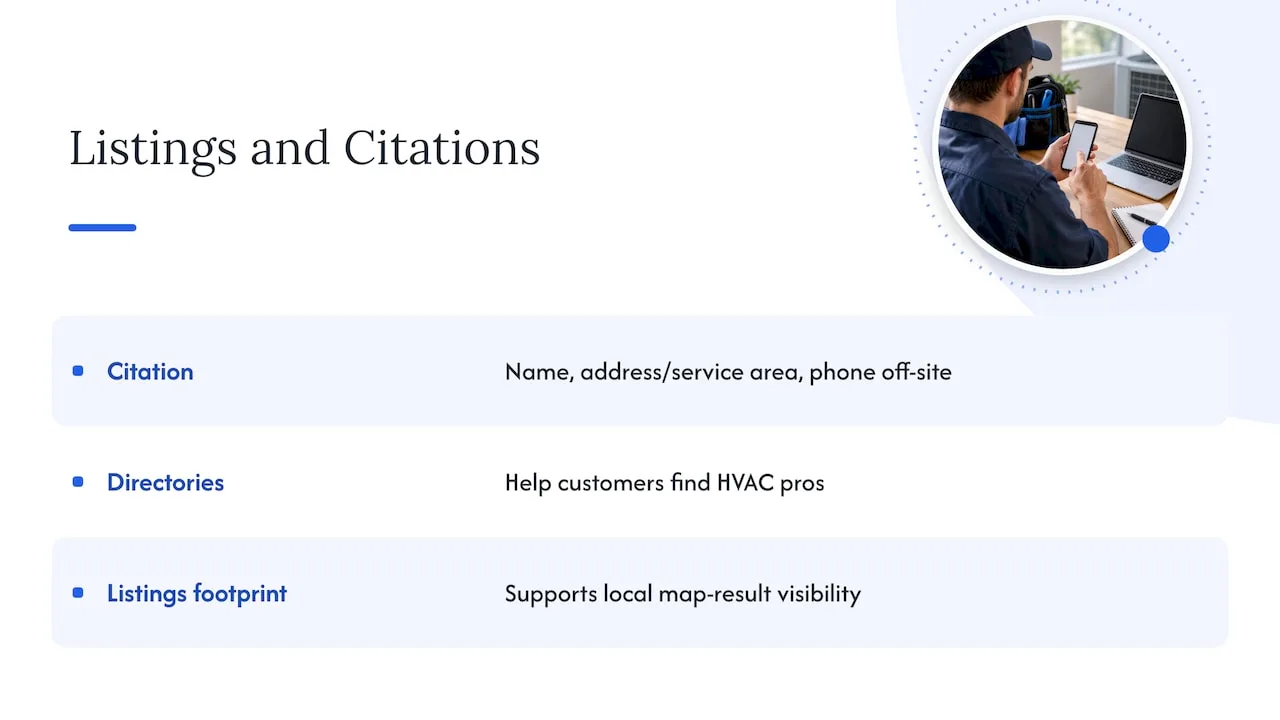
Blog posts bring readers to your site. Listings and citations help people and search engines confirm that your business is real, local and trustworthy. A citation is any mention of your business name, address or service area, and phone number outside your own site: directories, trade associations, chamber of commerce pages, review platforms and similar pages. Professional listings for HVAC businesses on well-known home-service directories help potential customers find a professional and help search engines judge whether a business is trustworthy. A strong listings footprint also supports the local SEO for HVAC companies that decides who shows up in the map results when someone searches for help nearby.
What to keep consistent
Google’s guidelines are the baseline. They say to use your real-world business name, an accurate address or service area, a business phone number and regular customer-facing hours. Treat that as your master record and copy it exactly everywhere:
- Business name, with no added keywords such as “Best Cheap AC Repair” appended.
- Phone number, ideally one primary number across listings.
- Address, or service area if customers do not visit you.
- Website URL.
- Hours, including emergency availability if you offer it.
- Categories and a short description in the same wording.
On your own site, you can also mark up these details. Google explains that LocalBusiness structured data can supply details such as hours, and requires the business name and physical address. Ask your web developer to add it to your contact page.
Service-area businesses
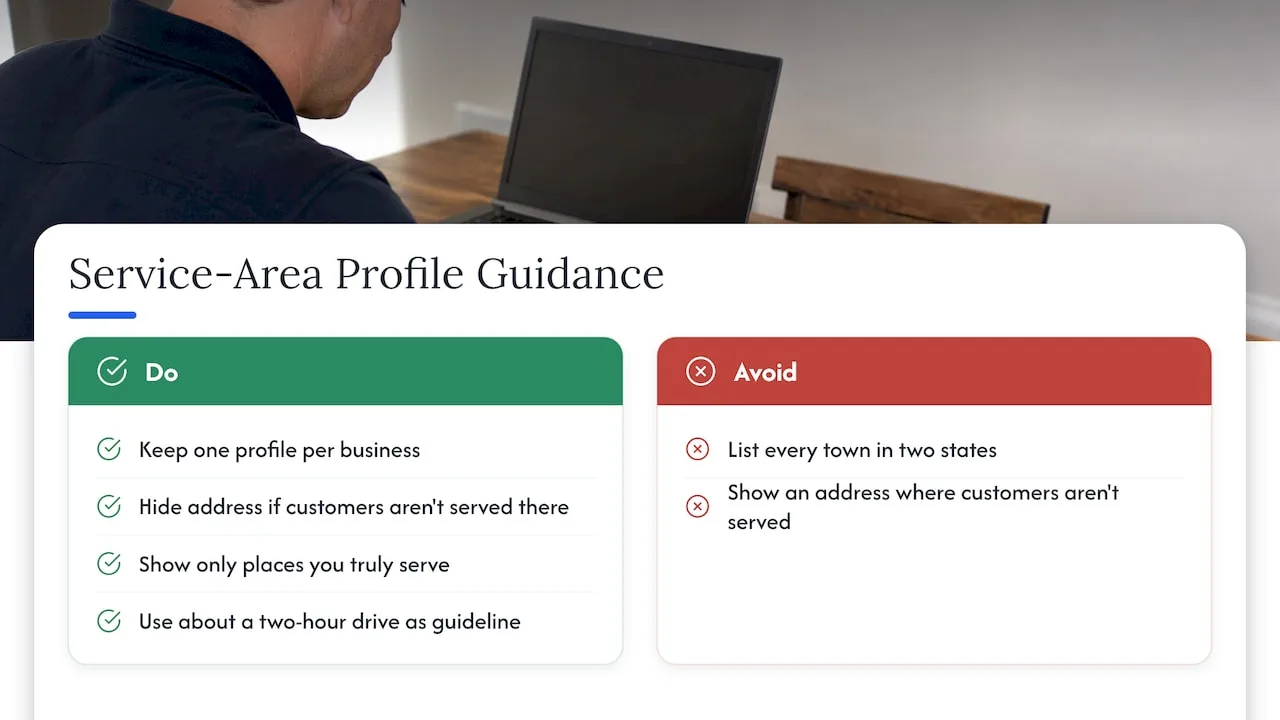
Most HVAC companies travel to the customer. Google’s guidance for this case is to keep one profile per business and, if you do not serve customers at your location, to hide the address and show a service area instead. For the service area itself, Google recommends staying within about a two-hour drive of the business, though a larger area may suit some businesses. Listing every town in two states helps nobody. Pick the places you truly serve.
If Google asks you to verify a service-area business by video, the recording has to show where the business operates, work tools or equipment, and proof of management. Plan that walk-through before you open the app: your truck with signage, your tools, your shop or staging area, and your business paperwork.
A simple citation cleanup routine
- Write your master record (name, address or service area, phone, URL, hours).
- Search your business name and phone number and note every listing you find.
- Fix mismatches: old phone numbers, former addresses, misspelled names.
- Claim and correct duplicates. Remove or merge extra profiles so each platform has one.
- Add the listings that matter for your trade and region: major map platforms, home-service directories, your chamber of commerce, trade associations and manufacturer dealer locators if you qualify.
- Recheck twice a year, and any time you change a phone number, move or rebrand.
Outdated and duplicate listings are the most common problems. A tech who moved on in 2019 and a phone number that no longer rings will send customers to a competitor, so this is revenue work, not housekeeping.
Where Coastal Connect fits
A blog calendar is only one piece. The homeowner still has to find you, trust you, reach you and book. We build all of that for contractors in Rhode Island and Massachusetts: websites designed to book jobs, local SEO and Google Business Profile work, review requests that run automatically, and AI tools that answer calls and website chats when your crew is on a roof or under a house.
Our plans are published: Foundation is $597 per month, Growth is $1,297 per month and Scale is $2,497 per month. You can compare what each includes on the pricing page.
If you would rather talk it through, start at coastalconnect.ai and tell us your trade and the towns you serve.
Publishing and measuring your HVAC blog
You do not need a post a day. Two good posts a month, written from real questions, will beat thirty thin ones.
- Pace. Draft a quarter at a time and schedule posts a month ahead of each season.
- Length. Long enough to answer the question completely. A simple symptom post can be 600 words, and a replacement-versus-repair guide can run 1,500 or more.
- Format. Use short paragraphs, a clear heading for each question, a checklist where it fits, and real photos from your jobs.
- Links. Link each post to the service it leads to, and link your service pages back to the best posts.
- Refresh. Update the top posts each year: new seasonal angles, current equipment, and any rules that changed.
- Measure. Track calls, form fills and texts that start from blog pages, not just pageviews. Ask every new caller how they found you and write down the answer.
FAQ
How often should an HVAC company blog?
Two quality posts a month is a realistic pace for most small contractors. Consistency matters more than volume, and posts timed ahead of each heating and cooling season tend to be the most useful. Update your best performers once a year.
What should an HVAC blog post include?
A direct answer near the top, safe steps the homeowner can take, a clear point for when to call a technician, and a local detail that shows you work in the area. End with one next step, such as a phone number, a text link or a booking button.
Are local citations still worth the effort for HVAC contractors?
Yes, because consistent listings give customers and search engines the same trusted details about your business. The work is mostly cleanup: match your name, address or service area, phone and hours, and remove duplicates. Start with your Google Business Profile, then the directories your customers actually use.
Should I write a separate page for every town I serve?
Only when you have something genuinely local to say about that town, such as common housing types, weather patterns or local permit steps. Copying one page and swapping the town name is weak content. A few strong pages beat many thin ones.
Can I use customer jobs in blog posts?
Yes, and these are often your most persuasive posts. Get the homeowner’s permission before using their name, street address or photos of their home. Describe the problem, what you did and the result, in plain language.
Sources
- How to Keep Your HVAC System Working Efficiently, ENERGY STAR
- Residential Air Cleaners: A Technical Summary, U.S. EPA
- The Ultimate HVAC Guide for Homeowners, ARS/Rescue Rooter
- ACCA Standard 4 QM
- Guidelines for representing your business on Google
- Verify your business with a video recording, Google Business Profile Help
- Sign up for Business Profile, Google Business Profile Help
- Local Business structured data, Google Search Central
- Local SEO for HVAC companies
- HVAC forum for service techs