Audit Review Gating: Vendor Settings and Fixes for Contractors
Coastal Connect
Review gating, the practice of screening customers by expected sentiment before asking for a public review, violates the policies of Google and Yelp and falls squarely under the FTC’s Consumer Reviews and Testimonials Rule (16 CFR Part 465). The risks are not theoretical: platforms remove reviews and suspend profiles, and the FTC can pursue civil penalties per violation. If your funnel routes unhappy customers away from public review links, stop that routing today and audit every automated touchpoint before you send another request.
TL;DR:
- Review gating, whether deliberate or accidental, risks violating platform policies and the FTC rule by filtering customers based on sentiment before review requests.
- Platforms like Google and Yelp detect gating through pattern analysis such as spikes in five-star reviews and similarities across multiple reviews, often resulting in suspension or review removal.
- The FTC considers review suppression a deceptive practice punishable by substantial civil penalties per violation, especially when businesses route dissatisfied customers away from public reviews.
- Auditing your review funnel involves mapping the customer journey, reviewing vendor settings for sentiment filters, and comparing review timing with internal feedback to ensure compliance.
- Consistent, transparent review requests sent to all customers within 24 to 48 hours, with private feedback channels alongside, are the safest and most compliant approach.
Table of Contents
- What Is Review Gating, Exactly?
- What Do Google and Yelp Actually Say About Gating?
- Is Review Gating Illegal Under the FTC Rule?
- How Do You Audit Your Review Funnel for Gating?
- How Do You Ask for Reviews the Compliant Way?
- What Should You Do If Your Profile Gets Flagged?
- Which Companies Have Actually Been Penalized for This?
- How Do You Train Staff to Never Gate Reviews?
- Do International Review Rules Differ From U.S. Law?
- Why Compliant Review Programs Win Long-Term
- How Coastalconnect Helps Contractors Build Reviews the Right Way
- Sources
- FAQ
What Is Review Gating, Exactly?
Review gating means filtering customers by their likely sentiment before you let them leave a public review. A business asks “How was your experience?” first. Happy customers get pushed toward Google or Yelp. Unhappy ones get routed to a private form, an email address, or nowhere at all.
That’s the formal version. The informal version is sloppier and just as risky: a technician who only hands out the review card to customers who seemed pleased, or a follow-up email sequence that quietly skips anyone who filed a complaint in the last 30 days. BrightLocal’s breakdown of review gating notes that both the deliberate star-filter widget and the casual staff habit count as the same violation.
Watch for these patterns in your own systems:
- A “rate us” screen with star buttons where only 4 and 5 stars link to Google or Yelp
- Review request emails that get manually paused for known problem tickets
- A CRM tag like “detractor” that silently excludes a customer from the review campaign
- Front-desk staff instructed to “only mention reviews to the happy ones”
What Do Google and Yelp Actually Say About Gating?
Google’s contribution policy directly prohibits discouraging negative reviews or selectively soliciting only positive ones, and the platform enforces this by removing flagged reviews or suspending the business profile entirely. Yelp takes an even harder line, actively discouraging any solicited reviews and using algorithmic filtering that tends to suppress reviews it suspects were incentivized or funneled.
Both platforms detect gating through pattern analysis rather than manual review of every business. Here’s what typically flags an account:
- A sudden spike in five-star reviews with almost no one-, two-, or three-star reviews mixed in
- Reviews clustering in unnatural bursts, all within a few days of a service completion
- Near-identical phrasing across multiple reviews, suggesting a scripted request
- Referral traffic patterns showing customers arriving at the review page through a filtered link rather than a direct search
Enforcement is not rare. Reuters reported that Google filed a lawsuit specifically targeting fake and manipulated business reviews, underscoring that platform-level enforcement against review manipulation is an active, ongoing effort rather than a rarely-used policy line.
Is Review Gating Illegal Under the FTC Rule?
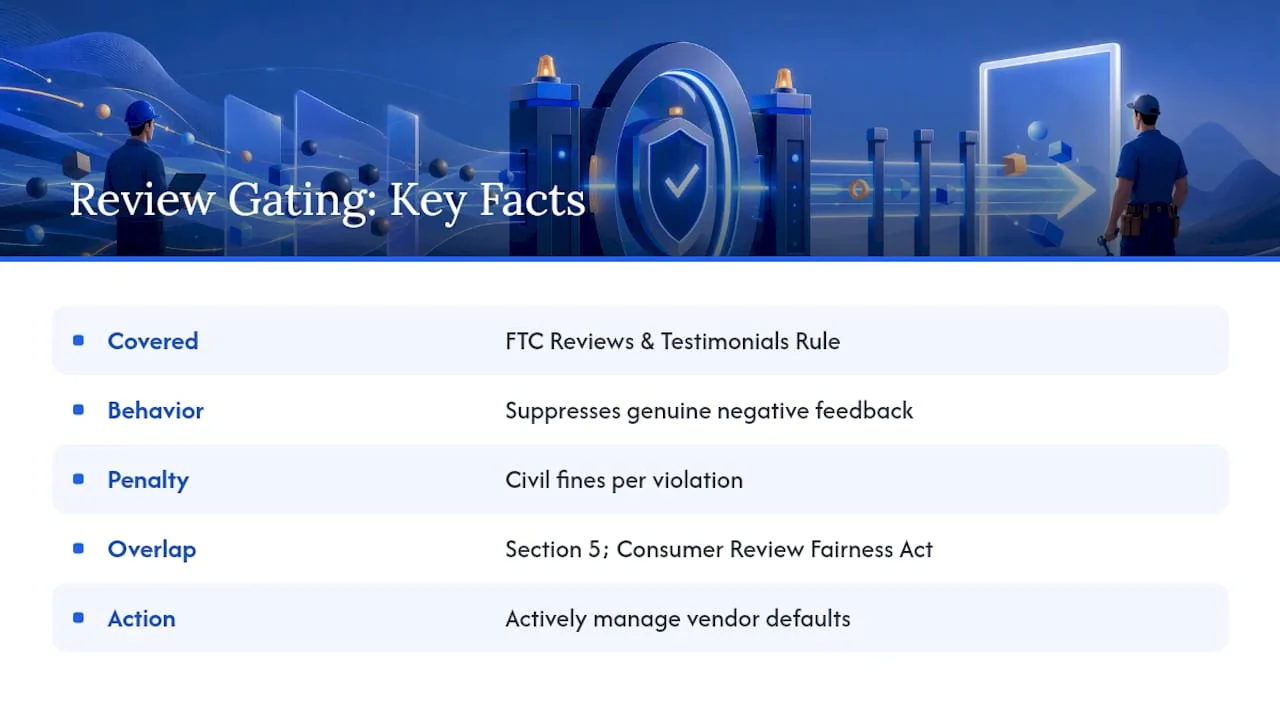
Review gating sits squarely inside the FTC’s Consumer Reviews and Testimonials Rule, which took effect in October 2024 and specifically addresses review suppression as a deceptive practice. The rule doesn’t just target fake reviews. It also covers businesses that suppress genuine negative feedback by controlling who gets asked to leave one.
Systematically routing dissatisfied customers away from public review platforms, while funneling satisfied ones toward them, creates a misleadingly inflated public record. The FTC’s rule treats that distortion as its own violation, separate from writing fake reviews outright.
Civil penalties for knowing violations can reach tens of thousands of dollars per violation, with the exact figure adjusted periodically for inflation. That “per violation” language matters. A business that gates ten customers a month isn’t looking at one penalty. It’s looking at exposure that compounds with every customer routed through the filter.
The rule also overlaps with Section 5 of the FTC Act, which broadly prohibits unfair or deceptive practices, and with the Consumer Review Fairness Act, which protects a customer’s right to post an honest review. A gating program can trigger scrutiny under more than one of these at once, which is part of why FTC guidance to marketers treats soliciting and paying for reviews as a compliance area businesses need to actively manage, not something to leave to a vendor’s default settings.
How Do You Audit Your Review Funnel for Gating?
Most gating today isn’t intentional. It’s baked into a reputation management tool’s default settings, and nobody on the team ever checked the box. Running an audit takes an afternoon and it should happen at least twice a year.
- Map the full customer journey. Trace every step from job completion to review request. Note anywhere a decision point exists, even a small one like “send this email only if satisfaction score is above 4.”
- Check vendor settings line by line. Log into your review software and look for any feature labeled “smart routing,” “sentiment filter,” or “positive review funnel.” If it exists, it’s probably on by default.
- Pull your review velocity data. Compare your star distribution against your industry’s typical spread. A near-total absence of three-star reviews is a red flag, not a compliment.
- Listen to staff scripts. Sit in on a few customer calls or read a few message templates. If the pitch changes based on how the conversation went, that’s gating in practice, even without software involved.
- Confirm private feedback stays separate. A private feedback form is fine on its own. It becomes a violation only when it replaces the public review invite instead of running alongside it.
Pro Tip: Export your review timestamps and job-completion dates into a spreadsheet. If public review requests consistently lag two or three days behind negative internal feedback tickets, someone is manually delaying the ask.
How Do You Ask for Reviews the Compliant Way?
The compliance rule is simple, even though the execution takes discipline: every customer gets the same public review invitation, sent the same way, on the same timeline, regardless of how the job went. A private feedback option can exist alongside that invite. It can never substitute for it.
Here’s what a compliant workflow looks like in practice:
- Send the same review request link to 100% of customers, typically within 24 to 48 hours of job completion
- Offer a separate, clearly labeled private feedback channel for anyone who wants to flag a problem, without making it the only visible option
- Avoid pressuring customers on-site, in person, or over the phone to leave a review before they leave the property
- Never train staff to gauge satisfaction before deciding whether to mention reviews at all
- If you use incentives, keep them neutral (a small discount or entry into a drawing offered to everyone who reviews, regardless of star rating) and disclose the incentive in the review itself where the platform requires it
TrueReview’s guidance on compliant alternatives frames this as “ask everyone, filter nothing,” which is a useful shorthand for training new staff.
Pro Tip: Before signing up for any reputation management software, ask the sales rep directly: “Does this tool ever route customers to different destinations based on their rating?” If the answer is yes, or if they dodge the question, that’s a vendor to avoid.
Timing matters almost as much as fairness. Requests sent too early (before the customer has really used the product or service) tend to get ignored. Requests sent too late compete with a fading memory. Most service businesses land in a sweet spot between same-day and 48 hours out.
What Should You Do If Your Profile Gets Flagged?
Move fast, but move methodically. Platforms and regulators both respond better to businesses that can show they caught and fixed the problem rather than argued about it.
- Disable any conditional routing immediately, even if you’re not certain it caused the flag. Pause the campaign entirely if you can’t isolate the setting.
- Gather your documentation: every message template, vendor configuration screenshot, automation rule, and a timeline of when settings changed and who changed them.
- File a platform appeal with specifics. Vague appeals get denied. Show exactly what changed and when, and attach the documentation.
- Loop in legal or compliance counsel if the flag involves a regulatory inquiry rather than just a platform notice, since FTC exposure carries real financial risk.
- Build a written review-request policy afterward so the fix outlives the person who happened to catch it.
Which Companies Have Actually Been Penalized for This?
The consequences here aren’t hypothetical. Google’s lawsuit over fake and manipulated business reviews targeted operators running review manipulation schemes at scale, including businesses that sold fake reviews and companies that filtered which customers got asked to post them. The litigation made clear that Google treats sentiment-based routing as part of the same enforcement bucket as outright fake reviews, not a lesser offense.
On the regulatory side, the FTC’s 2024 rule gave the agency a direct enforcement tool it didn’t have before in the same form. Prior to the rule, the FTC often had to build cases under the broader unfair-and-deceptive-practices standard in Section 5, which took longer and required more evidence of consumer harm. Now, review suppression is its own actionable violation with defined per-violation penalties.
The pattern across these cases is consistent: the businesses caught weren’t hiding fake five-star reviews written from scratch. They were quietly deciding who got asked to review them at all, assuming that omission was safer than fabrication. Platforms and regulators disagree. Selective silence reads as manipulation just as clearly as a fabricated quote does, and it’s often easier to detect because the data trail (who got a request, who didn’t, and why) tends to survive in email logs and CRM records long after anyone remembers making the decision.
How Do You Train Staff to Never Gate Reviews?
Most gating happens at the front line, not in a boardroom. A technician who feels good about a job says “please leave us a review” and forgets to say it after a rough call. That’s human nature, but it’s also exactly the pattern that shows up in an uneven star distribution and draws platform attention.
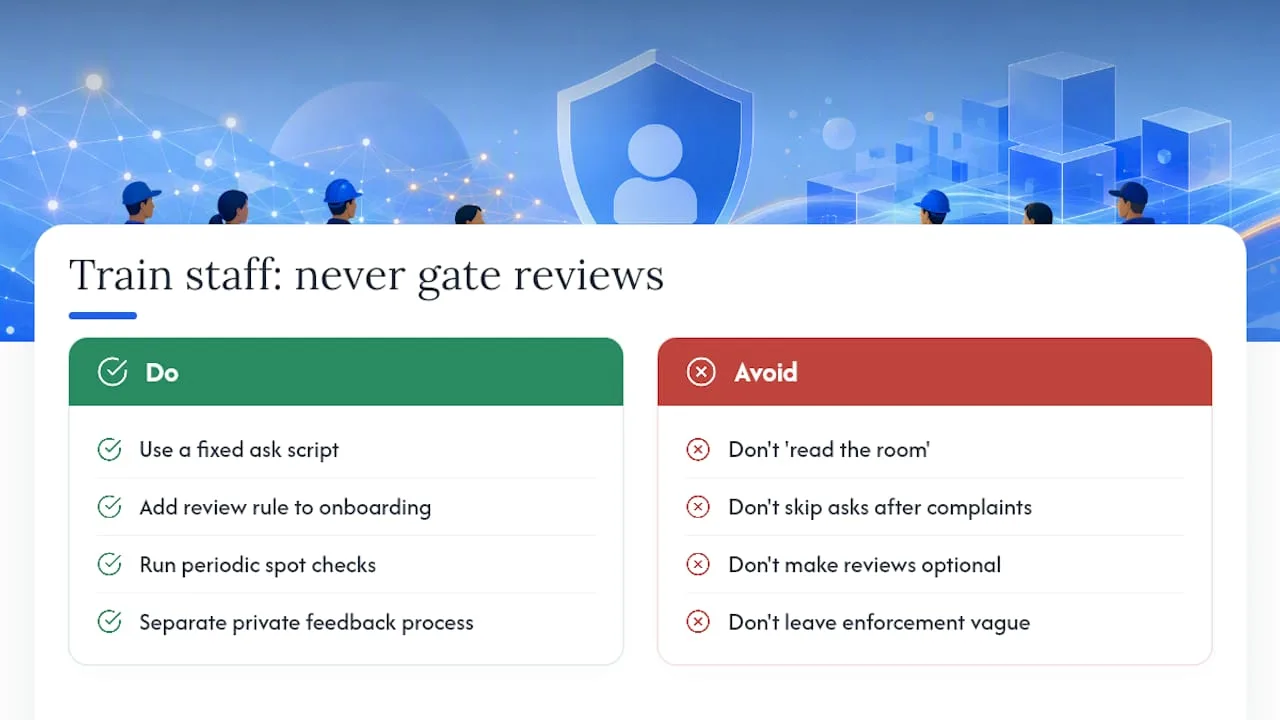
Fix it with a script, not a suggestion. Every customer-facing employee should have one line they say at the end of every job, worded identically regardless of how the visit went: something like “We’ll send you a quick link to share feedback, we’d appreciate a review either way.” No judgment call, no reading the room, no deciding who “deserves” the ask.
Build this into onboarding, not just an annual memo. New hires should hear, explicitly, that selectively asking for reviews is a compliance violation with real financial consequences for the business, not just a bad look. Frame it the same way you’d frame a safety rule: non-negotiable, not a matter of judgment.
Run periodic spot checks. Pull a sample of recent jobs, cross-reference who received a review request, and look for any correlation with job outcome, customer complaint history, or staff member. If one technician’s customers consistently show a different request rate than another’s, that’s a training gap worth addressing directly.
Finally, separate the private feedback conversation from the public review ask in your team’s mental model. Staff should understand that collecting a complaint privately is good customer service. Using that complaint as a reason to skip the public review invite is the violation. Those two things need to stay procedurally distinct, every time.
Do International Review Rules Differ From U.S. Law?
If you serve customers outside the United States, the FTC rule doesn’t reach every one of those relationships, but that doesn’t mean you’re clear. The European Union enforces its own consumer protection framework, including provisions under the Unfair Commercial Practices Directive that treat misleading review practices, including selective solicitation, as actionable deception. The UK’s Competition and Markets Authority has pursued similar cases independent of the FTC.
Platform rules, meanwhile, apply globally regardless of where the FTC’s jurisdiction ends. Google’s contribution policy and Yelp’s solicitation stance don’t have a geographic carve-out. A business gating reviews from customers in Toronto or London faces the same account suspension risk as one gating reviews from customers in Boston.
The practical guidance stays consistent regardless of jurisdiction: ask everyone the same way, keep private feedback separate from public solicitation, and don’t build sentiment-based routing into any customer-facing system. That approach satisfies the FTC rule, EU consumer protection law, and platform policy simultaneously, which is a more efficient compliance posture than trying to maintain different review workflows for different regions.
Why Compliant Review Programs Win Long-Term
Gating feels like a shortcut, and for a while it works: the public rating climbs, complaints stay hidden, everyone’s happy. Then a platform algorithm flags the pattern, or a disgruntled former customer reports it, and the whole thing unwinds at once, often with a public suspension notice attached. Transparent collection doesn’t have that failure mode.
Most accidental gating I’ve seen traces back to a vendor default nobody questioned, not a deliberate scheme. That’s the real lesson here: automation is not the enemy, unaudited automation is. A business can run a fully automated review request system at scale and stay completely compliant, as long as the automation asks everyone the same question in the same way. The moment a tool starts making sentiment-based decisions on your behalf, you’ve outsourced a legal risk to a settings menu you probably never read.
— Tyson
How Coastalconnect Helps Contractors Build Reviews the Right Way
An alternative to guessing whether your review software is quietly filtering customers is an automated review request system that sends the identical public ask to every customer on the same schedule, with a separate private feedback channel available alongside it, never instead of it.
That same platform handles Google Business Profile optimization and can run a straightforward audit of your existing review funnel to check for sentiment-based routing you may not know is active. If you’re a plumber, electrician, HVAC technician, or roofer running review requests through a third-party tool right now, it’s worth confirming those settings before your profile gets flagged rather than after. Get a funnel audit and compliant automation setup built specifically for trades businesses in Rhode Island and Massachusetts.
Sources
- Google contribution policy: identifying and removing fake or biased content
- What Is Review Gating & What Are the Risks? - BrightLocal
FAQ
Is Review Gating Legal?
No. It violates the platform policies of Google and Yelp and falls under the FTC’s Consumer Reviews and Testimonials Rule, which treats review suppression as a deceptive practice subject to civil penalties.
What Is Google’s Policy on Review Gating?
Google’s contribution policy explicitly bans discouraging negative reviews or selectively soliciting positive ones, and violations can lead to review removal or full profile suspension.
What Is a Review Gate?
A review gate is any step in your review request process, formal or informal, that filters customers by expected sentiment before deciding whether to send them a public review invite.
What Are Examples of Five-Star Reviews?
A genuine five-star review typically names a specific service, mentions a real detail like a technician’s name or a timeline, and reads like unprompted praise rather than scripted language repeated across multiple customers. Businesses using Coastalconnect’s compliant automation collect these naturally by asking every customer the same way instead of pre-filtering for likely positive responses.
Want this done for your business?
Get a free audit. We'll look at your site, your Google profile, and your phones, and send you a checklist of exactly what to fix.